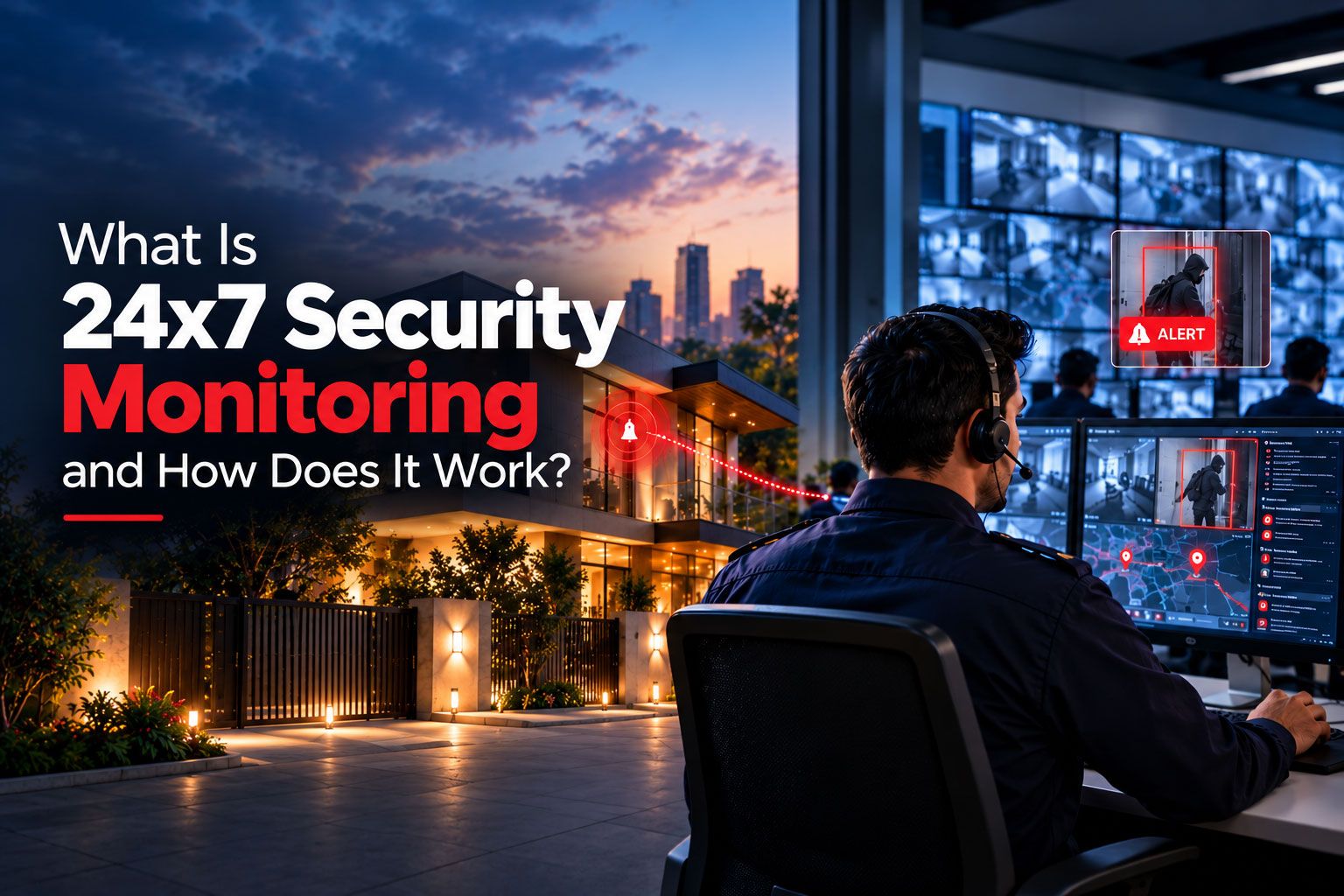

Quick answer: 24x7 security monitoring means trained people watch your security system's alerts every hour of every day. When a sensor detects a break-in, smoke or a panic button press, the alert goes to a monitoring centre, where an operator checks what's happening and coordinates the right response, then keeps you informed.*
Most security systems are good at noticing things. A door sensor knows the moment the balcony door opens. A smoke detector picks up smoke long before anyone smells it. The weak link is what comes next: the alert lands on a phone that's on silent, in a pocket, in another city, at 3 am.
That's the gap 24x7 security monitoring fills. This guide explains what it is, how it works from the first beep to the final response, what actually happens inside a monitoring centre, and how to tell whether you need it for your home, shop or office.
What is 24x7 security monitoring?
24x7 security monitoring is a service in which a professional team receives and responds to alerts from your security system round the clock, including nights, Sundays and festival holidays. The devices at your property detect. The monitoring team decides what each alert means and what should happen next.
You'll also hear it called a monitored security system, an alarm monitoring service or remote security monitoring. The idea behind all three is the same. Your sensors, panic buttons and cameras are connected to a monitoring centre over the internet or a mobile network, so a person, not just an app, is on the other end of every alert.
It helps to think of it as two jobs split between machines and people. Sensors are tireless; they watch every door and room without blinking. People are good at judgement; they can tell a real intrusion from a cat on the window sill. 24x7 monitoring puts each on the job it does best.
How does 24x7 security monitoring work?
24x7 security monitoring works in four stages: a device detects something, the alert reaches a monitoring centre, an operator verifies it, and a response is coordinated. The whole point is that each stage hands off to the next without depending on you being awake or reachable.
Here's how it plays out on an ordinary night in a locked 2BHK, with the family away at a wedding in Jaipur:
1. Detection. At 1:50 am, the sensor on the balcony door registers that the door has opened. The motion sensor in the living room picks up movement a few seconds later.
2. Alert. The control panel sounds the siren and sends a signal to the monitoring centre. It names the zone ("balcony door, then living room") and the time.
3. Verification. An operator sees the alert on screen, checks which sensors triggered and in what order, and looks at camera footage where available. Two sensors in sequence points to a real entry, not a glitch.
4. Response. The operator follows the agreed plan: informing the owner, alerting response officers, and coordinating with the police where needed. Every step is logged.
Compare that with an unmonitored system. The siren sounds, the neighbours wonder whose alarm it is, and the owner sees the notification at 7 am.
What happens inside a security monitoring centre?
A security monitoring centre is a control room staffed in shifts, where operators receive alerts from many properties, check each one and act on it. It's less dramatic than the movies suggest, and that's a good thing. The work is calm and methodical.
Most of an operator's time goes into three things.
Sorting real alerts from false ones. Plenty of alerts are harmless: a family member who forgot to disarm, a curtain moving under a fan, a low battery. Operators check the pattern of sensors, review any camera view and, where needed, call the customer to confirm. Verifying first means real emergencies get full attention and nobody is called out for a stray cat.
Following each customer's plan. Every property has its own instructions agreed in advance. Who to call first. Which neighbour has a spare key. Whether the house has an elderly parent who may need medical help rather than security. Operators work from that plan, not from guesswork.
Coordinating the response. For a genuine alert, that could mean sending response officers, informing the police, alerting fire services for smoke, or arranging medical help after a panic button press. The customer is kept informed throughout.
The value of 24x7 security monitoring sits in this middle layer. Detection without it is a siren. Response without it is guesswork.
Monitored security system vs self-monitoring: what's the difference?
With self-monitoring, alerts go only to your phone and you decide what to do. With a monitored security system, alerts go to a professional team as well, who verify them and organise the response. Both use similar devices. What differs is who's on the other end.
Self-monitoring suits some situations well enough: a flat where someone is usually home, or a low-value store room. It gets harder when nobody can respond, which is often exactly when it matters.
| Point of difference | Self-monitored | Professionally monitored (24x7) |
|---|---|---|
| Who receives alerts | You, on your phone | A monitoring centre, and you |
| At 3 am, or while you travel | Depends on you waking up or noticing | Operators are on shift and watching |
| Checking false alarms | You judge, often from a distance | Operators verify before anyone is called |
| Arranging help | You call the police, neighbour or guard yourself | Response is coordinated for you, to an agreed plan |
| Record of what happened | Whatever your app stores | A logged sequence of alerts and actions |
How VProtect India provides 24x7 monitoring
VProtect India, an SIS Group company offering monitored e-surveillance, builds its service on three steps: Detection, Monitoring and Response. Wireless sensors, including door and window contacts, motion, glass-break and smoke or heat sensors, plus panic buttons and an AI camera that can flash a light and play a voice warning, handle detection.
Alerts reach VProtect's 24x7 monitoring centre, where trained operators check each one before acting. When action is needed, trained response officers and coordination with emergency services follow. Customers choose which zones are actively monitored, so private rooms can stay private, and the system stays passive until an alert needs action. The how VProtect monitoring works page shows each step, and the VProtect devices page shows the sensors.
Who needs 24x7 security monitoring?
You're most likely to benefit from 24x7 security monitoring if your property is often empty, holds valuable stock, or has someone at home who may need help without being able to make a phone call.
• Families who travel often, or who leave the flat locked for weeks during festivals, weddings and summer holidays.
• Elderly parents living alone, where a panic button press needs to reach someone who will act, not just a busy son or daughter in another city.
• Jewellery stores, showrooms and retail shops that sit closed every night with stock inside.
• Offices and clinics that are empty on nights, weekends and public holidays.
• Independent houses and villas, with more doors, windows and open ground than one person can watch.
Questions to ask an alarm monitoring service before you sign up
Not every alarm monitoring service works the same way. These questions help you compare like with like:
1. Is the monitoring centre staffed round the clock, including festivals and public holidays?
2. How are alerts verified before anyone is called out?
3. What exactly happens after a verified alert, and who goes on site?
4. Does monitoring cover fire, smoke and panic alerts as well as intrusion?
5. Can you choose which zones are monitored, for privacy?
6. What happens to alerts during a power or internet cut?
7. How are you kept informed during and after an incident?
Clear, specific answers are a good sign. Vague ones are worth probing. For homes, see VProtect home security solutions, and for businesses, VProtect solutions for shops and small offices.
Key takeaways
• 24x7 security monitoring means trained operators receive, verify and act on your alerts round the clock.
• It works in four stages: detection, alert, verification and coordinated response.
• Verification filters out false alarms, so genuine alerts get full attention.
• A monitored security system matters most when nobody is home or able to respond.
Frequently asked questions about 24x7 security monitoring
What does 24x7 security monitoring mean?
24x7 security monitoring means a professional team watches the alerts from your security system every hour of every day, including nights and holidays. When a sensor or panic button triggers, operators check the alert and coordinate a response such as response officers, police, fire services or medical help, and keep you informed.
How is a monitored security system different from a CCTV camera with an app?
A camera with an app sends alerts or footage only to you, and you decide what to do. A monitored security system connects sensors and cameras to a monitoring centre, where operators verify each alert and organise a response, whether or not you are awake or reachable at the time.
What happens if my alarm goes off by mistake?
In a monitored system, an operator checks the alert first, looking at which sensors triggered, reviewing camera footage where available, and calling you to confirm if needed. If it turns out to be a mistake, such as forgetting to disarm, the alert is closed and logged, and no one is sent out.
Does remote security monitoring work during a power cut?
Most remote security monitoring setups use wireless sensors with their own batteries and a control panel with battery backup, so alerts can still be sent during a power cut. Ask your provider how long the backup lasts and whether the panel can use a mobile network if the internet goes down.
Is 24x7 security monitoring only for businesses?
No. It is widely used by homes, especially those left empty during travel, independent houses and villas, and families with elderly parents living alone. Businesses such as jewellery stores, showrooms, shops and offices use it to cover nights, weekends and holidays when nobody is on the premises.
What should I look for in an alarm monitoring service?
Look for a monitoring centre staffed round the clock, a clear process for verifying alerts, a defined response plan, coverage for fire and panic alerts as well as intrusion, privacy controls over which zones are monitored, and backup for power and internet cuts. Ask for specific answers, not general promises.
Conclusion: someone on the other end of every alert
Sensors and cameras are very good at noticing. What they can't do is decide, call for help or check on an elderly parent. 24x7 security monitoring adds the people who do, so an alert at 2 am is handled as it happens rather than discovered in the morning.
If you'd like to see how 24x7 security monitoring could work for your home or business, you can book a security consultation with VProtect.