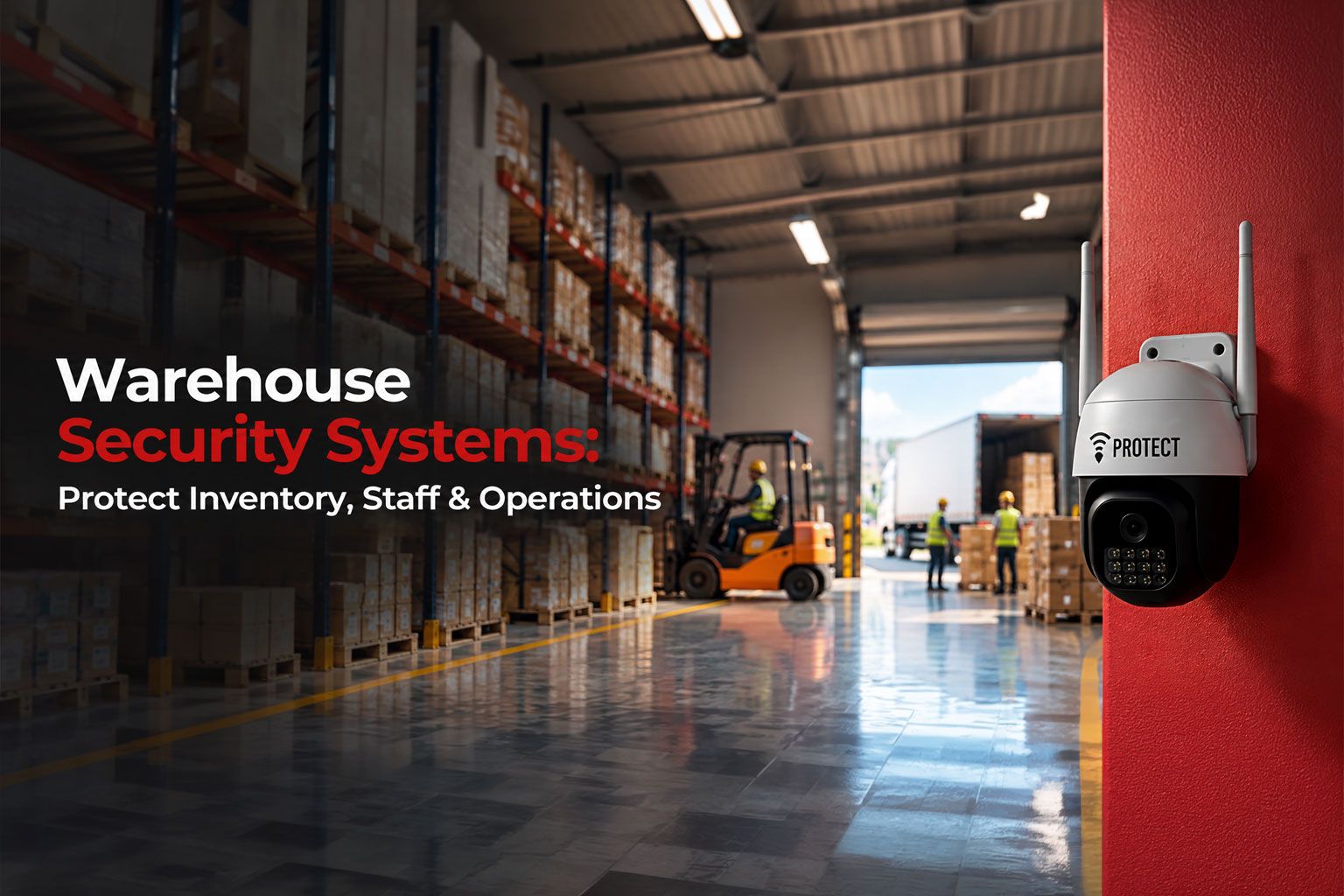

Warehouses concentrate inventory, employees, vehicles, equipment and high-value business activity in one environment. That creates a security problem that is very different from protecting a conventional office or retail outlet.
A warehouse may face after-hours intrusion, internal theft, unauthorised access, loading-bay losses, fire, equipment failure and operational disruption. The financial impact is rarely limited to the value of stolen stock. A serious incident can interrupt dispatch schedules, affect customer commitments, compromise employee safety and create prolonged business loss.
For that reason, a professional warehouse security system should not be designed around CCTV alone. It should combine perimeter protection, intrusion detection, video surveillance, access management, fire detection, alarm transmission, monitoring, verification and a defined response process.
Quick Answer: What Should Professional Warehouse Protection Include?
A professionally designed warehouse security system normally combines several security layers:
Perimeter and entry-point protection
Intrusion and motion detection
Video surveillance and analytics
Access control for restricted areas
Fire and smoke detection
Emergency or panic alerting where required
Device-health monitoring
Central alarm transmission
24/7 monitoring and verification
Defined escalation and response procedures
The exact design should be based on the site's layout, stored commodities, operating hours, loading activity, staff movement, fire load and business-continuity requirements.
A camera can show what happened. A mature security architecture is designed to detect risk early enough for somebody to act.
Why Warehouse Security Requires a Layered Design
Warehouse sites are typically large, operationally dynamic and only partially occupied at different times.
Long perimeter walls, multiple shutters, loading bays, yards, parking areas, roof access and remote corners create more potential vulnerabilities than a conventional commercial building. At the same time, legitimate movement is constant: workers move stock, forklifts cross aisles, trucks arrive and leave, and contractors may enter controlled zones.
A professional design therefore has to manage three different risk categories.
Inventory Risk
Inventory may be lost through burglary, pilferage, unauthorised movement, collusion or loading and dispatch irregularities.
People Risk
Employees, drivers, vendors and visitors may be exposed to intrusion, violence, fire, medical emergencies or unsafe access to restricted areas.
Operational Risk
A fire, security breach or critical equipment failure can interrupt operations even when no stock is stolen.
This is why warehouse protection should be treated as an operational-resilience programme rather than simply a camera installation.
1. Start With Perimeter and Entry-Point Protection
The earlier suspicious activity is detected, the more response options remain available.
Perimeter protection can include controlled gates, boundary cameras, exterior lighting, shutter contacts, door contacts, motion detection, restricted vehicle access and video analytics in selected zones.
For example, a person moving along a restricted perimeter after closing time should ideally generate attention before that person reaches a loading shutter or storage area.
This is where security cameras for warehouse sites should be positioned according to risk rather than equal spacing.
2. Design Camera Coverage Around Operational Questions
Installing more cameras does not automatically create better surveillance.
A professional camera plan starts with one question:
What decision must this camera help the security team make?
Different warehouse zones require different visual information.
Gates and Vehicle Entry Points
Camera coverage may need to establish vehicle movement, driver or visitor entry, entry and exit sequence, and unusual after-hours access.
Loading and Dispatch Areas
These zones deserve particular attention because inventory changes custody here.
Well-positioned warehouse security cameras can help establish what moved, which loading bay was used, when the movement occurred and what happened immediately before or after an exception.
High-Value Storage
Sensitive stock should not rely only on broad overview footage. Video should be combined with access control and intrusion protection.
Internal Aisles
Racking, changing stock heights and equipment can create blind spots. Camera positions should therefore be reviewed against the actual warehouse layout.
Yards and Perimeters
Outdoor cameras must cope with low light, weather, glare, vehicle headlights and longer viewing distances.
The best security cameras for warehouse applications are therefore not defined by megapixels alone. The correct choice depends on the viewing objective, distance, lens, lighting, environmental conditions, recording requirement and monitoring strategy.
What Matters in a Warehouse Camera Specification?
The best security cameras for warehouse operations are the cameras that satisfy a defined security requirement—not simply the highest specification on a product sheet.
3. Move From Passive CCTV to Event-Driven Surveillance
Traditional CCTV is often reactive. Cameras record continuously and footage is reviewed only after stock is found missing or an incident has occurred.
A modern warehouse surveillance system can be configured around events instead.
Depending on the technology and operating rules, relevant events may include:
After-hours movement
Perimeter intrusion
Restricted-zone entry
Camera obstruction or loss
Loitering in selected areas
Unusual activity at loading zones
Fire or smoke alarms from integrated systems
Analytics should support professional decision-making, not replace it.
An automated event is useful only when it reaches somebody who knows how to assess and escalate it.
VProtect's enterprise offering combines live video, video analytics, device-health monitoring, alerts and 24/7 human monitoring, and specifically lists logistics and warehousing among the sectors it supports.
4. Combine Cameras With Intrusion Detection
Video and intrusion detection perform different jobs.
A warehouse may use door contacts, shutter contacts, motion detectors, perimeter sensors and panic or emergency devices.
A protected shutter opening can generate a specific alarm. Interior movement can generate a second event. A camera can then provide visual context.
This layered approach gives monitoring personnel more useful information than video alone because the system identifies the exact zone and event requiring attention.
A professional warehouse security system should therefore connect sensors, cameras and response procedures instead of treating every device as an isolated installation.
5. Control Access to Sensitive Areas
Not every warehouse loss begins with an intruder crossing the outer perimeter.
Some risks involve legitimate users entering areas they are not authorised to access.
Access control can help restrict high-value inventory zones, server rooms, security rooms, maintenance spaces, document storage and other sensitive areas.
Permissions should reflect job roles, shifts and operational requirements.
VProtect's enterprise security stack includes access-control capability alongside intrusion, fire, CCTV and monitoring services, supporting this integrated approach.
6. Treat Fire Protection as a Business-Continuity Requirement
Fire can create greater warehouse losses than theft because it can affect stock, building structure, equipment, staff safety and continuity simultaneously.
BIS IS 3594:2024, Fire Safety of General Storage and Warehousing Including Cold Storages — Code of Practice, notes that fires in storage and warehouse buildings can become serious when they start during periods when premises are closed and remain undetected. It also identifies stored materials, storage arrangement and building type as important fire-protection considerations.
A warehouse fire alarm system therefore requires a site-specific risk assessment rather than a standard detector layout.
Important factors include:
Commodity type and fire load
Storage and rack height
Compartmentation
Electrical risks
Hot-work activities
Occupancy pattern
Smoke and heat movement
Fire access and local firefighting arrangements
Applicable codes and authority requirements
IS 3594:2024 also emphasises the importance of automatic fire detection, alarm and protection arrangements because storage buildings may have comparatively low occupancy during working hours and little or no occupancy after hours.
A warehouse fire alarm system should therefore be treated as part of life safety and business continuity—not merely as a compliance item.
Fire and Security Events Need Different Escalation Procedures
A mature monitoring platform should distinguish a fire alarm from an intrusion event, access violation, panic signal or device fault.
Each event has a different urgency and operating procedure.
VProtect states that intrusion, fire, CCTV and security cameras can be integrated with its Alarm Receiving Center, supported by automated alert escalation and device-health monitoring.
The operational value of integration is not simply having multiple systems on one dashboard. It is ensuring that the right event reaches the right person or response resource quickly.
7. Protect Staff During Operating Hours
Warehouse security is often discussed as an after-hours problem, but employees may also face emergencies during normal operations.
Relevant scenarios can include aggressive visitors, unauthorised people entering work areas, fire, medical emergencies or violence.
Depending on the site risk, staff-safety measures may include:
Panic or emergency buttons
Controlled access
Guard communication
Monitored emergency alerts
Camera verification
Defined civic-response procedures
Employees should know how to raise an alert and what happens after they do.
An emergency button or phone number is not an emergency plan unless the organisation has a clear response process behind it.
8. Monitor the Health of the Security Infrastructure
A camera can lose connectivity. A recorder can fail. A detector can go offline. A field device can be obstructed.
If nobody knows, the security gap may remain hidden until after an incident.
For that reason, a professional warehouse surveillance system should supervise device health as well as security events.
VProtect states that its enterprise platform provides continuous device checks, centralised health alerts and a unified dashboard for video, ticketing, equipment health and security alerts.
Monitoring and Verification: Who Acts on the Alarm?
An alarm has limited value if it does not reach somebody capable of making a decision.
A professional process can look like this:
VProtect describes its wider model around detection, monitoring, verification and response, with trained monitoring teams and civic-response coordination where required.
This is the difference between having CCTV footage and having an operational security service.
Warehouse Protection Checklist
How VProtect Fits Warehouse and Logistics Security
VProtect specifically includes logistics and warehousing within its enterprise security offering. Its platform brings intrusion, fire, CCTV, security cameras, analytics, access control, device-health monitoring and Alarm Receiving Center connectivity into one operating environment.
For warehouse operations, the security lifecycle can be understood as:
Deter → Detect → Monitor → Verify → Escalate → Respond
The advantage is not simply centralisation. It is clearer incident ownership.
A camera failure, intrusion alert, restricted-area event or fire condition can enter a defined operating process instead of remaining isolated in separate systems.
Frequently Asked Questions
What Does an Integrated Warehouse Security Setup Include?
A warehouse security system is an integrated set of physical and electronic controls used to protect inventory, employees, buildings and operations. It can include surveillance, intrusion detection, access control, fire alarms, emergency alerting, monitoring and incident-response procedures.
How Many Warehouse Security Cameras Are Required?
There is no reliable answer based only on floor area.
The required number of warehouse security cameras depends on site geometry, risk zones, storage layout, lighting, entrances, loading bays and the level of detail required from each scene.
What Are the Best Security Cameras for Warehouse Sites?
The best security cameras for warehouse sites are those selected for the particular scene and security objective.
Important factors include viewing distance, lighting, lens choice, scene detail, environmental conditions, recording requirements, analytics and integration with the wider security platform.
Why Is a Warehouse Fire Alarm System Important After Hours?
A warehouse fire alarm system becomes especially important when occupancy is low because a developing fire may otherwise remain unnoticed longer.
BIS IS 3594:2024 specifically recognises the increased risk when warehouse fires begin while buildings are closed or sparsely occupied.
What Is a Warehouse Surveillance System?
A warehouse surveillance system combines cameras, recording, monitoring and, where configured, video analytics to provide security visibility across the facility.
More advanced systems can also supervise camera health and correlate video events with intrusion or access alarms.
Final Perspective: Protect the Operation, Not Just the Building
Warehouse security should not be measured by the number of cameras mounted around the property.
A strong design should answer more important questions:
Can unauthorised activity be detected before inventory is lost?
Can the security team verify what is happening?
Are high-risk areas protected differently from general areas?
Can staff raise an emergency alert?
Can fire be detected when the site is lightly occupied or empty?
Will operators know when critical security equipment fails?
Is there a defined response when an alarm is confirmed?
Cameras provide visibility. Sensors provide dedicated alarms. Access control limits movement. A warehouse fire alarm system addresses a different but potentially catastrophic risk. Device-health supervision keeps the infrastructure accountable. Professional monitoring gives critical alerts an operational destination.
The objective is not more equipment.
It is earlier detection, better verification, clearer accountability and faster response.