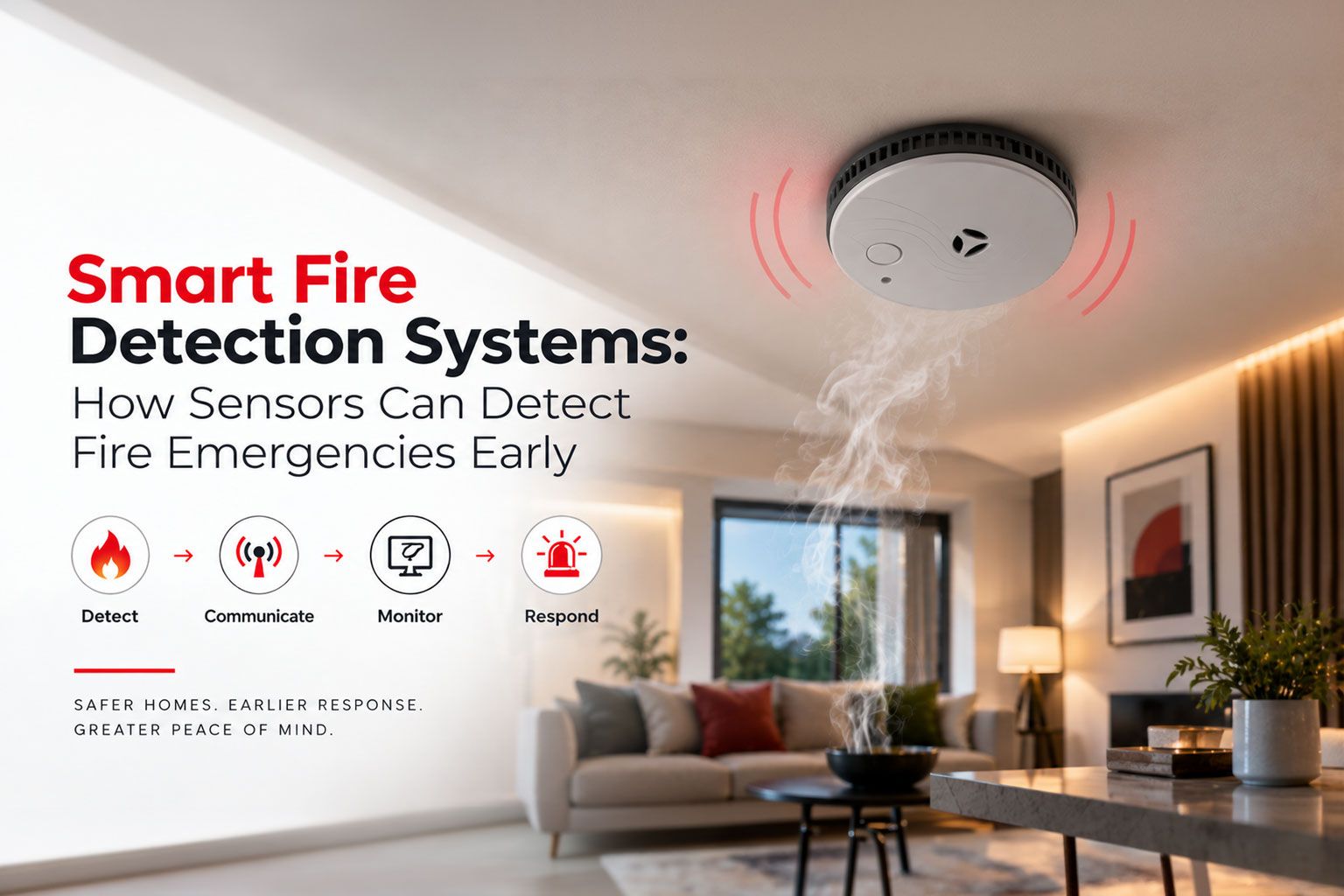

Fire protection is fundamentally a time-and-response problem: how early can a hazardous condition be identified, how reliably can that information be communicated, and what happens in the minutes that follow?
A residential fire may begin as an overheating electrical connection, a smouldering furnishing, a cooking incident or an equipment fault. The first visible flame may not be the first detectable sign. Smoke particles or abnormal heat can develop before occupants fully understand what is happening, which is why a professionally designed fire detection system focuses on early recognition rather than visual confirmation.
A complete system must combine appropriate sensing, correct placement, local warning, dependable signal transmission, system supervision and a defined alarm-handling process.
Fire Detection Is a System, Not a Single Device
A detector performs only one part of the safety chain.
Professional fire security systems are built around several connected functions:
Detection: A sensor identifies smoke, heat or another defined fire-related condition.
Local warning: Occupants are alerted so evacuation can begin.
Signal transmission: The event is communicated to a control unit or monitoring infrastructure.
Alarm handling: The event is classified and processed according to an established procedure.
Escalation and response: Appropriate emergency action can be initiated according to the service configuration.
This distinction is important because a standalone home fire alarm and a professionally monitored alarm may use similar sensing principles but produce very different operational outcomes.
A standalone detector may sound only inside the property.
A monitored system can additionally communicate the fire event beyond the premises so that it enters an established alarm-management process.
VProtect places fire and smoke detection within a broader alarm, monitoring and response ecosystem. Its current security offering includes heat and smoke detection alongside a control hub and 24/7 Alarm Receiving Center infrastructure for handling triggered security events.
What Does a Fire Sensor Actually Detect?
There is no single physical signal that represents every fire.
Different fires generate different combinations of:
Smoke particles
Heat
Combustion gases
Flame radiation
This is why the choice of fire detection sensors must be based on the environment and expected hazard rather than using one detector type everywhere.
Photoelectric Smoke Detection
A photoelectric detector contains a light source and a photosensitive receiver within its sensing chamber.
Under normal conditions, very little light reaches the receiver. When smoke enters the chamber, airborne particles scatter the light. Once the amount of scattered light reaches the detector's alarm threshold, the device signals a fire condition.
NIST explains that photoelectric alarms tend to respond particularly well to larger particles commonly associated with many smouldering fires.
For residential protection, this matters because some fires can produce significant smoke before large flames become visible.
Ionisation, Heat and Multi-Sensor Detection
Ionisation detectors respond to changes in a small electrical current when airborne combustion particles enter the sensing chamber. NIST notes that ionisation and photoelectric technologies have different response characteristics.
Heat detectors use temperature rather than airborne smoke as the primary trigger.
A fixed-temperature detector operates after a defined temperature threshold is reached, while a rate-of-rise detector identifies an unusually rapid increase in temperature.
Heat detection may be appropriate in locations where steam, aerosols or environmental particles make conventional smoke sensing less suitable. However, it should not automatically be treated as a replacement for smoke detection in sleeping or occupied areas.
Multi-sensor detectors go a step further by assessing more than one fire-related parameter.
For example, the Bureau of Indian Standards lists IS/ISO 7240 Part 27 for point-type detectors combining smoke sensing with carbon-monoxide sensing and, optionally, one or more heat sensors.
Fire Sensors Types: How the Technologies Differ
Understanding the main fire sensors types helps explain why professional fire protection cannot rely on a single detector specification throughout a property.
The correct question is therefore not:
“Which sensor is best?”
It is:
“Which sensor is appropriate for this particular risk and environment?”
Detector Placement Is as Important as Detector Technology
Even a technically advanced detector can perform poorly if it is installed in the wrong location.
Smoke and heat must physically reach the sensing element before the detector can respond.
Factors that can influence detection include:
Room configuration
Ceiling geometry
Air movement
Doors and partitions
Air-conditioning supply and return paths
Cooking activity
Dust or steam
Location of potential ignition sources
Professional installation of fire detection sensors therefore requires more than placing detectors at convenient or visually symmetrical points.
A competent assessment should consider sleeping areas, escape routes, stair circulation, kitchens, utility spaces, garages, ventilation paths, ceiling geometry and areas exposed to dust or steam.
Exact installation requirements should follow applicable Indian requirements, local authority rules, manufacturer instructions and qualified fire-system design.
Kitchens Require a Different Detection Strategy
Kitchens are one of the clearest examples of why professional fire detection requires engineering judgement.
Normal cooking can generate:
Steam
Oil aerosols
Heat
Smoke
Airborne food particles
A smoke detector installed too close to normal cooking activity may repeatedly generate unwanted alarms.
That is not simply an inconvenience.
Frequent nuisance alarms can result in occupants silencing, relocating or even disabling detectors, reducing the effectiveness of the entire protection arrangement.
The correct response is to review:
Detector technology
Detector position
Distance from the cooking source
Air movement
Extraction
Normal temperature conditions
Manufacturer guidance
In some applications, appropriately selected heat detection may be preferable near routine cooking aerosols while smoke detection continues to protect other areas.
The objective is not maximum sensitivity everywhere.
It is appropriate detection for the actual risk environment.
A Professional Fire Detection System Must Monitor Faults Too
One of the most important differences between basic detection and professional security engineering is system supervision.
A modern connected fire detection system should distinguish between a genuine fire alarm and a technical fault.
Depending on the system architecture, monitored conditions may include:
Low battery
Detector tamper
Device offline status
Communication failure
Mains-power failure
Backup-power condition
Fire-alarm activation
A detector that has stopped communicating may still look completely normal from the outside.
Without system supervision, that failure could remain unnoticed until the detector is actually needed.
Professional fire protection therefore requires both:
Alarm visibility + system-health visibility
Standalone Home Fire Alarm vs Connected Fire Monitoring
A local home fire alarm has one essential responsibility: warn people who are physically present so they can move to safety.
Remote monitoring should never replace that local warning.
But consider another situation.
A family leaves home at 9:00 a.m. At 11:30 a.m., an electrical fault begins producing smoke.
A standalone detector may correctly activate—but there may be nobody inside the property to hear it.
That is where connected fire security systems provide an additional operational layer.
The most important difference is therefore not the detector itself.
It is the communications and operating process around the detector.
What Should Happen After a Fire Sensor Activates?
This is where professional fire detection becomes operational.
The response process should already be defined before an emergency takes place.
Stage 1: Detection
The fire detection sensors identify smoke, heat or another condition that satisfies their alarm criteria.
Stage 2: Local Warning
The home fire alarm warns occupants.
People inside the property should follow the household's fire-safety and evacuation procedure. They should not remain inside a potentially dangerous environment simply because the alarm is being monitored remotely.
Stage 3: Alarm Transmission
The connected control system transmits the event using its available communications infrastructure.
Stage 4: Monitoring-Centre Receipt
Where professional monitoring is part of the service, the event reaches the monitoring centre with the appropriate event classification.
A fire alarm should not appear operationally identical to a low-battery notification, intrusion alert or routine system event.
Stage 5: Assessment and Escalation
The monitoring operator follows the organisation's defined standard operating procedure.
Depending on the service design and information available, the process may include alert verification, contact attempts and escalation towards the appropriate emergency response.
VProtect states that its monitoring infrastructure operates 24/7 and describes a process in which triggered security events reach its Alarm Receiving Center, are assessed and move into an appropriate response workflow. Its public material also describes coordination with police, fire and medical teams as part of its civic-response capability.
For a homeowner, this is one of the most important advantages of connected detection:
the fire alarm can remain operationally visible even when nobody is at home.
Communication Resilience Is Part of Fire Safety
A connected alarm has limited value if its signal cannot leave the property.
Professional system design should therefore consider:
Primary communication path
Secondary communication path
Backup power
Communication-loss reporting
Detector-health supervision
VProtect's current residential-security material describes a control hub responsible for managing alerts and system health, along with LAN and GSM connectivity and backup-power capability within its connected ecosystem.
These are not convenience features.
They address a fundamental security principle:
one supporting-service failure should not automatically make the emergency system blind.
Indian Fire Detection Standards: What Should a Professional Specification Consider?
Fire protection should not be specified solely from product advertisements or general online advice.
BIS identifies these standards within its fire detection and alarm systems framework.
These references illustrate why detector performance, application, installation and maintenance should all form part of a professional specification.
Questions to Ask Before Choosing a Fire Detection System
Before installing a fire detection system, homeowners should ask more than the price of the detector.
1. What hazard is each detector intended to identify?
The installer should be able to explain why a smoke detector, heat detector or multi-sensor device has been selected for each location.
2. What happens when nobody is home?
If the only answer is “the siren will sound,” the system may provide local warning but no remote operational visibility.
3. How does the fire alarm communicate?
Ask about primary connectivity, secondary connectivity and backup power.
4. Can the system identify technical faults?
A professional setup should distinguish between:
System healthy
and
Detector offline
5. Who receives the fire event?
Determine whether the alert goes only to:
A smartphone
Nominated family members
A security control panel
A 24/7 professional monitoring centre
The answer significantly changes the operational value of the system.
Maintenance Is Part of Fire-Detection Performance
Fire protection is not complete on installation day.
Detection performance can deteriorate when:
Dust enters sensing chambers
Batteries age
Detectors are obstructed
Devices are painted over
Renovation changes airflow
Communication settings change
Devices remain offline after maintenance
A professional maintenance programme should include:
Functional testing
Battery and power checks
Inspection for contamination
Verification of communications
Review of detector status
Confirmation of the full alarm path
The objective is not simply to prove that the home fire alarm can make a sound.
It is to verify that the entire detection-and-notification chain is still functioning.
How Smart Fire Detection Fits Into VProtect's Security Model
VProtect approaches residential protection as a connected security ecosystem rather than a collection of unrelated devices.
Its current security framework combines smart detection, an Alarm Receiving Center, verification and response. Fire and smoke sit alongside other monitored risks such as intrusion, panic situations and medical emergencies.
For fire protection, the operational chain can be understood as:
Detect → Communicate → Monitor → Escalate → Respond
That does not replace statutory fire protection, evacuation planning or public emergency services.
It adds a professional monitoring layer around the detection infrastructure.
Frequently Asked Questions About Smart Fire Detection
What Is a Fire Detection System?
A fire detection system combines sensors, controls, warning devices and communication infrastructure to identify defined conditions associated with fire and generate an alarm.
Connected systems can additionally transmit the event to a remote platform or professional monitoring centre.
How Do Fire Detection Sensors Detect Fire Early?
Fire detection sensors respond to measurable effects associated with combustion.
Smoke detectors identify airborne particles, heat detectors identify temperature conditions, and multi-sensor devices can assess more than one input.
The response depends on the technology and the characteristics of the developing fire.
Which Fire Sensors Types Are Suitable for a Home?
There is no single detector suitable for every room.
Smoke detection is central to residential early warning, while heat detection may be appropriate in selected environments where routine steam or airborne particles make smoke detection difficult.
Choosing between different fire sensors types should be based on the hazard, environment, applicable standards and professional assessment.
Is a Home Fire Alarm Enough?
A working home fire alarm is essential for warning occupants.
However, a standalone unit normally depends on someone being present to hear it. A connected monitored system can additionally transmit the event beyond the property.
Monitoring complements local warning; it does not replace it.
Can CCTV Replace Fire Detection Sensors?
No.
Conventional cameras may show smoke or visible flames, but they are not a substitute for purpose-built fire detection sensors designed to identify defined fire conditions.
Are Fire Security Systems Useful When the House Is Empty?
Yes—provided the alarm can be transmitted beyond the premises.
One of the practical advantages of connected fire security systems is that an alarm can become visible to a remote monitoring process even when nobody is physically present in the property.
Conclusion: Measure Fire Protection From Detection to Action
A professional fire-safety strategy should not be evaluated simply by counting how many detectors have been installed.
It should be evaluated by the complete operating chain.
Ask:
Was the appropriate hazard detected?
Was the warning generated early enough?
Could occupants evacuate promptly?
Was the alarm transmitted reliably?
Would a communication or device fault be visible?
Did the event reach a defined monitoring or escalation process?
Is the equipment regularly tested and maintained?
That is the difference between owning individual fire detectors and operating a dependable fire detection system.
For modern homes, early warning remains the first objective.
Connected monitoring adds another: ensuring that a genuine fire event does not remain confined to an empty property.
A well-designed system therefore combines suitable sensing, correct detector placement, reliable communications, fault supervision, local warning and a defined response process.
That is the standard homeowners should use when evaluating a home fire alarm, professional fire detection sensors, and connected fire security systems.