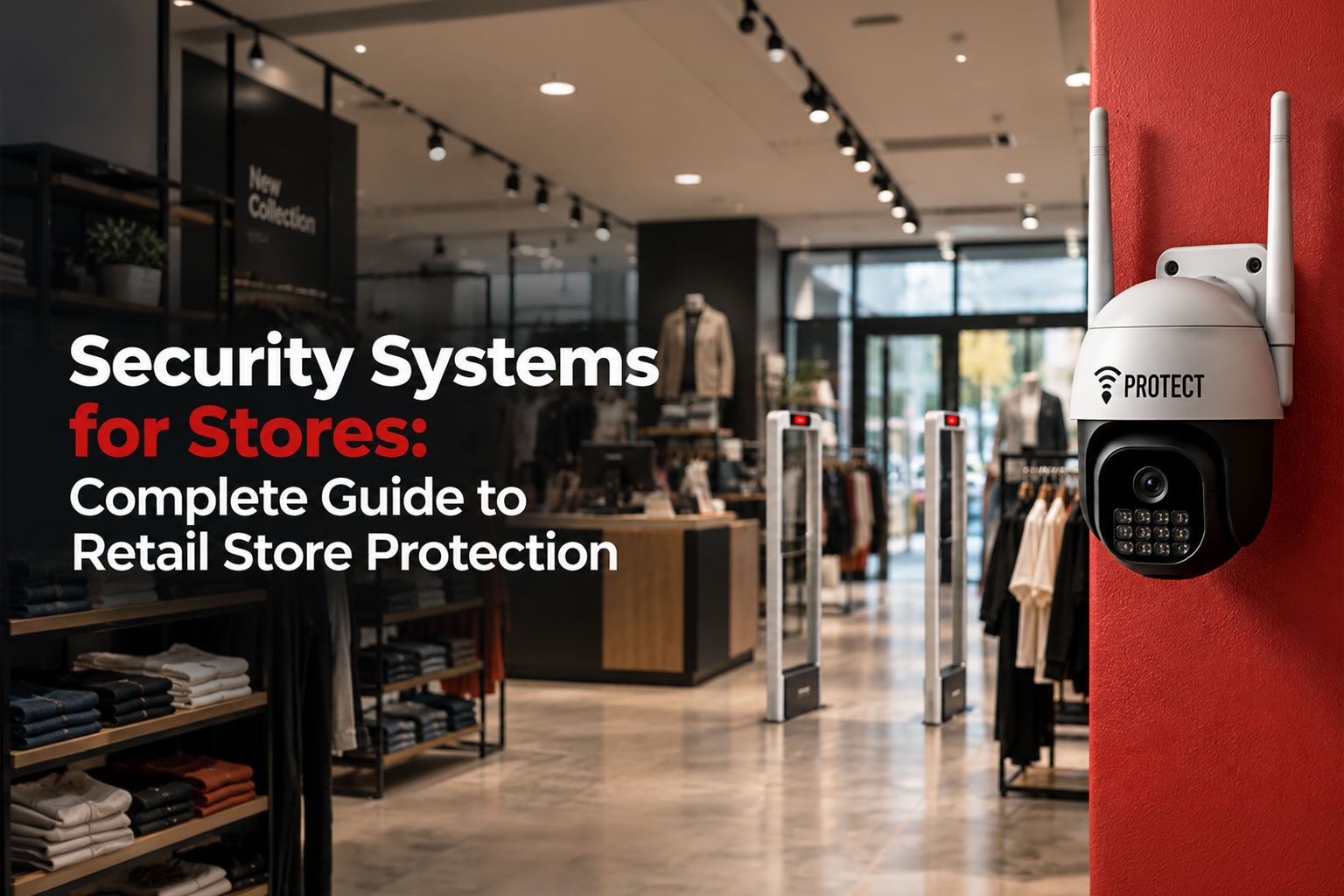

Retail loss is rarely caused by one weakness. A store can lose merchandise through shoplifting, employee theft, cash-handling irregularities, unauthorised stockroom access, burglary after closing, fire, or failures in security equipment. A professional protection strategy must therefore control risk across the entire store—not only the sales floor.
Effective security systems for stores combine several layers: video surveillance, merchandise protection, intrusion detection, access control, fire detection, staff emergency procedures, system-health monitoring, alarm verification and response.
The objective is not to install more devices. It is to create a security architecture that can detect a meaningful event, provide enough information to assess it and move the incident into a defined response process.
Quick Answer: What Should a Professional Retail Security System Include?
A retail store security system should be based on the store's risk profile, merchandise, layout, opening hours and operating procedures.
A mature design may include:
Strategically positioned CCTV
Electronic Article Surveillance (EAS)
Door, shutter and motion sensors
Controlled access to staff-only areas
Panic or duress alerting
Fire and smoke detection
Device-health supervision
Remote monitoring
Documented escalation procedures
These controls should work together. A security event that remains trapped inside one standalone device provides limited operational value.
Start With a Retail Risk Assessment
Modern retail loss prevention combines physical security, employee procedures, analytics and integrated surveillance. Axis Communications similarly describes loss prevention as a layered discipline covering theft, fraud, internal loss and operational controls rather than cameras alone.
A useful assessment should identify high-value merchandise, entrances and exits, checkout areas, stockrooms, receiving doors, cash-handling points, staff-only zones, blind spots, after-hours entry routes and previous incident patterns.
This assessment becomes the basis for retail store security. Technology should be selected only after the risks and required outcomes are clear.
1. Design CCTV Around Specific Security Objectives
Security cameras for retail stores should not be installed simply to "cover the store." Each camera should have a defined operational purpose.
At the entrance, the requirement may be useful images of people entering and leaving. At checkout, the objective may be to review transaction activity. In a stockroom, the purpose may be accountability around inventory access. Around high-value displays, the requirement may be to understand product handling and removal.
Priority Camera Zones
Axis notes that video integrated with point-of-sale information can help investigate transaction exceptions such as unusual refunds, voids or drawer events.
The effectiveness of security cameras for retail stores depends on field of view, lighting, scene detail, lens selection, recording availability, device health and how quickly relevant footage can be retrieved—not resolution alone.
2. Build Merchandise Protection Around the Entire Product Journey
A store anti theft system should protect merchandise as part of the full customer journey, not only after an item is discovered missing.
For many retail formats, Electronic Article Surveillance is a central control.
EAS typically uses security tags or labels attached to merchandise and detection antennas positioned around exits. At legitimate checkout, the tag is removed or deactivated. If an active tag passes through the detection field, the system can generate an alarm.
Checkpoint Systems describes this principle for RF EAS systems, while Sensormatic identifies RF, AM and RFID among established merchandise-protection technologies.
However, EAS alone is not a complete store anti theft system.
A professional programme should also include consistent tagging, checkout deactivation, exit-area video coverage, staff response procedures and investigation of repeated alarms or loss patterns.
The important point is integration: product protection should support the wider loss-prevention process rather than operate as an isolated alarm.
3. What Is a Retail Store Security System Checkpoint?
A retail store security system checkpoint is the controlled loss-prevention zone at or near an entrance or exit where merchandise-protection technology, CCTV and staff procedures come together.
This checkpoint commonly includes EAS detection antennas. Checkpoint Systems explains that RF EAS creates a detection zone around the store exit and can generate an alarm when an active merchandise tag enters that zone.
A professional checkpoint should address three questions.
Detection
Can tagged merchandise be detected reliably across the intended exit width?
Verification
Can employees or security personnel quickly understand what caused the alarm?
Response
Is there a clear and safe procedure for handling the event without creating unnecessary confrontation?
A retail store security system checkpoint should therefore be treated as an operating control—not simply as hardware positioned beside the door.
4. Protect the Store After Closing
Shoplifting during trading hours and burglary after closing require different security controls.
Once the premises are closed, a retail store security system may arm shutter and door contacts, internal motion detectors, sirens, selected shock sensors and cameras used for remote alarm verification.
The objective is to detect an unauthorised attempt while it is happening, not discover damage the following morning.
VProtect's enterprise-security offering combines intrusion, fire, CCTV, security cameras, access control, automated alert escalation, device-health monitoring and 24/7 live monitoring. Retail is specifically included among the sectors supported by its enterprise platform.
This creates an important distinction between a local alarm and an operationally monitored security event.
5. Use Video Analytics Only Where They Support a Defined Procedure
Analytics can make video surveillance more proactive, but every analytic rule should have a defined purpose.
Potential retail applications include:
After-hours movement
Loitering in selected high-risk zones
Unauthorised entry into staff-only areas
Camera obstruction
Unusual footfall patterns
Selected perimeter activity
Axis notes that modern retail analytics can help identify events such as loitering and combine video with access control and other security information.
Analytics should support human decision-making.
A high volume of automated alerts without clear ownership can create alarm fatigue rather than stronger retail store security.
6. Secure Stockrooms, Cash Offices and Staff-Only Areas
Retail security is often strongest on the customer-facing floor and weakest behind the scenes.
Stockrooms, receiving points, cash offices and IT rooms may contain valuable assets but can sometimes be accessible to more people than operationally necessary.
Access control can establish who is authorised, which doors they may use, permitted access times and an audit trail of entry. Video can then provide context around selected access events.
This matters because retail store security must address internal and operational risk as well as customer-facing theft.
For multi-location retailers, standardised access policies also make it easier to manage staff changes and reduce dependence on physical keys.
7. Protect Employees Without Making Them Security Responders
Store employees should not be expected to physically confront suspected offenders as the primary loss-prevention control.
A safer design can combine:
Visible surveillance
Clear EAS procedures
Panic or duress buttons
Manager escalation
Remote monitoring
Controlled access
Axis notes that integrated loss-prevention technology can help reduce the need for employees to directly confront suspected offenders while supporting employee safety and accountability.
A professional store anti theft system should therefore protect both merchandise and the people expected to operate the store.
Technology should allow employees to raise or escalate an incident without requiring them to take unnecessary personal risk.
8. Treat Fire Protection as a Separate Life-Safety Layer
Theft is primarily a loss-prevention issue. Fire is a life-safety and business-continuity issue.
Store protection should therefore account for appropriate fire detection, alarm notification, evacuation procedures, emergency exits and compliance with applicable Indian requirements and qualified fire-system design.
Where the security architecture supports integration, fire events can also be transmitted into a monitored environment.
VProtect states that its enterprise stack can integrate fire, intrusion, CCTV and security devices with its Alarm Receiving Center and automated alert escalation.
Fire detection should complement retail store security. It should never be substituted with ordinary CCTV analytics or intrusion sensors.
9. Monitor the Security System Itself
One frequently overlooked security risk is equipment failure.
A camera that goes offline creates a blind spot.
A detector with a depleted battery can create false confidence.
A recording fault can mean that critical evidence is unavailable when an incident needs to be investigated.
Professional security systems for stores should therefore monitor infrastructure health as well as security events.
Relevant conditions can include:
Camera offline
Recording or storage fault
Communication loss
Detector battery issue
Tamper event
Control-panel power failure
VProtect's enterprise offering describes continuous device checks and centralised health alerts alongside live video and incident monitoring.
For chains operating multiple outlets, centralised health monitoring becomes particularly important because local teams may not notice a technical fault before a security incident occurs.
10. Build a Defined Monitoring and Response Workflow
Security technology becomes operational only when a critical event reaches somebody responsible for assessing and acting on it.
A professional workflow can follow this structure:
VProtect describes its wider operating framework through deterrence, detection, monitoring and response, including human monitoring, alert verification and escalation.
This is a major distinction between connected retail store security and independent devices producing unrelated notifications.
How to Select Security Cameras for Retail Stores
When selecting security cameras for retail stores, begin with the required evidence or operational outcome.
Consider:
Viewing distance
Lighting conditions
Field of view
Required image detail
Low-light performance
Recording retention
Cybersecurity
Device-health reporting
Integration with alarms or analytics
A higher-resolution camera is not automatically the correct camera.
For example, a premium camera positioned too high above a checkout may provide less useful incident information than a correctly selected camera installed at an appropriate angle.
The camera specification should follow the security objective.
How a Store Anti Theft System and CCTV Should Work Together
Consider a merchandise-protection alarm at an exit.
EAS may establish that an active tag has crossed the checkpoint.
It does not necessarily establish:
Which item triggered the alarm
Whether checkout deactivation failed
Who was carrying the product
Whether the alarm resulted from theft or error
What occurred immediately before activation
Video can provide additional context.
This is why a store anti theft system and camera coverage should be designed as complementary controls.
Similarly, an intrusion detector can indicate after-hours movement, while a camera may help a monitoring team assess the cause.
No single technology should be expected to answer every security question.
Security for Multi-Store Retail Operations
Security becomes more complex when a business moves from one outlet to ten, fifty or hundreds.
The challenge is no longer only detecting incidents. It is achieving consistency.
A multi-site security operation should ideally provide visibility into:
Site alarm status
Camera availability
Device health
Security incidents
Escalation history
Repeated technical faults
Site-specific trends
VProtect's enterprise platform includes a unified dashboard covering live video, ticketing, equipment health and alerts, together with 24/7 live monitoring.
For distributed security systems for stores, central visibility can help ensure that a branch-level technical failure or alarm is not dependent entirely on local staff noticing it.
How VProtect Supports Retail Store Security
VProtect specifically lists retail among the industries supported by its enterprise-security platform.
Its current offering brings together intrusion protection, fire, CCTV, security cameras, video analytics, access control, live monitoring, device-health supervision, unified dashboards and response coordination.
VProtect also identifies commercial risks such as blind spots, theft discovered only during inventory checks, unverified alerts and employees being unprepared for emergencies.
For a retailer, the operating model can be summarised as:
Deter → Detect → Verify → Escalate → Respond
The value is not simply having all security technology in one place.
It is creating clearer ownership of what happens when a genuine incident occurs.
Retail Store Protection Checklist
Frequently Asked Questions
What Are Security Systems for Stores?
Security systems for stores combine security technology and operating procedures to protect merchandise, employees, cash, restricted spaces and the premises itself.
A complete design may include video surveillance, EAS, intrusion detection, access control, panic alerting, fire detection and professional monitoring.
What Is a Store Anti Theft System?
A store anti theft system is designed to deter or detect unauthorised removal of merchandise.
Electronic Article Surveillance is one common technology, but an effective programme should also include CCTV, correct tagging procedures, trained employees and incident-investigation controls.
Why Are Security Cameras for Retail Stores Important?
Security cameras for retail stores support deterrence, situational awareness, verification and investigation.
Their effectiveness depends on whether each camera has a defined purpose and produces sufficient information for that purpose.
What Is a Retail Store Security System Checkpoint?
A retail store security system checkpoint is the controlled area around an entrance or exit where EAS, camera coverage and staff response procedures work together to manage merchandise-protection alarms.
The checkpoint should support detection, verification and safe response rather than simply generating an audible alarm.
Is CCTV Enough for Retail Store Security?
No.
Retail store security also requires controls for merchandise protection, restricted access, after-hours intrusion, staff safety, fire, equipment health and incident response.
CCTV is an important layer, but it should form part of a wider security architecture.
How Does a Retail Store Security System Work After Closing?
After closing, a retail store security system can arm selected intrusion zones, monitor doors and shutters, detect internal movement and transmit triggered events for verification and response according to the configured security service.
Final Perspective: Protect the Store as an Operating Environment
Retail protection has two very different operating modes.
During business hours, security must reduce merchandise loss, protect employees and maintain a customer-friendly environment.
After closing, the emphasis shifts toward perimeter protection, intrusion detection, alarm verification and response.
Effective security systems for stores must support both.
That means combining surveillance, merchandise protection, access control, intrusion detection, fire safety, staff procedures, equipment supervision and professional monitoring into one coherent strategy.
A store anti theft system at the exit can identify an active merchandise tag. Cameras can provide context. Access control can protect stockrooms and cash areas. Intrusion devices can protect the premises after hours. Monitoring can ensure that critical alarms have an operational destination.
The objective of professional retail protection is not more footage or more alarms.
It is earlier detection, stronger verification, safer staff action, better accountability and a defined response when something genuinely goes wrong.