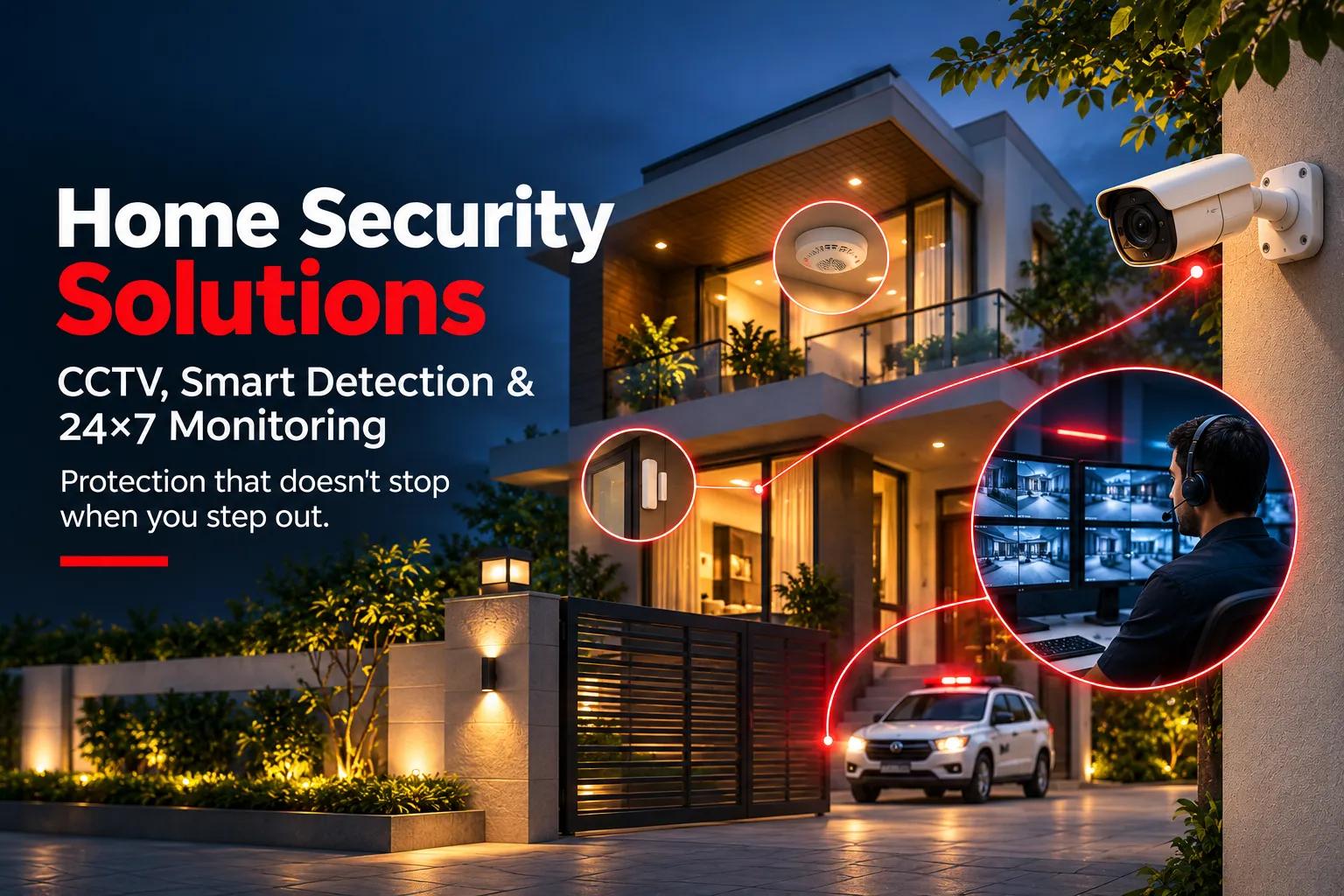

Quick answer: A complete home security solution has four parts: deterrence, detection, monitoring and response. CCTV surveillance cameras help you see and record what happens, while sensors on doors, windows and rooms detect a break-in, smoke or an emergency. 24x7 monitoring makes sure a trained person checks every alert and arranges help, even when you're away.
Most families start home security the same way: they get a couple of CCTV surveillance cameras installed at the gate and the main door, download the app, and feel a little better. That's a sensible first step. But a few weeks later, the same questions come up. Who is actually watching the feed at night? What happens if smoke starts in the bedroom while we're at a wedding? What if my mother at home needs help and can't reach the phone?
This guide looks at home security as a complete solution, not just cameras. We cover how security video surveillance fits in, the types of home video surveillance cameras and where to put them, what home CCTV installation involves, how to choose an installation company or security provider, and how monitoring turns all of it into real protection. We also explain how VProtect India approaches home security.
What does a complete home security solution include?
A complete home security solution includes devices that deter and detect, people who monitor alerts, and a plan for responding. Cameras are one important part of it, but not the whole thing.
| Layer | What it includes | What it does at home |
|---|---|---|
| Deterrence | Visible signage, cameras, an AI camera that can flash a light and play a voice warning | Makes your home a less attractive target before anyone tries to get in |
| Detection | Door and window sensors, motion sensors, glass-break sensors, smoke and heat sensors, a panic button | Notices a break-in, fire or emergency the moment it starts, in the exact room or entry point |
| Visibility | CCTV surveillance cameras and a phone app | Lets you and the monitoring team see what's happening and keeps a record |
| Monitoring | A 24x7 monitoring centre | Trained operators check each alert, day and night, including when you're travelling |
| Response | Response officers and coordination with emergency services | Turns a verified alert into action, and keeps you informed |
Each layer covers a gap in the others. A camera may miss a back window; a sensor won't. A sensor can't show you who is at the door; a camera can. And neither can call for help on its own, which is what monitoring and response are for.
Where do CCTV surveillance cameras fit in home security?
CCTV surveillance cameras are the eyes of a home security solution. They deter casual intruders, let you check on your home from your phone, and keep a record if something goes wrong. Security video surveillance works best when cameras are paired with sensors that detect events and a team that responds to them.
What cameras do well at home:
- Show who's at the gate or main door before you open it.
- Let you check on children back from school or elderly parents at home.
- Record deliveries, visitors and anything unusual in the compound or parking.
- Provide footage if you ever need to report an incident.
What cameras don't do on their own:
- Raise an alarm the moment someone forces the balcony door.
- Notice smoke from a short circuit in a closed room.
- Help a parent who has fallen and can't reach the phone.
- Call anyone. Most recordings are watched the next morning, if at all.
So the question for most homes isn't "how many cameras?" It's "what happens between the camera seeing something and someone acting on it?" The rest of this guide answers both.
Which home video surveillance cameras suit which spots?
The right home video surveillance cameras depend on the spot: dome cameras for indoors, bullet cameras for gates and driveways, PTZ cameras for large compounds, and AI cameras where you want smarter alerts and a visible deterrent.
| Camera type | Best spot at home | Why |
|---|---|---|
| Dome | Living room, entrance lobby, staircase | Discreet, hard to tamper with, wide indoor view |
| Bullet | Main gate, driveway, parking | Long, clear view of one area; visible deterrent |
| Wi-Fi home camera | Small flats, a child's play area | Quick to set up, easy phone viewing |
| PTZ | Villa compounds, large gardens, long boundary walls | Pans and zooms to cover a big area with one camera |
| AI camera | Main entrance, front of the house | Tells people from pets or shadows, and can flash a light and play a voice warning |
Placement tips that make a real difference:
- Main door first. Mount the camera so it sees faces, not the tops of heads.
- Cover the routes in, not just the valuables. Gate, main door, balcony and any ground-floor window.
- Check the night view before you finalise each position.
- Respect privacy. Keep cameras out of bedrooms and bathrooms, and don't point outdoor cameras into a neighbour's home.
- Protect the recorder. Keep it locked away or out of sight, so it can't simply be carried off with the footage.
What does home CCTV installation involve?
Home CCTV installation usually takes a site survey, a coverage plan, fitting and cabling, setting up the recorder and app, and a final test. A good installer plans the whole home security solution at the same time, rather than just fixing cameras where it's easiest.
1. Site survey: the installer walks your home and notes every entry point, blind spot and power point.
2. Coverage plan: which cameras go where, and which areas need sensors instead of, or as well as, cameras.
3. Fitting and cabling: wired cameras need neat cable runs; wireless ones need a strong, stable Wi-Fi signal.
4. Recorder and app setup: the recorder is configured, storage is set, and the app is connected to your phone.
5. Testing: every camera is checked in daylight and at night, and you're shown how to view live and recorded footage.
6. Handover: passwords are changed from the defaults, and you know who to call for service.
What affects home CCTV installation cost?
Home CCTV installation cost depends on how many cameras you need, the type and quality of cameras, wiring work, storage, and whether you add sensors and monitoring. Instead of comparing a single headline number, compare what each quote includes:
- Number and type of cameras: indoor dome, outdoor bullet, PTZ or AI cameras.
- Image quality and night vision: clearer footage in the dark costs more.
- Wired or wireless: wiring a finished home takes more labour; wireless needs good Wi-Fi.
- Recorder and storage: more cameras and more days of footage need more storage.
- Power backup: a UPS or battery keeps recording through power cuts.
- Sensors, panic button and monitoring: these add protection that cameras alone can't give.
A cheaper quote that skips night vision, power backup or monitoring often costs more in the end, because the footage you need is missing or nobody saw the alert in time.
How do you choose a CCTV installation company near you?
When you search for a CCTV installation company near me, you'll find many local options. The right one does more than fit cameras: it understands your home, explains what each device covers, and is clear about what happens after installation.
Questions worth asking before you decide:
1. Will you visit the home before quoting? A quote without a site visit is a guess.
2. Which areas will cameras cover, and which will be blind spots? Ask to see the plan.
3. Do you also offer sensors, a panic button or smoke detection? Cameras alone leave gaps.
4. Who watches the alerts? Only my phone, or a monitoring team as well?
5. What happens in a power cut? Ask about battery backup for cameras, recorder and sensors.
6. What service do you offer after installation? Who comes if a camera stops working?
7. How do you handle privacy? Can I choose which areas are monitored and who can view footage?
The answers usually show you quickly whether you're talking to a camera installer or a security provider. Both have their place. If your home is often empty, or you have elderly parents or children at home alone, the second is usually the better fit.
Why aren't CCTV cameras enough on their own?
CCTV cameras record what happens, but on their own they rarely change what happens. The difference comes from monitoring: a trained person who sees the alert as it arrives, checks it, and arranges help.
Consider a family away at a cousin's wedding in another city. At 1:30 am, someone forces the balcony door of their locked flat. Here's how three setups would handle it:
| Setup | What happens |
|---|---|
| Cameras only | The camera records it. The family sees the footage the next day. |
| Cameras plus phone alerts | An alert arrives on a phone that's on silent. It's seen at 7 am. |
| Sensors, cameras and 24x7 monitoring | The balcony door sensor triggers at once. An operator checks the alert, looks at the camera view, and coordinates a response while informing the family. |
The cameras are the same in all three. What changes is whether anyone acts while it matters. That's why a home security solution is worth thinking about as one connected system, not a set of separate gadgets.
What does VProtect India offer for home security?
VProtect India, part of the SIS Group, offers smart e-surveillance and monitored security for homes and businesses across India. Rather than selling cameras on their own, VProtect brings deterrence, detection, monitoring and response together into one service.
How the VProtect service works
1. Deterrence. Visible signage and an AI camera that can flash a light and play a voice warning when it spots someone, as an early warning.
2. Detection. Wireless smart sensors on doors and windows, motion sensors, glass-break sensors and smoke or heat sensors, plus a panic button for medical or other emergencies.
3. Monitoring. Every alert goes to a 24x7 monitoring centre, where trained operators check it before acting. Checking first helps cut false alarms.
4. Response. When an alert needs action, trained response officers and coordination with emergency services, such as the fire brigade, follow, and you're kept informed.
Privacy built in
You choose which zones in your home are actively monitored, so bedrooms and private spaces can stay private. The system stays passive until an alert needs action; nobody is watching your family's everyday life.
Who it's for
- Family homes and residences: flats, independent houses and villas, including homes left locked during travel.
- Families with elderly parents or children at home alone: the panic button and monitoring mean help can be arranged even when you're in another city.
- Shops and small offices: covered under VProtect's SoHo solutions.
- Larger businesses: enterprise security needs are handled separately.
How VProtect compares with a cameras-only setup
| Cameras only | VProtect monitored security | |
|---|---|---|
| Deterrence | Visible cameras | Signage plus an AI camera with light and voice warning |
| Detects a forced door or window | Only if a camera happens to see it | Door and window sensors trigger at once |
| Detects smoke or heat | No | Smoke and heat sensors |
| Emergency help at home | No | Panic button |
| Who checks the alert | You, if you notice | Trained operators, 24x7 |
| What happens next | Depends on you | Response officers and coordination with emergency services |
You can see the full process on how VProtect works, the sensors and AI camera on the VProtect devices page, and home plans on VProtect home security solutions.
Key takeaways
- A complete home security solution covers deterrence, detection, monitoring and response, with cameras as one part.
- CCTV surveillance cameras show and record what happens; sensors detect break-ins, smoke and emergencies as they start.
- Good home CCTV installation starts with a site survey and covers every entry point, with night vision and power backup.
- Compare installation quotes by what's included, not just the headline cost.
- 24x7 monitoring means a trained person checks every alert and arranges help, even when you're away.
Frequently asked questions about home security solutions
What is the best security solution for home?
The right security solution for a home combines cameras with door and window sensors, motion sensors, smoke or heat detection and a panic button, all connected to 24x7 monitoring. Cameras show what's happening; sensors detect it as it starts; monitoring makes sure a trained person checks the alert and arranges help.
Are CCTV surveillance cameras enough to secure a home?
CCTV surveillance cameras help deter intruders and record evidence, but on their own they usually help after the event. They don't detect smoke, can't help in a medical emergency and don't call anyone. Pairing them with sensors and professional monitoring covers those gaps, especially when the home is empty.
What affects home CCTV installation cost?
Home CCTV installation cost depends on the number and type of cameras, image quality and night vision, wiring work, storage, power backup, and whether you add sensors, a panic button and monitoring. Ask each installer for an itemised quote, and compare what's included rather than only the total.
How do I choose a CCTV installation company near me?
Choose a company that visits your home before quoting, shows you a coverage plan with any blind spots, explains power backup, and offers service after installation. Ask whether they also provide sensors and monitoring, and how they handle privacy, so you know whether you're getting cameras only or a full security solution.
Can I see my home security cameras on my phone?
Yes. Most home video surveillance cameras connect to a phone app for live and recorded viewing. The app is useful for quick checks, but it relies on you noticing alerts. With a monitored service, trained operators also receive alerts round the clock, so nothing depends on your phone being in your hand.
Does VProtect watch my home through cameras all the time?
No. With VProtect, you choose which zones are actively monitored, and the system stays passive until an alert needs action. Operators check an alert when a sensor or the AI camera raises one, so private spaces stay private during everyday life at home.
Conclusion: cameras to see, a system to act
CCTV surveillance cameras are a good place to start, and a well-planned home CCTV installation gives you a clear view of your gate, door and compound. Real protection comes from connecting those cameras to sensors that detect problems as they start, and to people who act on them.
If you'd like to see how a monitored home security solution could work for your family, you can schedule a consultation with VProtect.