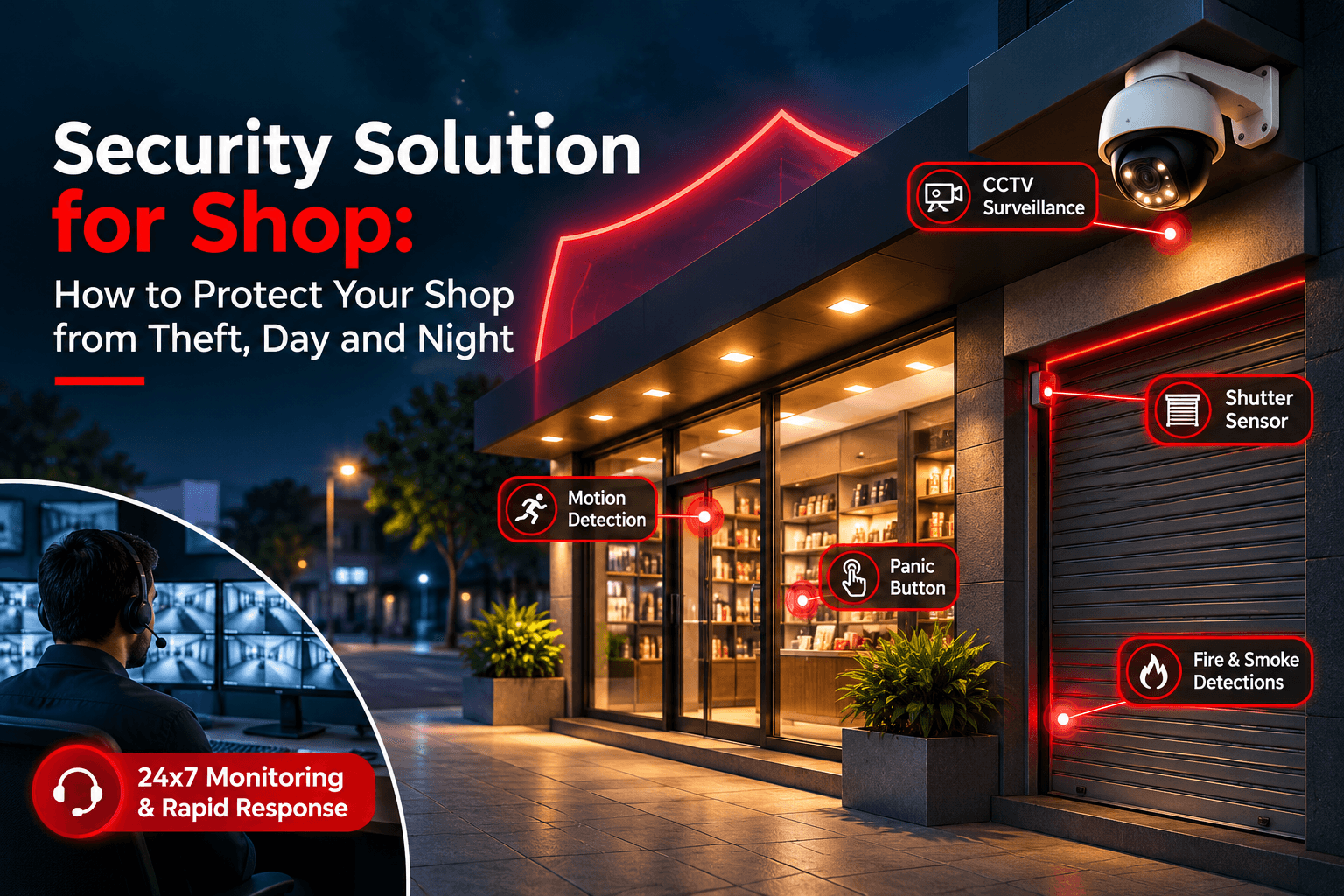

Quick answer: A good security solution for shop owners combines detection, monitoring and response. Sensors on the shutter, doors and display areas detect a break-in, a panic button covers threats at the counter, and cameras show what's happening. With 24x7 monitoring, trained operators verify each alert and coordinate a response, even after the shop has closed.*
Every shop owner knows the feeling of pulling the shutter down at 10 pm and hoping the night stays quiet. During the day, you're there. You see who walks in, you know your regulars, and your staff keep an eye on the counter. At night, the shop is on its own.
Most owners respond by adding a camera or two. That helps, but it doesn't answer the question that matters at 2 am: will anyone know if someone breaks in, and will anyone act? This guide looks at the real risks shops face, what a complete security solution for shop premises includes, where cameras fit, and how to choose a setup that suits your shop.
What security risks do shops face?
Shops face different risks at different times of day. During business hours, the concern is theft from the shelf or counter and, occasionally, a threat to staff. After closing, it's a break-in through the shutter, back door or roof, and fire in an empty building.
After hours
Shutter and lock forcing: the most common route for shops on main roads and in markets.
Back doors, ventilators and rooftops: less visible entry points, often with weaker locks.
Electrical fire: a short circuit in a display light or an overloaded board, with no one there to notice the smoke.
During business hours
Shoplifting: small, high-value items walking out in a busy hour.
Cash counter risk: pressure or threats at the counter, especially around closing time when cash is being counted.
Insider issues: stock or cash going missing with no clear record of who accessed what.
A camera can record all of these. What it can't do on its own is raise the alarm while they're happening. That's the gap a proper security solution fills.
What does a complete security solution for shop premises include?
A complete security solution for shop premises has three layers: devices that detect a problem, people who monitor alerts, and a plan for responding. Each layer covers what the others can't.
| Layer | What it includes | What it does for a shop |
|---|---|---|
| Detection | Shutter contacts, door and window contacts, motion sensors, glass-break sensors, smoke and heat detectors | Flags a break-in or fire the moment it starts, at the exact entry point or room |
| Deterrence and visibility | Cameras, an AI camera with light and voice warning, a siren | Discourages intruders and lets someone see what's happening |
| Emergency alert | Panic button at the counter or in the back office | Lets staff call for help quietly in a threatening situation |
| Monitoring | A 24x7 monitoring centre that receives every alert | Trained operators verify alerts, including at night and on holidays |
| Response | Response officers and coordination with police or fire services | Turns a verified alert into action, and keeps the owner informed |
Notice that cameras are one row of five. Shop owners often start with that row because it's familiar. The rows around it decide whether a break-in is stopped early or simply recorded.
Security alarm systems for shops also let you arm only part of the premises. For example, the shutter and back door can be armed while staff finish closing inside, or only the stock room can stay armed during the day.
Where does a CCTV camera for shop security fit in?
A CCTV camera for shop security is useful for deterring theft, settling disputes and recording evidence. It's most effective when it's one part of a wider solution rather than the whole plan.
Where cameras earn their place:
Over the cash counter, so transactions are on record.
Covering the entrance, angled to capture faces as people walk in.
On display areas with small, high-value stock.
Outside, covering the shutter and the approach to it.
Many owners ask for a CCTV camera for shop with mobile connectivity, so they can check in from home. That's handy for a quick look. The catch is that it still depends on you opening the app at the right moment.
Where cameras fall short on their own:
They record, but nobody is watching at 2 am.
They can be covered, turned or unplugged by someone who knows where they are.
They don't detect smoke from a short circuit in the back room.
Looking for the best CCTV camera for shop use is a fair question, but even the sharpest camera can't call for help.
That's why the most useful question for a shop owner isn't "which camera?" but "what happens when something goes wrong and I'm not there?"
How does a shop security solution work at night?
At night, a shop security solution works as a chain: sensors detect, a monitoring team verifies, and a response is coordinated. Here's how that plays out at a typical market shop.
10:15 pm: The owner pulls the shutter down and arms the system from a keypad or app.
Overnight: Shutter contacts, door sensors and motion sensors stay active. The AI camera watches the front of the shop.
Something happens: Someone tries to lift the shutter. The shutter contact triggers at once, and the AI camera flashes a light and plays a voice warning.
Verification: The alert reaches a monitoring centre. An operator checks which sensor triggered and looks at the camera view.
Response: If it's genuine, the operator coordinates help and informs the owner. If it's a false trigger, it's logged and closed.
The owner may still be asleep through steps 3 to 5, and that's the point. The system doesn't depend on them waking up.
How VProtect India approaches shop security
VProtect India, an SIS Group company offering monitored e-surveillance, builds its service around Detection, Monitoring and Response. For shops and small offices, that means wireless door and window contacts, motion and glass-break sensors, smoke or heat sensors, panic buttons and an AI camera that can flash a light and play a voice warning.
Alerts go to a 24x7 monitoring centre, where trained operators check each one before acting. When action is needed, trained response officers and coordination with emergency services follow. Owners choose which zones are actively monitored, and the system stays passive until an alert needs action. See VProtect solutions for shops and small offices and how VProtect monitoring works.
How can you prevent shop theft at night?
To prevent shop theft at night, start with simple habits that cost little, then add detection and monitoring for the hours when nobody is there.
Quick wins you can do this week
Check the shutter lock and bottom channel. A worn lock or a loose channel is easier to force. Replace it before it fails.
Don't leave cash in the shop overnight. If you must, use a proper safe that's fixed to the floor or wall.
Keep a light on at the front. A lit shop front is less inviting than a dark one.
Secure the back. Back doors, ventilators and roof access often have the weakest locks.
Switch off and unplug display lights and extension boards at closing time, to reduce fire risk.
Choosing the right security solution for your shop
| Shop type | Main risks | Suggested focus |
|---|---|---|
| Small retail or kirana store | Shutter break-in, cash at night | Shutter contact, motion sensor, siren, monitoring |
| Mobile and electronics shop | High-value small items, shoplifting | Display-area sensors, cameras on counters, AI camera at the front |
| Jewellery store | Break-in, threat at the counter | Strong-room sensors, panic button at the counter, monitored response |
| Pharmacy or medical store | Stock and cash, night-time entry | Door contacts, motion sensors, smoke detection |
| Showroom with stock outside | Yard and display theft | Perimeter sensors, outdoor or PTZ cameras, monitoring |
Whatever the shop, the same questions apply: which entry points need covering, who will receive alerts after closing, and what happens next. A security alarm system for shop premises is a good start; pairing it with 24x7 monitoring is what covers the night.
Key takeaways
A complete security solution for shop premises combines detection, monitoring and response, not just cameras.
Shutter contacts, motion sensors, smoke detectors and a panic button cover the risks cameras miss.
Cameras deter and record; 24x7 monitoring makes sure someone acts on an alert at night.
Simple habits, like a strong shutter lock and no cash left overnight, help prevent shop theft at night.
Frequently asked questions about shop security
What is the best security solution for shop owners?
The best security solution for shop owners covers detection, monitoring and response together. That usually means shutter and door contacts, motion sensors, smoke detection, a panic button at the counter and cameras, connected to a 24x7 monitoring centre that verifies alerts and coordinates help when the shop is closed.
Is a CCTV camera for shop security enough?
A CCTV camera for shop security helps deter theft and record evidence, but on its own it usually helps after the event. It doesn't raise an alarm or call anyone. Pairing cameras with sensors and 24x7 monitoring means a break-in is noticed and acted on while it's happening.
How can I prevent shop theft at night?
Strengthen the shutter lock, secure back doors and ventilators, avoid leaving cash overnight and keep a light on at the front. Then add a security alarm system for shop premises, with shutter contacts and motion sensors linked to 24x7 monitoring, so someone is alerted the moment a break-in starts.
Can I check my shop security on my phone?
Yes. Many systems, including CCTV cameras for shops with mobile connectivity, let you view cameras and arm or disarm the system from an app. The app helps for quick checks, but it depends on you noticing alerts. Professional monitoring covers the times you can't respond, such as late at night.
Why does a shop need a panic button?
A panic button lets staff call for help quietly if they feel threatened, for example at the cash counter around closing time. In a monitored system, the alert goes to a monitoring centre that can coordinate a response, without the staff member needing to make a phone call in front of the person.
What should a shop do if the alarm goes off at night?
In a monitored system, operators verify the alert first by checking which sensor triggered and reviewing the camera view. If it's genuine, they coordinate a response and inform the owner. Owners should never go alone to check a possible break-in; let the response team and police handle it.
Conclusion: protect the shop when you can't be there
During the day, you're your shop's best protection. At night, it needs a system that notices, decides and acts without you. A security solution for shop premises that combines sensors, a panic button, cameras and 24x7 monitoring is built for exactly that, while you get on with your evening.
If you'd like to see how a monitored security solution could work for your shop, you can request a site assessment with VProtect.