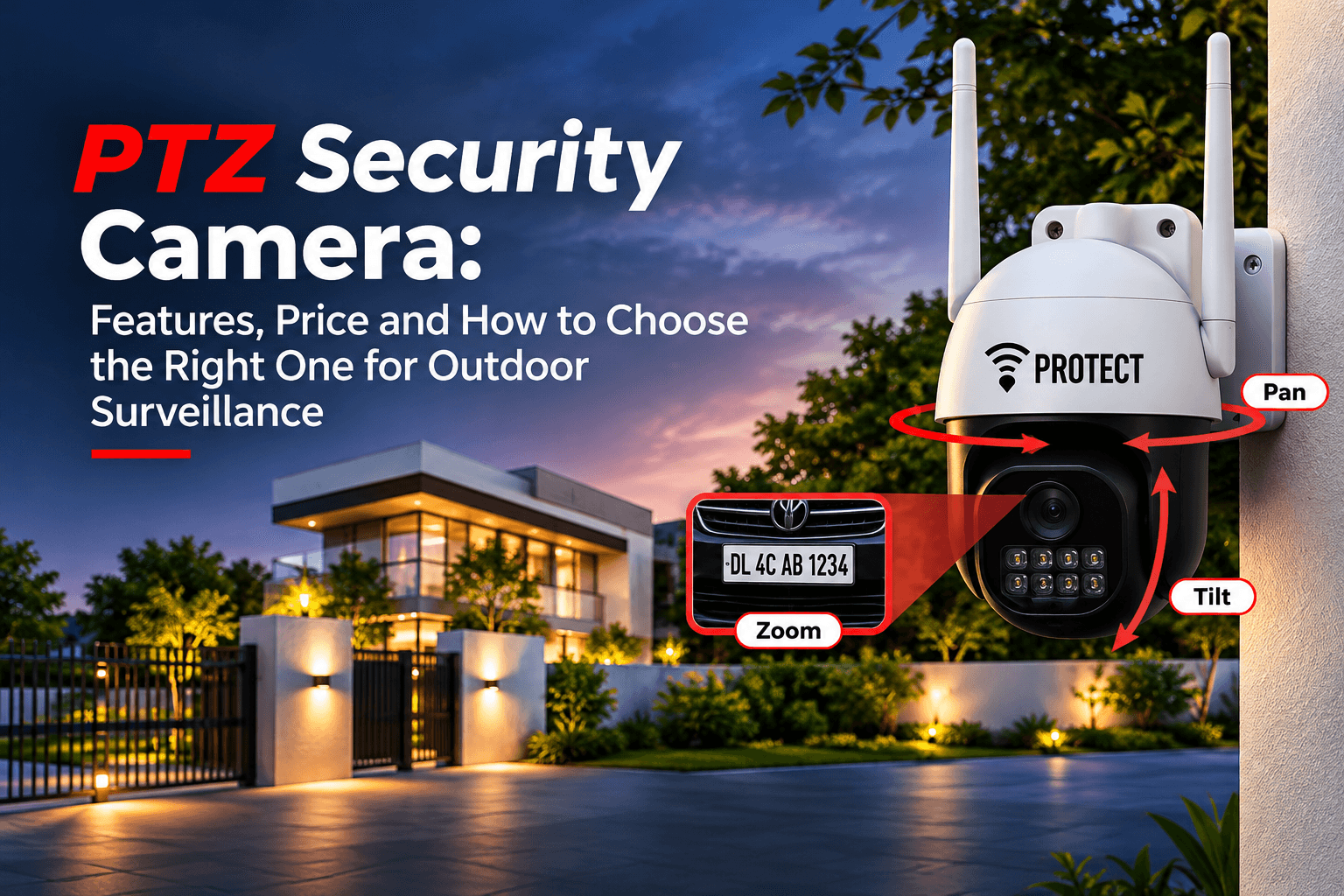

Quick answer: A PTZ security camera is a surveillance camera that can pan (turn left and right), tilt (move up and down) and zoom in on detail, controlled remotely or automatically. One PTZ camera can watch a large outdoor area and zoom in on a face or number plate. It works best alongside fixed cameras, sensors and 24x7 monitoring.*
Walk around a car showroom, a warehouse yard or a big villa compound and count how many fixed cameras it would take to cover every corner. Usually it's a lot. And even then, each one sees a wide, flat picture where a face at the far gate is just a few blurry pixels.
That's the problem a PTZ security camera is built to solve. In this guide, we explain what it is, how a PTZ surveillance camera works, which features actually matter, what drives PTZ camera price, and how to choose one for outdoor use. We also cover the part most buyers miss: who is going to be watching it when something happens.
What is a PTZ security camera?
A PTZ security camera is a pan tilt zoom security camera: a motorised camera that can rotate horizontally, move up and down, and zoom optically, all controlled from a screen, a phone app or pre-set routines. PTZ simply stands for those three movements.
Pan: the camera turns left and right. Many models can rotate all the way round.
Tilt: it looks up and down, from the horizon to the ground right below it.
Zoom: its lens magnifies distant detail without moving the camera closer.
Compare that with the usual dome or bullet camera, which points one way and stays there. A fixed camera answers "what's happening in this spot?" A PTZ camera answers "what's happening anywhere in this area, and who exactly is it?"
That flexibility is why PTZ cameras show up on larger sites: parking lots, warehouse yards, campus gates, construction sites and the grounds of independent houses and villas.
How does a PTZ surveillance camera work?
A PTZ surveillance camera has small motors that move its body and lens on command. It is connected to a recorder and network, usually over a single cable that carries both power and data, and it can be controlled in three main ways.
Manual control. An operator or owner moves the camera from a screen, joystick or app, for example to follow a vehicle across a car park or zoom in on someone at the gate.
Presets and patrol tours. The camera is programmed to visit a set of positions in turn: the main gate for twenty seconds, then the loading bay, then the back fence, and round again. This lets one camera keep an eye on several spots without anyone touching it.
Auto-tracking. On models that support it, the camera detects a moving person or vehicle and follows it automatically, zooming as needed. Newer AI-enabled PTZ cameras can tell people and vehicles apart from swaying trees or stray dogs, which cuts down pointless movement and alerts.
One thing to understand early: a PTZ camera looks at one place at a time. While it's zoomed into the gate, it isn't watching the back wall. That's not a flaw, just how it works, and it's why PTZ cameras are almost always paired with fixed cameras and sensors.
Which PTZ camera features matter for security?
The PTZ camera features that matter most for security are optical zoom, night vision, weather protection and auto-tracking. Spec sheets list dozens of numbers, but these are the ones that decide whether you can actually identify someone at 2 am in the rain.
If you remember only one thing from this table: for security, optical zoom and night vision matter more than the headline megapixel number.
Where does a PTZ camera outdoor setup work best?
A PTZ camera works best outdoors on large, open areas where people or vehicles move around and you need to see detail at a distance. Indoors, in a small flat or a narrow shop, fixed cameras usually do the job better and cost less.
Good places for a PTZ security camera outdoor installation:
Villa and independent house compounds: one camera at a high corner can sweep the gate, driveway, garden and boundary wall.
Parking lots of offices, societies and showrooms: follow a vehicle from the gate to its slot, and zoom on the number plate.
Warehouse and godown yards: keep watch over loading bays, stacked material and the perimeter.
Car showrooms: cover the display yard and the stock parked outside after closing.
Construction sites: a pole-mounted PTZ camera can watch material stores and machinery across a wide, half-built site.
Large retail frontages and campuses: entrances, walkways and open grounds.
Placement matters more than people expect. Mount the camera high enough to see over walls and parked vehicles, but not so high that faces become tops of heads. Keep it clear of tree branches and hoardings, and make sure it's out of easy reach so it can't be turned or covered.
What affects PTZ camera price?
PTZ camera price varies widely, from basic Wi-Fi models meant for homes to heavy-duty units built for industrial sites. Rather than chase a number, it helps to know what you're paying for, so you can compare quotes fairly.
Optical zoom level. The biggest single driver. Stronger zoom with a sharp image costs more.
Night vision range and low-light sensors. Seeing clearly across a dark compound needs better infrared and better sensors.
Weather and vandal protection. Outdoor-rated, sealed housings cost more than indoor units.
Auto-tracking and AI features. Cameras that can tell a person from a dog, and follow them, sit at the higher end.
Resolution and video compression. Higher resolution needs more processing and more storage.
Brand and support. Warranty, local service and spare parts availability all factor in.
Installation. Poles, brackets, cabling runs, height work and power backup can add as much as the camera itself on a large site.
Recording and storage. A recorder with enough hard disk space for the days of footage you need.
Monitoring. Whether alerts will be watched and acted on, not just recorded.
A cheaper camera with weak zoom and poor night vision can end up costing more in the long run, because it records an incident you can't use. When you compare quotes, compare these nine factors side by side, not just the camera's headline price.
How do you choose the best PTZ camera for your property?
The best PTZ camera for your property is the one that can see the specific things you need to see, in your conditions, at night. Start from the site, not the spec sheet.
Walk the site first. Note the longest distance you need to cover, where people and vehicles enter, and which spots matter most: the gate, the cash counter door, the material store.
Then match the camera to it:
Distance to detail: If you need to read a number plate at the far gate, you need strong optical zoom. Ask the installer to show you, on site, what the camera sees at that distance.
Darkness: Check the night view of the actual area, not a brochure image.
Weather: For a ptz security camera outdoor, look for an IP66 or IP67 rating and a sturdy mount.
Movement: If people pass through at odd hours, auto-tracking saves you from missing them.
Power and network: Plan backup power, so the camera keeps running through outages.
Who watches: Decide upfront whether footage will just be recorded, checked on an app, or monitored round the clock.
PTZ vs fixed cameras at a glance
For most properties, the answer isn't PTZ or fixed. It's a few fixed cameras on the spots that must be watched constantly, with one or two PTZ cameras covering the wider area.
Why isn't a PTZ camera enough on its own?
A PTZ camera is excellent at seeing. On its own, it can't decide that something is wrong, and it can't call anyone. Without someone watching, even the sharpest zoom mostly helps after the event, when you're scrolling through footage the next morning.
There's also the coverage gap. While the camera is zoomed into the front gate on its patrol route, an intruder at the back wall may go unseen. Sensors close that gap. A door contact or motion sensor triggers the moment something happens, wherever the camera happens to be pointing, and on many systems the alert can swing the PTZ camera to the right spot.
Put together, the strongest setup works in three layers:
Detection: sensors on doors, windows, shutters and the perimeter, plus fixed and PTZ cameras.
Monitoring: alerts reach trained operators round the clock, who use the live PTZ view to check what's really happening.
Response: if the threat is real, a response is coordinated and the owner is informed.
How VProtect India uses PTZ surveillance
VProtect India, an SIS Group company offering monitored e-surveillance, includes PTZ surveillance within its Detection, Monitoring and Response approach. Cameras work alongside wireless door and window contacts, motion and glass-break sensors, smoke or heat sensors and panic buttons. Alerts go to a 24x7 monitoring centre, where trained operators verify each one before acting, and trained response officers and coordination with emergency services follow when needed.
For a large compound, showroom or yard, that means the PTZ camera isn't just recording. It's giving a trained operator a clear, zoomed-in view at the moment a decision has to be made. See how VProtect monitoring works and the VProtect devices page for details.
Key takeaways
A PTZ security camera can pan, tilt and zoom, so one camera covers a large area and captures detail at a distance.
For security, optical zoom, night vision, weatherproofing and auto-tracking matter more than megapixels.
PTZ camera price depends on zoom, night vision, outdoor protection, AI features, installation and storage.
A PTZ camera sees one spot at a time; pair it with fixed cameras, sensors and 24x7 monitoring.
Frequently asked questions about PTZ security cameras
What is the full form of PTZ camera?
PTZ stands for pan, tilt and zoom. A PTZ camera can turn left and right (pan), move up and down (tilt) and magnify distant detail (zoom), controlled remotely or by pre-set routines. In security, a PTZ camera lets one unit watch a large area and zoom in on a face or number plate.
What is the difference between a PTZ camera and a normal CCTV camera?
A normal CCTV camera, such as a dome or bullet camera, points in one fixed direction. A PTZ security camera can move and zoom, so it covers a much wider area and captures more detail at a distance. The trade-off is that it watches one spot at a time, so it's usually combined with fixed cameras.
What affects PTZ camera price?
PTZ camera price depends mainly on optical zoom level, night vision range, outdoor weather protection, auto-tracking or AI features, resolution and brand. Installation, poles, cabling, recording equipment and monitoring add to the total. Compare quotes on these factors together, not on the camera's price alone.
Is a PTZ camera good for outdoor use?
Yes, PTZ cameras are well suited to outdoor use on large, open areas such as villa compounds, parking lots, warehouse yards, showrooms and construction sites. Choose a model with an IP66 or IP67 weatherproof rating, good infrared night vision, and a mount high enough to see over walls and vehicles.
What is the best PTZ camera for a home?
The best PTZ camera for a home is one that clearly covers your gate, driveway and compound at night, with reliable optical zoom and weather protection. Small flats rarely need PTZ; fixed cameras are usually enough. Independent houses and villas with open grounds benefit most, especially with sensors and monitoring.
Can a PTZ camera track movement automatically?
Many PTZ cameras offer auto-tracking, which detects a moving person or vehicle and follows it, zooming as needed. AI-enabled models can ignore swaying trees or animals. Auto-tracking still covers one area at a time, so sensors and monitoring are needed to catch events elsewhere on the property.
Conclusion: a sharper view, and someone watching it
A PTZ security camera gives you something fixed cameras can't: one camera that can sweep a whole compound and zoom in on the detail that matters. Chosen well, with the right zoom, night vision and weather protection, it's one of the most useful cameras for a large property.
Its real value shows when it's part of a system: sensors to flag what's happening, and trained people watching the live view when it counts. If you'd like to see how PTZ surveillance with 24x7 monitoring could work for your property, you can request a site assessment with VProtect.