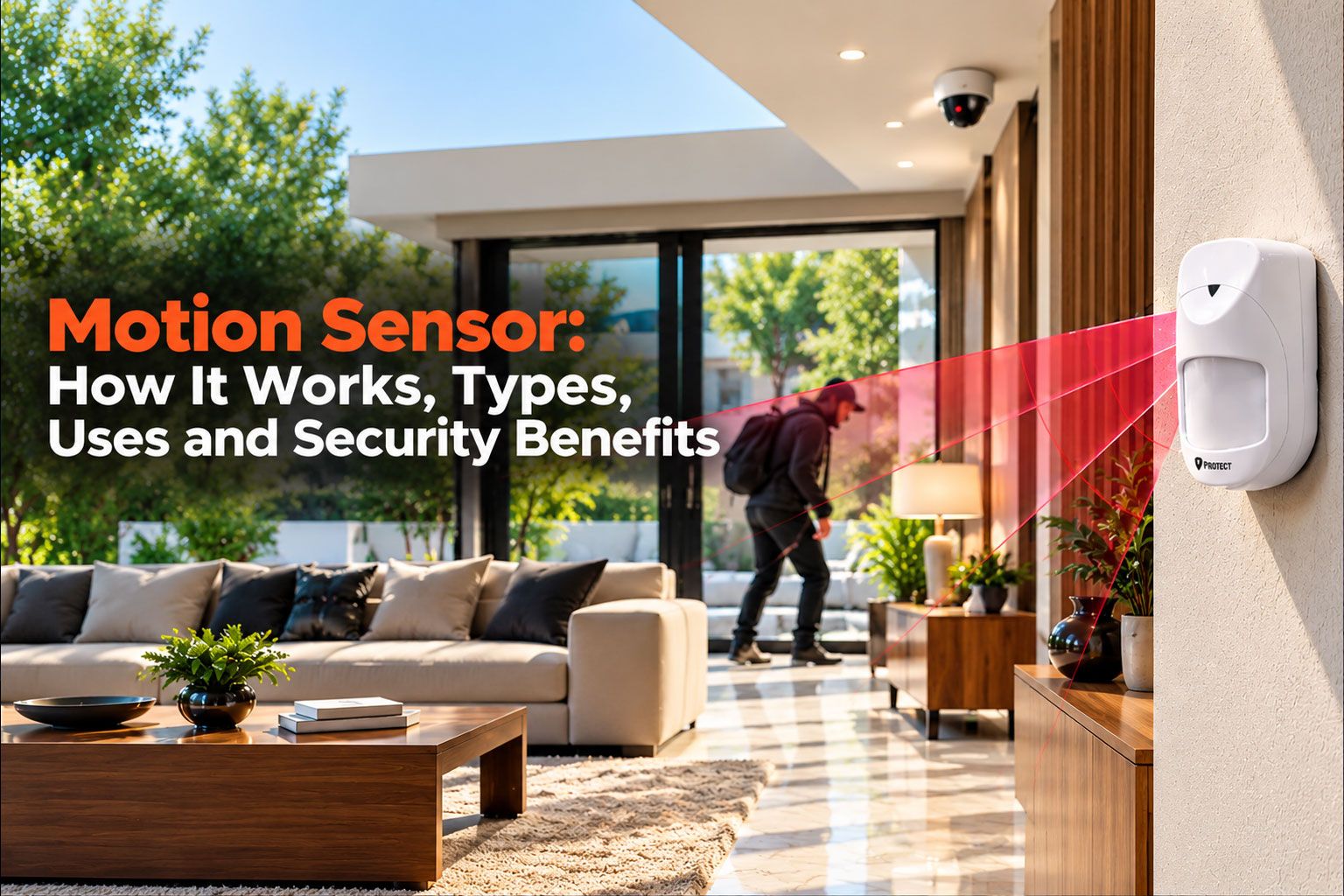

Quick answer:* A motion sensor is a device that detects movement in a defined area and sends a signal when it does. Most home security motion sensors use passive infrared (PIR) technology, which senses changes in body heat. Linked to an alarm or a monitored system, a motion sensor turns unnoticed movement into an alert someone can act on.
You lock the flat, take the overnight train home for Diwali, and spend half the trip wondering if everything is fine. A shop owner pulls the shutter down at 10 pm and hopes the night stays quiet. In both cases, the real gap is simple: nobody knows if someone walks in. A motion sensor closes that gap. It is one of the most common devices in any security system, and also one of the most misunderstood.
This guide explains the motion sensor meaning in plain terms, how a motion sensor works, the main types you will come across, where each one fits, and what a motion sensor can and cannot do for your home or business. By the end, you should be able to judge whether a sensor on its own is enough, or whether you need it connected to monitoring and response.
What is a motion sensor? (Motion sensor meaning)
A motion sensor is a security device that detects movement inside a protected area and reports it to the alarm system. When the system is armed, that report becomes an alert.
In security terms, the motion sensor meaning is simple: someone is moving where no one should be. The sensor cannot tell an intruder from a cousin who has a spare key. It only knows that movement happened while the space was meant to be empty, and what follows depends on what the sensor is connected to.
Most motion sensors in homes and offices are small white units fixed high on a wall, usually in a corner. Modern ones are wireless and battery-powered, and they talk to a central control panel. You have probably walked past dozens of them in bank branches, jewellery showrooms and ATM lobbies without noticing.
How does a motion sensor work?
A motion sensor works by watching its coverage area for a change, most often in body heat, and treating that change as movement. Once the change crosses a set threshold, the sensor sends a trigger signal to the device or control panel it is connected to.
The most common example in homes is the passive infrared (PIR) sensor. Every warm body, including a person, gives off infrared energy, which is invisible heat. A PIR sensor does not emit anything itself; it only "reads" this heat across several zones of its field of view. When a warm object moves from one zone to the next, the heat pattern changes quickly, and the sensor registers motion.
In a security system, how a motion sensor works can be broken into a simple sequence:
1. Sensing: The sensor continuously reads its area for changes in heat.
2. Detection: A change beyond the set sensitivity level is treated as movement.
3. Signal: The sensor sends a wireless or wired signal to the control panel.
4. Action: The panel acts according to its setting, for example sounding a siren, switching on a camera or sending an alert.
5. Verification and response: In a monitored system, a trained operator checks the alert and decides what response is needed.
The first four steps happen in any basic setup. The fifth step is what separates a gadget that makes noise from a security system that gets something done.
Which types of motion sensors are used in home and business security?
Security systems use five main kinds of motion detection: wall-mounted PIR sensors, ceiling-mounted PIR sensors, curtain sensors, outdoor PIR sensors and AI cameras with motion detection. The choice depends less on the technology and more on where the sensor sits and what it has to watch.
Wall-mounted PIR motion sensors
This is the standard indoor sensor and the one most people picture. Fixed in a corner at roughly head height or above, it watches a room in a wide fan shape. It suits living rooms, passages, cabins and cash counters, which is why it forms the backbone of most home security setups.
Ceiling-mounted PIR motion sensors
A ceiling sensor looks straight down and covers a full circle beneath it. Furniture, racks and display units block it less than a wall unit. It works well on open shop floors, car showroom halls and large offices where a corner-mounted sensor would leave gaps.
Curtain motion sensors
A curtain sensor creates a narrow, flat detection field, like an invisible sheet hanging in front of a window, balcony door or shop shutter. Anyone crossing that line triggers it. Because the field is so thin, the family can move freely inside the flat at night while windows and balconies stay armed.
Outdoor PIR motion sensors
Outdoor sensors are sealed against dust, heat and monsoon rain. They cover gardens, terraces, parking areas and warehouse yards, and can flag someone before they reach a door. They need careful aiming so that street traffic, stray dogs and swaying trees do not cause constant alerts.
AI cameras with motion detection
An AI camera detects movement by analysing video, and can tell a person apart from a passing shadow or car headlights. Its real value is visual: whoever checks the alert can see what actually happened. VProtect's AI camera can also flash a light and play a voice warning as a first line of deterrence.
Security motion sensors at a glance
How motion sensors work with other security sensors
A motion sensor is rarely used alone. Door and window contacts guard the perimeter and tell the system the moment an opening is breached. Glass-break sensors catch a shattered pane before anyone climbs through. Motion sensors then cover the inside, in case someone gets past the perimeter another way. A panic button rounds this off by letting someone at home raise an alert manually. Together, these give a layered picture instead of a single point of failure.
Where are motion sensors used at home and in business?
Motion sensors are used wherever movement in an empty or restricted space needs to be noticed: homes when the family is away or asleep, and businesses after closing hours. The device stays the same; the placement and the response plan change.
Uses of a home security motion sensor
Locked flat during travel: A sensor in the living room or passage flags movement while you are away on a hometown trip or a long weekend.
Night-time protection: In an independent house or villa, sensors on the ground floor can stay armed while the family sleeps upstairs.
Entry points: A sensor covering the main door area or balcony catches movement that a door contact alone might miss, for example entry through a window.
Rented flats and PGs: Wireless sensors need no drilling or wiring, which suits tenants and students who may shift every year or two.
Homes with elderly parents: Paired with a panic button, motion detection gives families a clearer picture of activity at home, though it is not a medical device.
Uses in shops, offices and commercial spaces
Jewellery and retail stores: Sensors cover the shop floor and display areas once the shutter is down.
Car showrooms and warehouses: Ceiling-mounted sensors cover large, open floors, while outdoor sensors can watch the yard or parking.
Offices and clinics: Server rooms, cash counters and record rooms can be armed after hours while common areas stay disarmed.
Restaurants: Back-of-house storage and cash areas can be monitored after the last staff member leaves.
If you run a shop or small office, the VProtect solutions for shops and small offices page explains how sensors fit into a setup built for SoHo businesses.
What are the security benefits of a motion sensor?
The main security benefit of a motion sensor is early detection: it tells you about movement inside a space as it happens, often before any damage is done or anything is taken. The other benefits follow from that.
Covers what doors and windows miss: Door contacts only know if a door opened. A motion sensor notices someone already inside, however they got in.
Works in the dark: PIR sensors read heat, not light, so they work in an unlit flat or a shuttered shop.
Fewer blind spots for less: One well-placed sensor can cover a room or a corridor that would otherwise need several devices.
Respects privacy: A motion sensor records no video or audio. It only reports that movement happened, which many families prefer for bedrooms and private areas.
Triggers other devices: A motion alert can switch on a siren, a light or a camera, so each device does more than it would alone.
What a motion sensor cannot do on its own
A standalone motion sensor detects. It does not decide, and it does not respond. If a siren goes off in a locked flat while you are 800 km away, someone still has to check what happened and act. Sensors can also be triggered by pets, pests or a gust from an open window if they are poorly placed or not tuned for the space. No sensor, however good, removes every risk.
This is why the useful question is not just "Do I have a motion sensor?" but "What happens after it detects something?"
Standalone sensor vs monitored sensor
How VProtect India uses motion sensors
VProtect India, an SIS Group company offering monitored e-surveillance, treats the motion sensor as the first link in a chain of Detection, Monitoring and Response. Wireless smart sensors, including motion, door and window, glass-break and smoke or heat sensors, detect activity. Alerts go to a 24x7 monitoring centre, where trained operators check each alert before acting, which helps cut false alarms. If action is needed, trained response officers and coordination with emergency services take over.
Customers also choose which zones are actively monitored, so a bedroom can stay private while the main door and living area stay covered. You can see the full sequence on the how VProtect monitoring works page, or explore the motion sensors and other VProtect devices.
What should you consider before choosing a home security motion sensor?
Before choosing a home security motion sensor, consider the size and layout of the space, whether you have pets, wired or wireless installation, and, most importantly, who will respond when it triggers. A sensor is only as useful as the plan behind it.
Decision checklist
1\. Space and coverage: A 2BHK flat may need sensors only in the living room and passage. A villa or a showroom may need several, covering every route between entry points and valuables.
2\. Pets at home: If you have a dog or cat, ask about pet-tolerant settings or placement that keeps animals out of the detection zone.
3\. Wireless or wired: Wireless sensors suit flats, rented homes and quick installation. Wired sensors suit new construction where cabling is planned in advance.
4\. Indoor or outdoor: Outdoor areas such as gardens and parking need sensors or cameras built for dust, rain and the monsoon.
5\. Connection to monitoring: Decide whether alerts should come only to your phone or also to a monitoring centre that can verify and coordinate a response.
6\. Privacy: Check whether you can choose which rooms or zones are armed at different times.
Placement tips that reduce false alarms
Mount sensors in a corner at the height the manufacturer recommends, so the view covers the whole room.
Point them across the likely path of movement, not straight at a door; PIR sensors detect movement across zones more readily than towards them.
Keep them away from windows that get direct sun, AC vents, heaters, kitchen chimneys and fans.
Avoid aiming at curtains, indoor plants or anything that moves in a breeze.
Test the sensor after installation by walking through the room and checking that alerts arrive as expected.
For a home-specific setup, the VProtect home security solutions page shows how sensors combine with other devices for flats, independent houses and villas.
Frequently asked questions about motion sensors
What is a motion sensor used for?
In security, a motion sensor is used to detect movement inside a home, shop or office while the alarm is armed. It reports that movement to the control panel, which can sound a siren, start a camera or send an alert to you or a monitoring centre for checking and response.
How does a motion sensor work in a home security system?
In a home security system, a motion sensor reads its area for changes, usually in body heat. When it detects movement while armed, it sends a signal to the control panel. The panel can sound a siren, alert your phone or, in a monitored system, notify operators who check the alert before responding.
What types of motion sensors are used in home security?
Home security systems mainly use passive infrared (PIR) motion sensors. These come as wall-mounted and ceiling-mounted units for rooms, curtain sensors for windows and balconies, and weather-sealed outdoor sensors for gardens and parking. AI cameras with motion detection are often added where a visual check of the alert helps.
Can a motion sensor work in the dark?
Yes. A passive infrared motion sensor detects body heat, not light, so it works in complete darkness. This makes it useful in a locked flat at night or a shop with the shutter down. Camera-based motion detection, by contrast, depends on lighting or infrared night vision to see movement clearly.
Will my pet set off a motion sensor?
A pet can set off a motion sensor if it moves through the detection zone. You can reduce this with pet-tolerant settings, careful placement and arming only the zones your pet cannot reach. When planning a system, tell the installer about your pets so coverage can be designed around them.
Is a home security motion sensor worth it?
A home security motion sensor is worth it if your home is often empty or you want to know about movement at night. Its value grows when it is connected to monitoring, because someone then verifies the alert and arranges a response. On its own, it mainly offers awareness.
Does a motion sensor record video?
No. A motion sensor only detects movement and sends a signal; it does not capture video or audio. This makes it a privacy-friendly choice for indoor areas. If you need visual confirmation, a motion sensor can be paired with a camera that records or streams when movement is detected.
Conclusion: know when something moves, and what happens next
A motion sensor is a small device that answers one important question: did something move where nothing should? Understanding how a motion sensor works, and which type suits your space, helps you place it well and trust its alerts.
The bigger decision is what happens after detection. For a home left empty during travel, a shop after closing or an office over the weekend, a sensor linked to monitoring and response gives you more than a notification. It gives you a plan.
If you'd like to see how monitored motion detection could work for your home or business, you can book a security consultation with VProtect and talk through your setup with the team