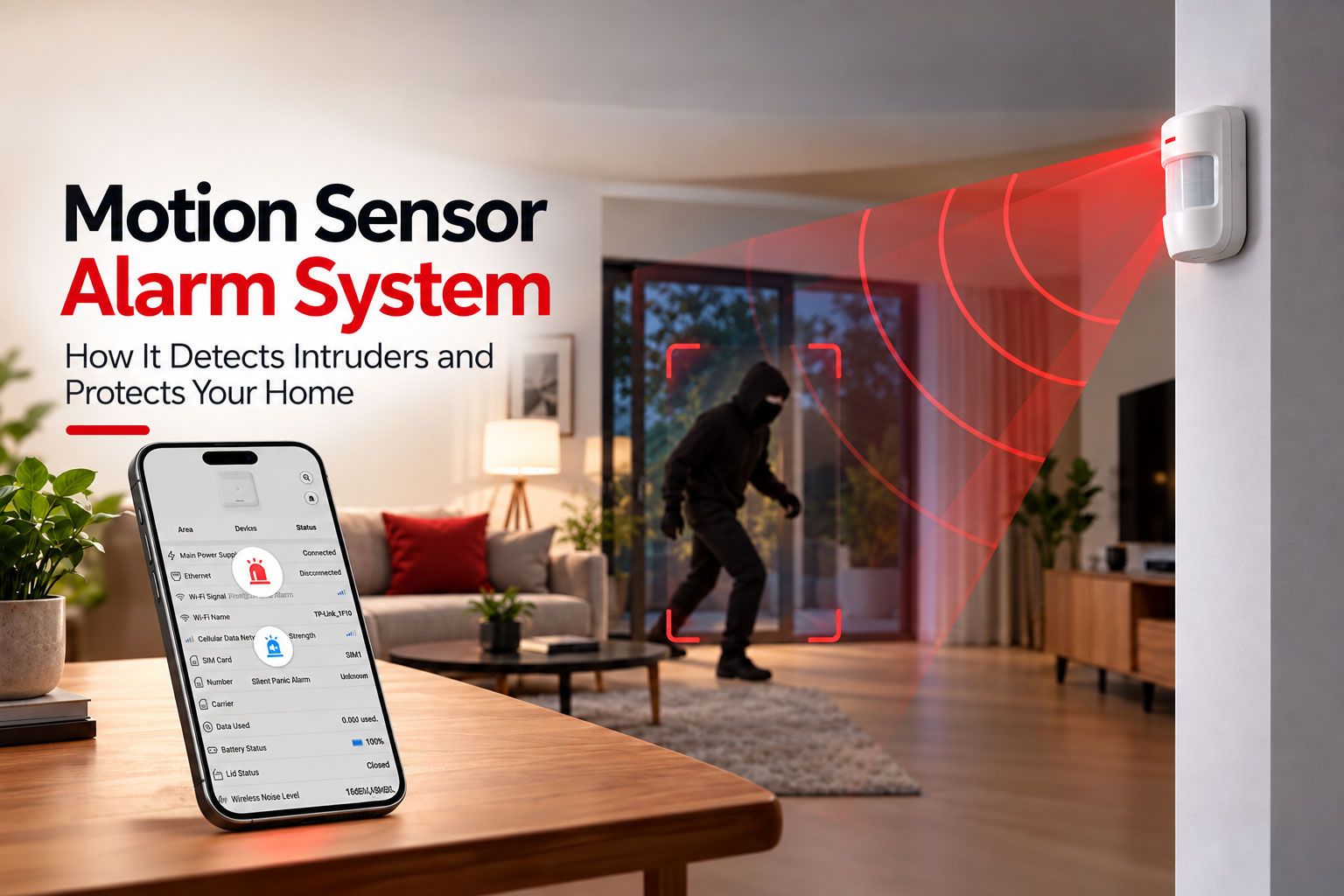

Motion Sensor Alarm System: How It Detects Intruders and Protects Your Home
The living room may look exactly as you left it. The doors may be locked. Nothing may appear unusual from outside. Yet if there is unexpected movement inside a protected area at a time when nobody should be there, that small change matters.
This is the basic idea behind a motion sensor alarm system.
Instead of having someone stare at the camera all day long, a motion sensor is created to look for motion in a certain area and alert when the movement meets the detection parameters of the system.
It sounds simple. In practice, however, the usefulness of a motion sensor depends on much more than the sensor itself.
Where it is placed, what it is expected to detect, how the surrounding area is used and what happens after an alert all influence the protection it provides.
That is why motion detection is best understood as one part of a properly planned home-security system.
Why Motion Detection Matters Inside a Home
Think about a house late at night.
The family is asleep. There should be very little movement in the hallway downstairs. If someone crosses that area, the important fact is not who the person is or what they look like. The important fact is that movement has occurred where it normally should not.
A motion sensor is designed to notice that change.
The same principle applies when a family is away. An empty home has a different pattern of activity from an occupied one. Movement inside a protected room can become an event worth investigating.
This is one reason motion detection remains useful even as home cameras become more common.
A camera provides visual information.
A motion sensor provides an event.
Used together, they can give a security system both an alert and useful context.
How Does a Motion Sensor Detect Someone?
Most residential motion detectors use a technology called Passive Infrared, or PIR.
The sensor does not send out a signal to find a person. Instead, it detects variations in infrared energy within its field of view.
Humans naturally emit heat. When a person moves across the areas monitored by a PIR sensor, the infrared pattern changes. The sensor can recognise that change as movement and communicate the event to the security system.
This is very different from a camera.
A camera captures visual information.
A PIR sensor is primarily concerned with movement and changes in its detection area.
That distinction is useful for homeowners who want security without unnecessary recording of everyday activity.
VProtect's current motion-sensor offering uses wireless smart-sensor technology and describes its motion detector as AI-powered and pet-friendly, with features intended to reduce false triggers.
Where Should a Motion Sensor Be Installed?
There is no universal position that works for every home.
The right location depends on how people move through the property and which areas need protection.
A sensor may be useful in:
- Entrance halls
- Stairways
- Corridors
- Living rooms
- Large open spaces
- Areas connecting important rooms
- Selected outdoor approaches
Consider a hallway leading from the main entrance into the rest of the house.
That route may be more important than simply placing a sensor in the centre of a room.
The same thinking applies outdoors. If the driveway is a meaningful approach to the property, a sensor can be positioned to monitor relevant movement around that area, depending on the sensor's specifications and environmental conditions.
Good sensor placement is therefore less about covering every square metre and more about understanding where movement matters.
Why One Sensor Cannot Do Everything
A motion sensor is not a replacement for every other security device.
Different sensors provide different information.
A door sensor can tell you that a protected door has opened.
A window sensor can identify an unexpected opening.
A motion sensor can identify movement within a protected area.
A smoke or heat detector deals with a completely different type of event.
This is why security planning should begin with the property rather than a shopping list.
For example, if a home has a large glass entrance, a balcony and a long corridor leading to the bedrooms, those areas may require different forms of protection.
Trying to make one motion detector responsible for all of them may create gaps.
A layered system allows each device to do the job it is actually suited for.
Indoor Motion Sensors and Outdoor Motion Sensors Are Not the Same Thing
Inside a home, the environment is relatively predictable.
Outside, it is not.
Sunlight changes. Plants move. Animals pass through. Cars arrive. Weather conditions shift. People may walk past the property.
That is why motion sensor alarms for outside need more careful planning than simply placing an indoor sensor near a gate.
Outdoor motion detection can be useful around:
- Driveways
- Gates
- Garden paths
- Side passages
- External access routes
- Perimeter areas
But the detection zone should be designed around the property's normal activity.
If a sensor covers an area where delivery workers, residents or pets regularly move, unnecessary alerts can quickly become frustrating.
The objective is not to make the sensor react to everything.
It is to make it useful when something relevant happens.
What Causes False Motion Alarms?
False alarms are one of the first concerns homeowners raise when discussing motion sensors.
And the concern is reasonable.
A sensor should not make the family respond to every moving curtain, passing animal or normal activity.
The possibility of unwanted triggers is one reason placement and sensor selection matter so much.
Potential sources can include:
- Pets
- Strong changes in temperature
- Direct sunlight
- Moving objects
- Poor positioning
- Normal movement in an area that has not been configured appropriately
Modern sensors may include technologies designed to reduce some of these unwanted triggers.
VProtect's motion sensor is described as pet-friendly and designed to reduce false triggering.
But technology is only part of the answer.
Correct installation and configuration matter just as much.
A sensor placed correctly can be useful.
The same sensor placed without considering the environment may become a source of unnecessary alerts.
Can a Motion Sensor Work With CCTV?
Yes—and in many homes, the two technologies make more sense together.
They simply do different jobs.
Suppose a camera covers the front entrance.
It may record someone approaching the property.
A motion sensor can detect movement in a protected area and generate an event.
Now the security system has two pieces of information:
Something moved.
And:
Here is the visual context around that area.
This can be especially useful around larger properties, driveways and outdoor approaches.
Where a PTZ camera is part of the setup, it can provide flexible visual coverage of an exterior area such as a driveway. The camera and motion sensor are complementary rather than competing technologies.
A useful security system does not ask which device is better.
It asks what each device can contribute.
What Happens When a Motion Sensor Detects Movement?
This is where a motion sensor alarm for home security becomes part of a wider security process.
Suppose the home is armed and a sensor detects movement in a protected area.
The system generates an alert.
The Alarm provides the immediate warning.
If Professional Monitoring is part of the security setup, the event can then be received and assessed through the monitoring process.
This is important because the homeowner may not always be available.
They could be:
- At work
- Travelling
- Asleep
- Driving
- Away from their phone
A security system should not assume that the homeowner will always be ready to investigate an alert personally.
That is where monitoring and verification become useful.
Professional Monitoring Should Respect the Privacy of the Home
Home security naturally raises a privacy question.
People want to know that their property is protected, but they do not necessarily want somebody watching their family's everyday activities.
VProtect's residential monitoring approach is non-intrusive and privacy-led.
The monitoring process is driven by security events generated by sensors rather than continuous observation of what the family is doing.
In normal circumstances, the system simply remains part of the background.
When a relevant event occurs, the monitoring process becomes involved.
This distinction is important.
Security does not have to mean surveillance of daily life.
It can mean having a process that becomes active when something genuinely requires attention.
What Happens After the Alert Is Received?
Detection alone does not tell you whether an incident is genuine.
A sensor can tell you that movement occurred.
It cannot, by itself, tell you whether the movement was caused by a family member, an authorised visitor or an intruder.
That is why verification matters.
VProtect 24*7 Monitoring center gets an instant alert on their platform, then our trained team makes the call and contacts up to five nominated family members or trusted near-and-dear contacts as part of alert verification.
This provides additional context when the primary homeowner is unavailable.
For example, a parent may know that a family member has returned home late. Another nominated contact may be able to confirm whether activity around the property was expected.
If the event is verified and requires further action, the Response process can then be followed.
This creates a sensible progression:
Detection → Alert → Verification → Response
The important point is that the homeowner does not have to personally interpret every single alert.
Why Rapid Response Completes the Process
A security alert has limited value if nobody can act on it.
Once an event has been assessed and requires action, a response mechanism becomes important.
Depending on the nature of the situation and the security arrangement, this can involve:
- Security response personnel
- On-ground verification
- Rapid response teams
- Police coordination
- Fire-service coordination
- Ambulance or medical coordination
The appropriate action will always depend on what has actually happened.
A suspected intrusion is different from a fire alert.
A panic situation is different from a technical fault.
The response should therefore follow the nature of the verified event rather than treating every alert in exactly the same way.
VProtect's wider security model combines detection, 24/7 monitoring, alert verification and response, with civic coordination forming part of its response ecosystem where applicable.
What Should You Look for in a Motion Sensor Security System?
When comparing motion sensors, detection range is only one part of the decision.
Look at the system around the sensor too.
Sensor suitability
Is the technology appropriate for the room or outdoor area where it will be installed?
Placement
Has someone considered normal movement, entrances and likely routes through the property?
False-alarm control
Does the sensor have features that help reduce unnecessary triggers?
Connectivity
Can the sensor communicate reliably with the central security system?
Device health
Can the system identify battery or device problems before they become a security gap?
Privacy
Does the system provide sensor-based protection without requiring continuous observation?
Monitoring
Is there a professional process for assessing important alerts?
Response
If an event is verified, what happens next?
These questions tell you much more about the usefulness of a security system than a single number printed on a product specification sheet.
Motion Sensors Are About the Right Movement, Not All Movement
A common misconception is that a good sensor should detect everything.
It should not.
A useful security sensor should detect the movement that matters in the area it is protecting.
A bedroom corridor has a different purpose from a driveway.
A living room has different normal activity from an empty warehouse-like storage area.
An outdoor gate has different environmental conditions from an enclosed hallway.
The best results come from matching the sensor, placement and security settings to the property.
That is why professional planning matters.
How VProtect Uses Smart Sensors as Part of Home Protection
VProtect's approach treats smart sensors as one part of a larger home-security system rather than as standalone gadgets.
Depending on the security requirement, the system can use sensors for areas such as doors, windows and movement zones, alongside other devices for fire, heat and emergency protection.
When a relevant event occurs, the system can generate an Alarm and bring it into the Professional Monitoring process.
The monitoring approach remains privacy-led and sensor-driven. It does not require someone to continuously watch the family's everyday activities.
If verification is needed, nominated contacts be reached through the defined process. Where a verified situation requires action, the appropriate Response can follow, including relevant emergency-service coordination where applicable.
That is the practical role of a motion sensor within a larger security setup.
It does not have to do everything.
It has to do its part well—and connect properly with everything around it.
Final Thoughts
A motion sensor may be a small device, but it can play an important role in deciding when a quiet home deserves attention.
The key is not simply installing one and expecting it to protect everything.
Think about where movement matters. Protect those areas with the right sensors. Use cameras where visual information adds value. Make sure the Alarm is connected to a reliable process. And, if Professional Monitoring is part of the setup, understand how alerts are verified and what Response looks like afterwards.
That is what turns motion detection into meaningful home protection.
VProtect combines smart sensor-based detection with Alarm, privacy-led Professional Monitoring, verification and Response to create a security process designed around real events—not continuous observation of everyday life.
VProtect — Alarm. Monitoring. Response.
If you are considering a motion sensor alarm system for your home, speak with VProtect about the areas that need protection and the right combination of security layers for your property.
FAQ’s (Frequently Asked Questions) How does a motion sensor alarm system work?
A motion sensor is used to monitor a designated area and detect any change that indicates movement. If the detected activity matches the criteria configured for the system, alarm can be generated. In a professionally monitored setup, that event can then be assessed and verified before the appropriate Response is initiated.
Where is a motion sensor alarm for home use most effective?
Motion sensors are commonly useful in areas where unexpected movement would be significant, such as entrance routes, hallways, stairways and selected rooms. The ideal location depends on the property's layout and normal activity, so placement should be based on the movement paths that actually matter.
Can motion sensor alarms be used outside?
Yes. Motion sensor alarms for outside can be used around suitable areas such as driveways, gates, gardens and external access routes. Outdoor installation requires more careful planning because sunlight, weather, vegetation, animals and normal movement can affect detection.
Will a motion sensor detect pets?
Some motion sensors are designed with pet-friendly detection features to reduce unnecessary triggers caused by pets. VProtect describes its motion sensor as pet-friendly and designed to reduce false triggering. Actual performance depends on the sensor, installation and configuration.
Is a motion sensor better than a CCTV camera?
They serve different purposes. A motion sensor is designed to detect movement and generate a security event, while a camera provides visual information. Using the two together can provide both an alert and additional context about what is happening.
Does a motion sensor continuously record activity?
A motion sensor is not really for continuous visual recording but for detecting movement. VProtect’s residential monitoring is privacy led and sensor driven, monitoring security events, not ongoing household activity.
What happens when a motion sensor triggers an Alarm?
The triggered event can enter the security system's monitoring and verification process. With VProtect, verification can involve contacting up to five nominated family members or trusted contacts. If the event is confirmed and requires action, the appropriate Response process can follow.
Can motion sensors protect a driveway?
A suitable outdoor motion sensor can add another detection layer around a driveway or access route. It can also complement a PTZ or fixed camera, with the sensor identifying movement and the camera providing visual information. The right setup depends on the property's layout and surrounding environment.
Is a motion sensor alarm enough to protect an entire home?
A motion sensor is one part of a broader security system. Effective protection may combine motion sensors with door and window sensors, cameras, Alarm, Professional Monitoring, verification and Response. The right combination depends on the home's specific risks and layout.