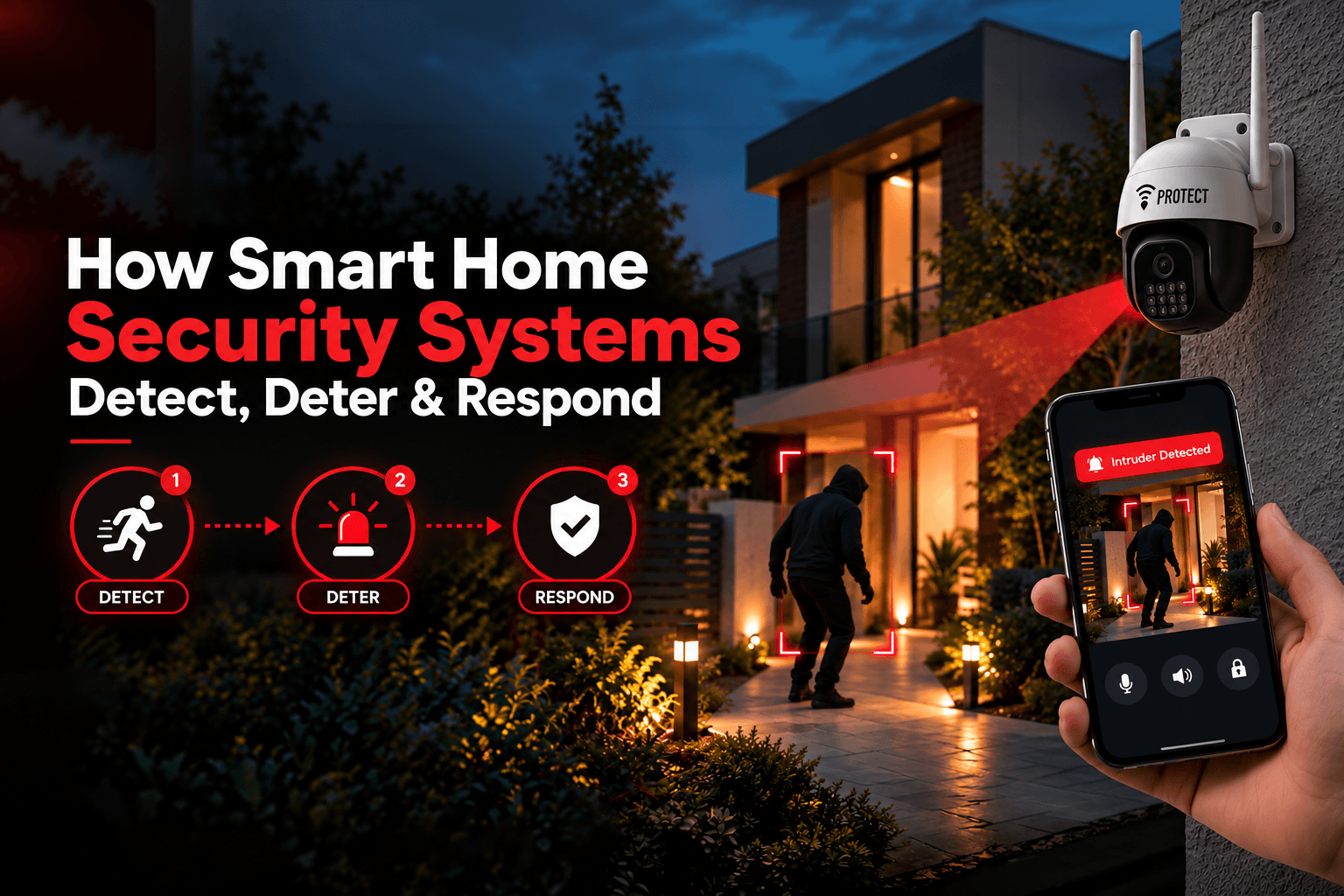

How Smart Home Security Systems Detect, Deter and Respond to Threats
A security camera can show you that someone is standing outside your gate.
A truly connected security system should be able to do more.
It should recognise that something unusual is happening, raise an alert, discourage the person from going further and make sure the situation receives attention if the threat continues.
That difference is changing the way homeowners think about security.
A modern Smart Home Security System is no longer simply a collection of cameras and alarms. It brings together sensors, intelligent cameras, sirens, connectivity, monitoring and response so that different parts of the security setup work together.
The idea is straightforward: detect the threat early, deter it where possible and respond when intervention is required.
For families, that creates a very different kind of protection from traditional CCTV.
What Is Smart Home Security System Technology?
If you are wondering what is smart home security system technology, the simplest answer is this:
A smart home security system is a connected network of security devices that can detect unusual activity around a home, generate alerts and initiate appropriate actions.
Depending on the setup, it may include:
- motion sensors
- door and window sensors
- AI-enabled cameras
- smoke and heat detectors
- external sirens
- panic buttons
- control panels
- keyfobs
- mobile connectivity
- professional monitoring
- on-ground response support
The important word here is connected.
A standalone CCTV camera may record somebody trying to enter a home. A connected security setup can detect movement, confirm that a protected entry point has been disturbed, trigger an alarm and send the event for verification.
That turns security from a passive recording function into an active process.
Why Cameras Alone May Not Be Enough
CCTV has an important role in home protection, but cameras have limitations when they operate independently.
Imagine a camera installed outside a villa.
At 2:30 in the morning, someone approaches a side window. The camera records the person clearly. Unless someone happens to be watching the feed at that moment, however, nothing may happen immediately.
The homeowner may discover the recording the next morning.
The footage is useful as evidence. It was not necessarily useful in stopping the event.
A modern Smart Home Security System tries to close that gap.
Instead of depending entirely on somebody noticing a video feed, different devices around the property watch for specific events.
A motion sensor may identify unexpected movement.
A window sensor may detect an attempted opening.
An intelligent camera may provide visual context.
A siren or warning may discourage the intruder.
A monitoring team may review the alert.
If the threat is genuine, an appropriate response can follow.
The value is not in one device. It comes from the sequence.
The Three Jobs of Modern Home Security
Almost every useful home security function can be understood through three stages:
Detect. Deter. Respond.
There is often a fourth layer—monitoring and verification—between detection and response, but the overall security journey remains easy to understand.
Detection asks:
Is something happening that should not be happening?
Deterrence asks:
Can we discourage the threat from continuing?
Response asks:
If the situation continues, who is going to act?
A good security system should have a clear answer to all three.
1. Detect: Spotting a Threat as Early as Possible
Early detection matters because the earlier an incident is identified, the more opportunity there is to prevent it from becoming serious.
Modern home security systems can use different types of sensors depending on the part of the property being protected.
Motion Sensors
Motion sensors can identify movement in selected areas around or inside a home.
They may be useful near entrances, passages, terraces, garages or other places where unexpected movement deserves attention.
More advanced systems can also use intelligent detection to reduce unnecessary triggers and distinguish relevant movement from routine environmental activity.
Door and Window Sensors
Doors and windows are obvious entry points.
A contact sensor can recognise when a protected door or window is opened while the security system is armed.
Some systems also use shock or vibration detection to identify attempted forced entry before the door or window is fully opened.
AI-Enabled Cameras
Cameras add visual context.
Rather than only recording continuously, intelligent cameras can work alongside sensors and analytics to help identify events that need attention.
This is particularly useful near gates, driveways, balconies and perimeter areas.
Fire and Heat Sensors
Not every home emergency involves an intruder.
Smoke, fire and abnormal heat can become dangerous very quickly.
A connected security ecosystem may therefore include smoke or heat detection so that fire-related events can also trigger alerts.
Panic and SOS Devices
Sometimes the person inside the home identifies the threat first.
A panic button, keyfob or similar device gives residents a direct way to raise an emergency alert.
This can be particularly relevant for elderly family members, people living alone or situations where immediate assistance is required.
VProtect's current home security ecosystem combines smart wireless sensors, AI-enabled cameras and alarm devices with round-the-clock monitoring and alert verification.
Detection Should Start Before the Intruder Gets Inside
One of the biggest changes in modern security thinking is the move towards perimeter protection.
Older systems often reacted only after somebody entered the home.
By then, the situation had already escalated.
A more proactive setup attempts to identify suspicious activity around vulnerable points before an intruder gets deep inside the property.
Consider someone approaching a villa boundary late at night.
If security starts only when the front door opens, several opportunities for intervention have already been lost.
But if movement around the boundary is detected earlier, the system has more time to raise an alert, activate deterrence and draw attention to the event.
This is why proper device placement matters as much as the devices themselves.
Every home has a different layout.
A ground-floor apartment, independent villa and multi-storey house should not necessarily use identical security plans.
2. Deter: Making the Intruder Think Twice
Detection tells the system that something is happening.
Deterrence tries to stop it from going any further.
This part of security is sometimes underestimated.
People often assume the main job of a security system is catching an intruder. In reality, preventing an intrusion from escalating is usually a better outcome.
Deterrence can take several forms.
Visible Security Signage
Visible indications that a property is professionally protected can discourage opportunistic intrusion.
An intruder looking for an easy target may reconsider when it is obvious that a home is actively monitored.
External Sirens
A loud alarm immediately changes the situation.
The intruder knows that the activity has been detected.
Neighbours may become aware.
The element of secrecy disappears.
In many situations, that alone can be enough to make someone retreat.
Lights and Camera-Based Warnings
Certain intelligent camera systems can activate lights or audible warnings after detecting suspicious activity.
That creates an immediate signal:
You have been noticed.
This is very different from a camera silently recording from a corner.
Active Intervention
Where professional monitoring is involved, verified incidents can move beyond automated alarms into human-led intervention or escalation.
VProtect describes deterrence as one layer of its security framework, using measures such as visible signage, sirens, AI cameras and audio alerts to discourage threats before they progress.
Why Deterrence Is Better Than Depending on Evidence Later
Suppose two homes have cameras.
At the first home, a camera records an intruder entering the property. The homeowner reviews the footage later.
At the second home, suspicious activity triggers a sensor, the system activates a warning and the intruder leaves.
Both homes had surveillance.
Only one had an active deterrence process.
That distinction matters.
Evidence is valuable after an incident.
Deterrence has the potential to change what happens during the incident.
The best security outcome is often the event that never progresses beyond an attempted intrusion.
3. Monitor: Making Sure an Alert Is Actually Seen
This is where many consumer security setups develop a weak point.
A sensor triggers.
The homeowner receives a phone notification.
But the homeowner is asleep.
Or on a flight.
Or in a meeting.
Or driving.
Or has the phone on silent.
A notification is not the same thing as a response.
That is why professional monitoring can add an important layer to a Smart Home Security System.
Instead of every event depending entirely on the homeowner being available, alerts can be routed to a monitoring centre for assessment.
VProtect states that its monitoring approach provides 24/7 coverage, with trained operators assessing triggered events and verifying alerts before escalation.
Why Alert Verification Matters
Not every alarm means there is a burglar.
A family member may arrive unexpectedly.
A worker may enter a designated area.
A harmless event may trigger a sensor.
Automatically treating every alert as a serious emergency can create unnecessary disruption.
Verification provides context.
The monitoring team can examine available information and determine whether the event appears genuine before moving to the next stage.
This has two benefits.
First, it can reduce unnecessary responses.
Second, genuine incidents can be escalated with greater confidence.
Modern security therefore works best when automation and human judgement support each other.
Technology notices quickly.
People understand context.
4. Respond: What Happens After a Real Threat Is Confirmed?
This is arguably the most important question to ask when evaluating home security:
What happens after the alarm goes off?
Many systems are very good at detecting.
Some are good at notifying.
Far fewer have a clear real-world response layer.
If the homeowner is 500 kilometres away and receives a burglary alert at midnight, being able to view the camera feed may confirm that something is wrong.
But then what?
A complete security process needs a defined next step.
Depending on the provider and incident, response can include:
- contacting the homeowner
- activating deterrent devices
- escalating to trained security personnel
- dispatching local response officers
- coordinating police support
- seeking fire assistance
- arranging medical emergency support
VProtect's published security process describes an alert being detected, verified by its monitoring operation and then escalated for appropriate response. Its system also incorporates quick mobilisation and coordination with police, fire or medical services where necessary.
A Realistic Example: An Attempted Break-In at Night
Consider an independent home at 1:45 a.m.
Everyone inside is asleep.
Someone enters the front boundary and moves towards a side door.
Here is how a connected security setup could work.
Step 1: Movement is detected
A sensor identifies unexpected activity within a protected area.
Step 2: The system raises an alert
The event is immediately transmitted through the security system.
Step 3: Deterrence activates
A siren, light or voice warning makes the individual aware that the property is protected.
Step 4: The event is reviewed
A monitoring professional assesses the available security information.
Step 5: The threat is verified
If the activity appears to be a genuine intrusion attempt, the incident moves into the response process.
Step 6: Assistance is mobilised
The appropriate response is initiated based on the nature and severity of the situation.
Notice that no single piece of technology is responsible for the whole process.
The sensor detects.
The deterrent disrupts.
Monitoring verifies.
Response acts.
That is what makes a connected security ecosystem more useful than simply adding more cameras.
What Is a Smart Home Security Alarm System?
A smart home security alarm system connects alarm devices with sensors, cameras, communication technology and, in some cases, professional monitoring.
Traditional alarms mainly made noise when a sensor was triggered.
Smart alarms can do more.
They can send instant alerts, identify which device was triggered, communicate with a central control hub, provide remote status information and connect the event to a monitoring or response process.
This makes the alarm part of a broader security network rather than an isolated siren on the wall.
What Happens If the Internet Goes Down?
Connectivity is an important consideration when choosing a security setup.
A system that relies on only one internet connection may become vulnerable if that connection is interrupted.
For this reason, homeowners should ask whether the control system offers alternate communication options and backup power.
VProtect lists LAN and GSM connectivity among its device capabilities and states that its control hub performs device-health monitoring to help maintain system availability.
The broader principle is simple:
A security system should be designed for the moment when things go wrong, not only when everything is working perfectly.
Why Device Health Is Part of Home Security
Imagine having a motion sensor near a back entrance.
It was installed six months ago.
It stopped communicating three days ago.
Nobody noticed.
Technically, the house still “has a security system.” In reality, it now has a blind spot.
This is why device-health monitoring is useful.
A smart setup should ideally make it easier to identify:
- device communication problems
- low battery levels
- tampering
- connectivity interruptions
- sensor faults
Security cannot protect an area effectively if the devices responsible for that area are not functioning.
VProtect's current device offering highlights real-time health checks, backup power, instant alerts and tamper protection as part of its connected system.
Choosing a Smart Home Security System in India
The requirements of a smart home security system India homeowners choose should reflect local property layouts and everyday realities.
Independent homes may need perimeter and gate coverage.
Apartments may place greater emphasis on the main entrance, panic alerts and fire detection.
Homes with elderly parents may benefit from easy-to-use SOS devices.
Families that travel often may care more about professional monitoring and remote visibility.
Power backup and dual connectivity can also matter because a security system should remain useful during disruptions.
Before choosing a provider, ask:
- Which parts of my property are actually vulnerable?
- Does the system detect intrusion before someone gets inside?
- What happens when an alarm is triggered?
- Is somebody monitoring alerts when I cannot?
- How are false alarms verified?
- Is there an on-ground response capability?
- What happens if internet connectivity fails?
- Does the system monitor the health of its own devices?
- Can fire, medical and panic situations also be handled?
- How is my privacy protected?
These questions are more important than simply comparing camera megapixels.
Privacy Matters in Smart Security
More technology does not automatically mean better security.
A system also needs to respect the people living inside the property.
Homeowners should understand what is monitored, when cameras are active, who has access to information and how alerts are reviewed.
VProtect describes its residential security approach as privacy-focused, allowing users to define protection zones while monitoring teams act on triggered security events rather than unnecessarily interfering with everyday life.
That balance matters.
People want their homes protected.
They do not want to feel watched inside them.
Smart Security Is Also About Fire, Medical and Panic Emergencies
Burglary receives most of the attention in conversations about home security, but families face other emergencies too.
A fire can begin while everyone is asleep.
An elderly parent may require urgent assistance.
Someone inside the home may feel threatened and need a discreet way to call for help.
That is why a broader Smart Home Security System can include more than intrusion detection.
Smoke and heat detectors can raise fire alerts.
Panic buttons can create immediate SOS signals.
A monitored security environment can route different types of incidents towards the appropriate response.
VProtect's residential security offering publicly lists intrusion, fire, medical emergencies and panic situations among the threats its connected system is designed to address.
Smart Security vs Traditional CCTV
The difference can be summarised simply:
Traditional CCTVSmart Home Security SystemPrimarily records videoDetects and communicates security eventsOften reviewed after an incidentDesigned to identify threats while they developUsually camera-focusedCombines cameras, sensors and alarmsMay depend on homeowner observationCan include professional monitoringProvides evidenceSupports detection, deterrence and responseLimited emergency integrationCan include intrusion, panic, fire and other alerts
CCTV is still valuable.
The point is not that cameras have become unnecessary.
The point is that cameras become much more useful when they are connected to detection and action.
Frequently Asked Questions
What is smart home security system technology?
A smart home security system is a connected setup of sensors, cameras, alarms and control devices designed to detect unusual activity and generate security alerts. More advanced systems can also include professional monitoring, verification and on-ground response.
How does a Smart Home Security System detect intruders?
It can detect movement or attempted access on protected areas with the use of motion sensors, door contacts, window sensors, shock sensors and smart cameras.
What is a smart home security alarm system?
A smart home security alarm system connects alarms with sensors and communication technology. When a security event occurs, the system can trigger an alarm, send an alert and potentially connect the incident to professional monitoring.
Is a smart home security system better than CCTV?
They serve different purposes. CCTV is primarily useful for surveillance and evidence. A connected security system goes further by integrating detection, alarms, monitoring and response.
Can smart home security work when I am travelling?
Yes. Connected systems can monitor the property when the residents are away from home. Professional monitoring means that triggered alerts will be dealt with even if the homeowner cannot check their phone at that time.
What to look for in a smart home security system India provider?
Look beyond camera specifications. Consider intrusion detection, professional monitoring, alert verification, backup connectivity, device-health checks, privacy safeguards and the provider's ability to respond when a genuine threat is confirmed.
Can a smart home security system detect fire?
When combined with compatible smoke or heat detectors, the system can detect fire conditions and provide an emergency warning.
Can a smart security system reduce false alarms?
Intelligent detection and professional verification can help reduce unnecessary escalation, although no security system can eliminate every false alarm.
The Best Security System Is the One That Knows What Happens Next
Security does not end when an alarm rings.
That is where it begins.
A useful modern security system should know how to move from an unusual event to a meaningful action.
Detect the threat.
Recognise the problem as early as possible.
Deter the threat.
Make it clear that the property is protected and the activity has been noticed.
Verify the threat.
Use technology and human judgement to understand whether the event requires intervention.
Respond to the threat.
Make sure a genuine emergency does not end as another notification sitting unread on a phone.
This is the real evolution of home security.
The question is no longer simply, “Do I have cameras?”
The better question is:
If something happens at my home tonight, what will my security system actually do about it?
That is where connected security makes the difference.