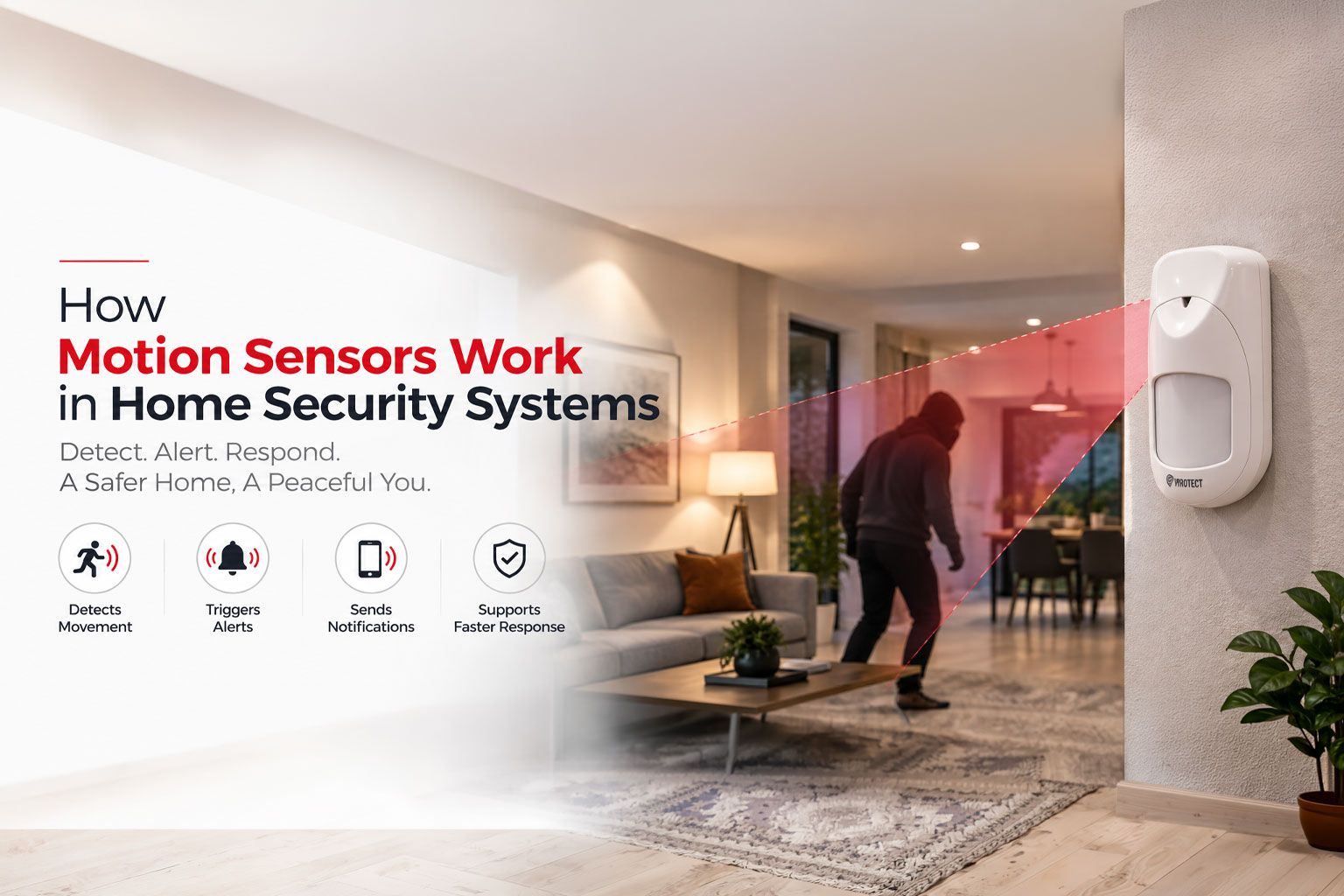

A professional home security system should do more than record an intrusion after it happens. It should detect suspicious activity early, transmit the event reliably and move a genuine alarm into a defined monitoring and response process. Interior motion detection is one of the technologies used to create that protection layer.
A motion detector sensor identifies movement within a defined field of view and sends an alarm event when its detection criteria are met. In residential security, passive infrared (PIR) technology is widely used because it recognises changes in infrared energy as a person moves through a protected area.
Reliable performance, however, depends on much more than the sensor itself. Detector technology, mounting position, coverage geometry, pets, sunlight, HVAC airflow, room temperature, communication reliability and alarm handling can all affect the outcome.
For that reason, a professional motion sensor alarm should be evaluated as part of a complete intrusion-security chain:
Detect → Transmit → Monitor → Verify → Respond
Quick Answer: How Does a Motion Sensor Detect Movement?
Most residential PIR detectors do not transmit a beam across the room. They passively monitor infrared energy within a defined coverage pattern.
Human bodies emit infrared radiation. When a person moves across the detector's zones, that infrared pattern changes.
Electronics inside the detector analyse the change and determine whether it matches the programmed alarm criteria. If it does, the detector sends an event to the alarm control panel.
The panel may then:
Activate an internal or external siren
Generate an app notification
Register the event in the security system
Transmit the alert to a professional monitoring centre
Initiate an alarm-verification workflow
The detector identifies the event.
The wider security system determines what happens next.
The Role of Motion Detection in Layered Home Security
Professional residential security is usually designed in layers.
Perimeter devices such as door contacts, window contacts and shock sensors protect likely entry points. Interior detectors identify movement within selected areas after the system is armed. Cameras may provide visual information for verification or evidence, depending on the security design.
For example, a door contact can report that a protected entrance has opened. A motion detector alarm can then indicate that movement is occurring inside the premises.
If visual verification is configured, a camera may help the monitoring team understand what caused the alert.
The objective is not to install the maximum possible number of sensors.
The objective is to create appropriate and overlapping detection around realistic intrusion routes.
How Passive Infrared Motion Detection Works
PIR stands for Passive Infrared.
The word passive is important. The detector does not normally illuminate the room with infrared energy. Instead, it monitors infrared radiation already present within its field of view.
1. The Sensor Monitors Infrared Energy
People, animals, furniture and building surfaces emit infrared radiation according to their temperature.
The PIR sensing element responds to changes in that thermal environment.
It is not identifying a person.
It is analysing a changing infrared pattern
2. Optics Create Detection Zones
The detector's lens divides its field of view into multiple detection zones.
When a person moves across those zones, the detector observes a sequence of changing infrared conditions.
This detection geometry is important because a person moving across several zones generally creates a stronger changing pattern than someone moving directly toward the detector along a narrow path.
3. Signal Processing Makes the Alarm Decision
A professional detector should not generate an intrusion alarm simply because a single infrared reading changes.
Modern detectors can evaluate characteristics such as:
Signal amplitude
Duration
Timing
Polarity
Temperature conditions
Repeated movement patterns
Bosch describes PIR detection as sensing infrared energy emitted by a human body as it moves through the detector's field of view. Its intrusion detectors also use signal-processing and temperature-compensation techniques to improve detection performance and reduce unwanted alarms.
If the activity satisfies the device's alarm criteria, the motion sensor detector alarm sends an event to the control panel.
PIR vs Microwave vs Dual-Technology Motion Detection
Not all motion-detection technologies work according to the same physical principle.
Dual-technology detectors can be useful in environments where one sensing method alone may be exposed to challenging conditions.
Bosch describes dual-technology designs in which PIR and microwave data are processed independently and an alarm decision can require agreement between both technologies.
However, this does not mean dual-technology detection is automatically necessary in every room.
Sensor selection should reflect:
The property's layout
Environmental conditions
Expected intrusion route
Pets
Required detection range
False-alarm risk
Motion Sensors Are Not Security Cameras
A standard PIR detector does not recognise:
Faces
Clothing
Identity
Behaviour
Objects being carried
It reports a motion event based on changing infrared energy within its coverage pattern.
A home motion detector can therefore tell the alarm system that activity occurred in a protected zone.
A camera performs a different function: it can provide visual information about what caused that activity.
Where a system supports alarm verification, the technologies can complement each other.
Motion sensor: provides the trigger.
Camera: can provide additional context.
This distinction is important when designing a privacy-conscious home security system.
What Happens After a Motion Detector Is Triggered?
Detection is only the first stage of a professional security process.
VProtect describes a similar process in its current residential security model. Its system sends triggered events to an Alarm Receiving Center, where trained monitoring personnel assess the event before an appropriate response is initiated. VProtect positions this within a wider deterrence, detection, monitoring and response framework.
This is why a professional motion detector security alarm should not be evaluated only by detection range.
The alarm-handling infrastructure behind the detector matters just as much.
Why Motion Detectors Can Produce Nuisance Alarms
Nuisance alarms are often caused by poor positioning, unsuitable sensitivity or environmental conditions rather than by motion detection itself.
Common causes can include:
Pets entering a non-pet-tolerant detection zone
Direct sunlight
Rapidly changing heat sources
Heating or air-conditioning airflow
Moving curtains
Incorrect mounting height
Incorrect detector angle
Insects entering the detector
Coverage extending into unintended areas
Professional detectors can reduce some of these risks through better optics, signal processing, temperature compensation and pet-tolerance logic.
Bosch's professional intrusion-detector documentation describes features such as sealed optical chambers, dynamic temperature compensation and signal analysis designed to improve false-alarm immunity.
Advanced electronics, however, cannot fully compensate for poor installation.
What Does “Pet-Friendly” Motion Detection Actually Mean?
A pet-friendly detector does not visually recognise an animal and decide to ignore it.
Instead, its optics, detection-zone design and processing logic are configured to reduce alarms caused by animals under specified conditions.
Performance still depends on:
Pet size
Pet behaviour
Detector mounting height
Furniture placement
Sensitivity settings
Access to elevated surfaces
For homes with animals, motion sensors for home should therefore be selected around the actual household environment rather than the phrase “pet-friendly” alone.
VProtect's current residential security material describes its wireless motion detector as pet-friendly and integrated into its monitored alarm system.
Where Should Motion Sensors Be Installed?
Detector placement should be based on security risk and likely movement paths—not visual symmetry.
Useful locations can include:
Entrance Transition Areas
Hallways or passages connecting an entrance with the rest of the home can provide useful coverage because an intruder is likely to cross the detector's field of view.
Staircases and Landings
Staircases connect different areas of a property and can create strategically important interior detection points.
Living Areas With Multiple Entry Routes
Where several doors or windows lead into one room, a correctly positioned detector can provide secondary detection after a perimeter breach.
Routes to High-Value Areas
Access routes leading toward a home office, storage area, safe or other valuable assets may justify dedicated detection depending on the risk assessment.
Installation should also consider:
Mounting height
Field of view
Detector range
Furniture
Windows
HVAC outlets
Pets
Likely walking direction
A home motion detector should be positioned to protect the identified risk—not simply to cover the largest possible floor area.
Why Cross-Traffic Matters
PIR detectors typically perform effectively when a person moves across their detection zones.
This is known as cross-traffic.
If a detector is positioned directly in line with an expected intrusion route, a person may move toward it without crossing as many detection zones.
Professional placement therefore considers both:
1. The detector's coverage pattern
2. The direction in which an intruder is likely to move
This is why sensor placement requires more thought than simply mounting a device in the corner of a room.
Motion Sensor Alarm vs Door Contact vs Shock Sensor
These devices are complementary, not interchangeable.
A door contact may indicate that an entrance has opened.
A motion detector sensor can indicate that movement is now occurring inside.
A camera can potentially provide visual context.
Together, these events can provide substantially more information to a professional monitoring operation than one device alone.
Why Communication Reliability Matters
A detector that correctly identifies an intruder but cannot communicate the event has not completed its security function.
Wireless detectors normally communicate with a central control hub or panel.
The control system then uses the property's available communications infrastructure to forward the alarm.
VProtect states that its connected security infrastructure includes LAN and GSM connectivity, backup power, real-time health checks, instant alerts and tamper protection. Its control hub manages alerts and system-health information.
For homeowners evaluating a motion detector security alarm, important questions therefore include:
How does the detector communicate with the control panel?
What happens if communication is lost?
Is a low battery reported?
Does the control panel have backup connectivity?
What happens during a power failure?
Is a device fault visible to the security system?
Detection range alone does not answer these questions.
Device Supervision and Tamper Detection
Professional alarm infrastructure should provide visibility into technical problems as well as intrusion events.
Depending on the system and detector, useful supervisory conditions may include:
Low battery
Communication loss
Detector tamper
Device offline status
Control-panel mains failure
Backup-power condition
More advanced detectors may also use anti-mask technology to identify attempts to cover or obstruct the sensing element.
Bosch's professional detector range, for example, includes anti-mask capability and cover/wall tamper switches that can report interference to the control panel.
The important principle is that a security system should not only know:
“Movement was detected.”
It should also be capable, where supported, of recognising:
“This detector may no longer be operating normally.”
How to Evaluate Motion Sensors for Home Security
When comparing motion sensors for home, homeowners should look beyond price, advertised range and smartphone features.
Ask the security provider:
1. What sensing technology is being proposed?
2. Why is that technology appropriate for this particular room?
3. What is the detector's actual coverage pattern?
4. Is the detector suitable for pets in the property?
5. How are nuisance alarms reduced?
6. Is communication with the control panel supervised?
7. What happens if the detector loses communication or battery power?
8. Does an alarm reach professional monitoring?
9. How is the intrusion event verified?
10. What happens after a genuine threat is confirmed?
These questions evaluate the security process, rather than treating the sensor as a standalone product.
How VProtect Integrates Motion Detection Into Its Security Model
VProtect positions motion detection within a four-layer protection structure:
Deterrence → Detection → Monitoring → Response
Its current residential material describes wireless motion detection connected to a central control hub and 24/7 Alarm Receiving Center. Triggered alerts can be received and assessed by trained monitoring personnel before moving into the appropriate response process.
The operating chain can therefore be summarised as:
Detect → Transmit → Monitor → Verify → Respond
A motion sensor detector alarm is the beginning of that process—not the end of it.
That distinction separates professional monitored security from a standalone device that simply generates a local notification.
Frequently Asked Questions
What Is a Motion Detector Sensor?
A motion detector sensor is an intrusion-detection device designed to identify movement within a defined coverage area.
Residential systems commonly use PIR technology, which detects changes in infrared energy as a person moves across the detector's sensing zones.
How Does a Motion Sensor Alarm Work?
A motion sensor alarm is generated when detected activity satisfies the device's programmed alarm criteria.
The event is transmitted to the security control panel, which can activate configured actions such as a siren, notification or transmission to a professional monitoring centre.
Is a Motion Detector Alarm the Same as a Security Camera?
No.
A motion detector alarm identifies movement through sensing technology such as PIR. It does not generate a visual image.
A security camera provides visual information and can complement motion detection where alarm verification is part of the security design.
What Is a Motion Sensor Detector Alarm Used For?
A motion sensor detector alarm provides interior intrusion detection.
It is primarily used to identify movement through a protected area when the relevant security zone is armed.
Can a Motion Detector Security Alarm Work in a Home With Pets?
Yes, provided the motion detector security alarm is designed for pet tolerance and installed within its specified operating conditions.
Pet size, detector height, furniture and animal movement patterns can all influence performance.
Where Should Motion Sensors for Home Be Installed?
Motion sensors for home should generally be positioned along likely intrusion routes where a person will cross the detector's coverage pattern.
Hallways, transition areas, stair routes and selected living areas are common examples, but final placement should follow a property-specific security assessment.
What Is the Best Position for a Home Motion Detector?
The ideal position for a home motion detector depends on room geometry and the expected movement path.
The detector should provide useful cross-traffic coverage while avoiding environmental conditions that could increase nuisance alarms.
Final Perspective: Motion Detection Is an Alarm Decision, Not Just a Movement Trigger
The purpose of professional motion detection is not simply to report that something moved.
A dependable system must:
Recognise an appropriate movement pattern
Decide whether it meets the alarm criteria
Communicate the event reliably
Identify technical problems that may affect protection
Place the alarm into an appropriate monitoring workflow
Support a defined response when the threat is verified
For homeowners, the quality of a motion detector security alarm should therefore not be judged by the detector alone.
The more meaningful questions are whether the device is correctly positioned, whether environmental interference has been considered, whether communication and technical faults are supervised, who receives the alert and what happens once the alarm has been verified.
When motion detection is integrated with perimeter sensors, cameras, a supervised control hub and professional monitoring, it becomes part of a layered intrusion-security strategy rather than a standalone accessory.
That is the role of motion detection within VProtect's wider security model: identify suspicious activity, transmit the event into a monitored environment, verify the threat and support an appropriate response.