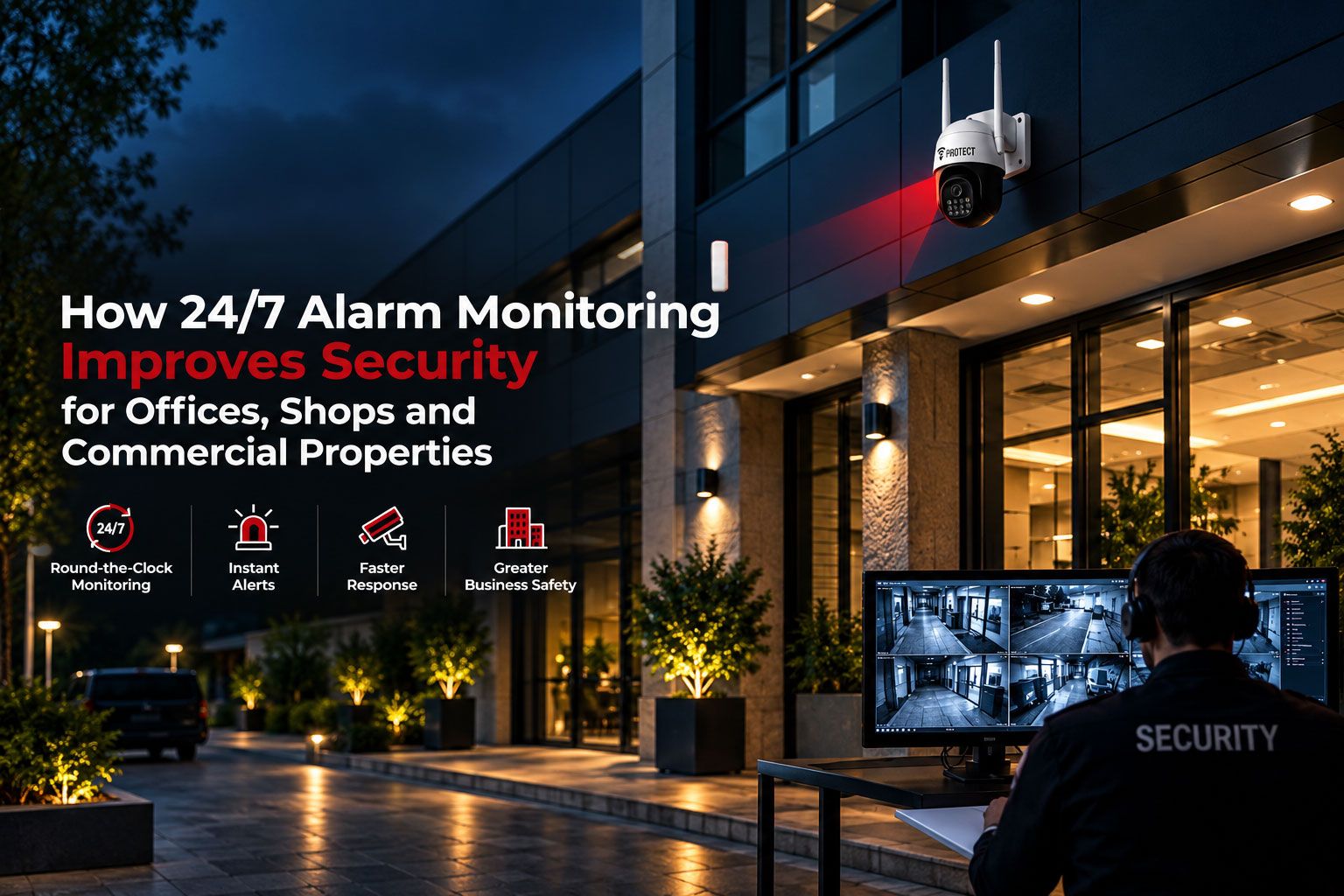

It is 2:07 AM. A sensor at the rear entrance of a closed retail store detects movement.
The alarm works exactly as it should.
But the owner is asleep. The store manager has put the phone on silent. CCTV is recording, but nobody is watching the screen.
So, is the business actually protected?
This is the gap that 24/7 alarm monitoring is designed to address.
For an office, shop, showroom, warehouse or other commercial property, detecting a possible threat is only the first step. What matters next is whether the alert reaches someone, whether the situation can be understood and whether appropriate action follows.
That becomes especially important after business hours, when the premises may be holding valuable stock, equipment, documents or data with no employees around to notice that something is wrong.
What Does 24/7 Alarm Monitoring Actually Mean?
24/7 alarm monitoring means that security alerts from connected devices can be received and assessed even when nobody from the business is physically present.
Think of it as the layer between an alarm being triggered and a response being initiated.
Depending on the security setup, an alert could come from:
a door or shutter being opened,
movement inside a restricted area,
a window or access point being disturbed,
a panic device,
smoke or heat detection,
or another predefined security event.
With a standalone alarm, the incident may end with a siren or mobile notification.
With professional security alarm monitoring, the alert becomes part of an organised process.
For a business owner, that difference matters.
The Real Security Problem Often Starts After Closing Time
During working hours, unusual activity is more likely to be noticed.
Someone sees an unfamiliar person near the stockroom. Staff hear a noise at the rear entrance. A receptionist notices an access problem. A store manager can investigate an alert.
After closing, those natural layers of observation disappear.
Consider three common situations.
A retail shop:
The shutter is down and staff have left for the night. High-value inventory remains inside.
An office:
Laptops, servers, confidential files and other equipment remain in a largely empty building until morning.
A warehouse or commercial unit:
Large areas may remain unattended for hours, particularly around loading entrances, storage areas and perimeters.
A camera can continue recording each of these spaces. An alarm can still sound.
The unanswered question is:
Who takes responsibility when something happens?
That is where commercial alarm monitoring becomes more relevant than simply adding another security device.
From Trigger to Action: What Should Happen After an Alarm?
A monitored system should not turn every sensor activation into a panic situation.
It should create a logical sequence.
This assessment stage is important.
An office cleaner arriving later than expected and someone forcing open a commercial shutter should not automatically be treated as the same event.
Verification gives an alert context.
VProtect follows a connected security approach built around deterrence, detection, monitoring and response. Its monitoring process includes 24/7 monitoring and alert verification before mobilisation when a threat is confirmed.
Where 24/7 Monitoring Makes the Biggest Difference
1. When the Owner Cannot Be Available All the Time
Many small and medium-sized businesses still depend heavily on one or two people for security decisions.
The owner gets the alerts.
The owner checks the cameras.
The owner calls the store manager.
The owner decides whether somebody needs to visit the premises.
That may work at 5 PM.
It becomes less reliable at 2 AM.
People sleep. Phones run out of charge. Network coverage drops. Meetings happen. Flights happen. Holidays happen.
A security plan should not assume that one person will always be available at the exact moment something goes wrong.
Professional business alarm monitoring reduces that dependency by keeping triggered security events connected to a monitoring process.
2. When a Shop Is Most Vulnerable After the Shutter Comes Down
Retail businesses have a particular after-hours problem.
Closing the shop removes customers and employees, but it does not remove the inventory.
Depending on the business, the premises might still contain electronics, jewellery, medicines, cash, equipment, documents or other valuable stock.
The most useful security setup therefore starts before somebody gets inside.
Door contacts, motion sensors, cameras and other devices can provide early signals around vulnerable areas such as:
front and rear entrances,
shutters,
stockrooms,
windows,
cash areas,
and restricted storage zones.
Monitoring then gives those signals somewhere to go.
3. When CCTV Captures an Incident but Nobody Sees It Live
CCTV is valuable. It can provide visibility, evidence and a record of events.
But CCTV footage and active intervention are not the same thing.
Imagine that someone enters an office at 1:30 AM.
The camera captures a clear image.
At 9:30 AM, the office team reviews the recording.
The footage may help explain what happened, but the security opportunity has already passed.
This does not mean businesses should choose between CCTV and alarm monitoring.
The stronger approach is to understand their separate roles.
For many commercial properties, the two are most useful when they complement each other.
False Alarms Matter More Than Most Businesses Realise
Imagine receiving three motion alerts in a week.
The first gets immediate attention.
The second turns out to be harmless.
By the third, there is a temptation to assume it is probably nothing.
This is how alert fatigue develops.
Businesses can generate legitimate non-emergency activity outside normal working hours: cleaners arrive, maintenance teams visit, employees stay late or authorised vendors enter a restricted area.
A monitoring process needs to account for this reality.
The goal is not to create more alerts.
It is to make genuine alerts more meaningful.
VProtect describes alert verification as part of its monitoring process, with the aim of reducing unnecessary false-alarm escalation and enabling faster action on confirmed events.
Every Commercial Property Has Different Weak Points
There is no universal list of devices that automatically makes every business secure.
A street-facing store has different risks from a corporate office on the tenth floor.
A warehouse has different vulnerabilities from a clinic.
A jewellery showroom should not be planned in exactly the same way as a small professional office.
A security assessment should therefore begin with the property, not the product catalogue.
This is also why simply counting cameras is a poor way to judge a security system.
Ten cameras do not automatically create better protection than six.
The more useful questions are:
What are they protecting? What can detect a threat early? Who receives the alert? What happens next?
Monitoring Becomes More Valuable When You Manage Multiple Locations
A single-store owner may still know most of what happens at the premises personally.
That changes quickly when the business expands.
Five stores can mean five sets of opening and closing routines.
Ten branches can mean ten different managers.
A larger commercial operation may have hundreds of daily security events across different locations.
At that point, checking separate WhatsApp groups, calling site managers and opening individual CCTV feeds becomes difficult to manage consistently.
Commercial security needs visibility as well as hardware.
For enterprise environments, VProtect provides 24/7 live monitoring and a unified dashboard designed to bring video, alerts, ticketing and system health information together.
That kind of centralisation becomes more useful as the number of properties grows.
What About Fire, Panic and Other Emergencies?
Security is not limited to burglary.
A closed office can experience a smoke-related event.
An employee working late may face an emergency.
A shop employee opening or closing alone may need immediate assistance.
Depending on the system installed, monitoring can extend beyond intrusion alerts to connected fire, panic and other emergency signals.
The response should then reflect the situation.
A door sensor alert and a smoke alert do not require identical handling.
VProtect's security model includes coordination with relevant civic services for verified incidents where police, fire or medical assistance is required.
Home Alarm Monitoring and Commercial Monitoring Are Not Quite the Same
The basic idea behind home alarm monitoring and commercial monitoring is similar: detect an event, communicate the alert and establish what happens next.
The operating environment is very different.
A home may have a small number of family members entering and leaving.
A business might have employees, cleaners, vendors, customers, contractors, deliveries and managers using the same premises at different times.
Commercial security may also need:
multiple protected zones,
different access routines,
several authorised contacts,
stock or high-value asset protection,
restricted rooms,
multiple branches,
and different escalation rules.
Someone researching the best home alarm monitoring system may rightly focus on reliable detection and dependable response. A commercial property needs those same fundamentals, but usually with a more detailed understanding of people, zones and operating schedules.
Five Questions to Ask Before Choosing Business Alarm Monitoring
Do not begin by asking, “How many sensors do I get?”
Begin with what happens when something goes wrong.
1. Who receives an alarm at 2 AM?
You should know whether responsibility rests entirely with your team or with a professional monitoring process.
2. How is the event verified?
Find out how genuine incidents are separated from accidental triggers.
3. What happens if I do not answer my phone?
A security system should not collapse simply because one contact is unavailable.
4. Can different parts of my property be protected differently?
A stockroom, reception area and server room do not carry the same risk.
5. What happens after a threat is confirmed?
This is often the most important question of all.
The quality of security alarm monitoring is not defined by how loudly an alarm sounds.
It is defined by what the system enables people to do next.
The Test That Matters: What Happens Tonight?
Businesses spend a lot of time evaluating security equipment.
Camera resolution.
Storage.
Sensor specifications.
Mobile applications.
All of those details matter.
But there is one question that cuts through the technical specifications:
If somebody tries to enter your property tonight after everyone has gone home, what exactly happens?
If the answer is only “the camera will record them” or “my phone will receive an alert”, there may still be a gap between awareness and action.
Effective commercial alarm monitoring is designed to narrow that gap.
VProtect combines intelligent detection with around-the-clock monitoring, alert verification and response capabilities, creating a security process that continues after employees leave the premises. Its broader model is designed around four connected layers: deterrence, detection, monitoring and response.
For an office, shop or commercial property, that is the real value of 24/7 protection:
not simply knowing that something happened, but having a clearer process for what happens next.
Frequently Asked Questions
What is alarm monitoring for a business?
Alarm monitoring connects triggered security devices to a monitoring process so an event can be received, assessed and escalated when necessary, including outside normal business hours.
Do small shops need 24/7 alarm monitoring?
It can be particularly useful for shops that remain unattended overnight while valuable stock or equipment stays inside. The appropriate setup depends on the location, operating hours and risks of the business.
Is business alarm monitoring better than CCTV?
They serve different purposes. CCTV provides visual information and evidence. Business alarm monitoring helps manage triggered events. Many businesses use both as part of the same security strategy.
Does an alarm monitoring system prevent every break-in?
No security system can guarantee that an incident will never occur. Monitoring improves the process around detection, verification and response when a connected security event takes place.
Can monitoring be used for more than burglary alarms?
Depending on the installed system, monitored events can include intrusion, panic, smoke, fire and other configured security alerts.
Is commercial alarm monitoring only for large businesses?
No. A monitored setup can be relevant to a single office or retail shop as well as a larger multi-location organisation. The design should match the size and risks of the property rather than simply adding more devices.