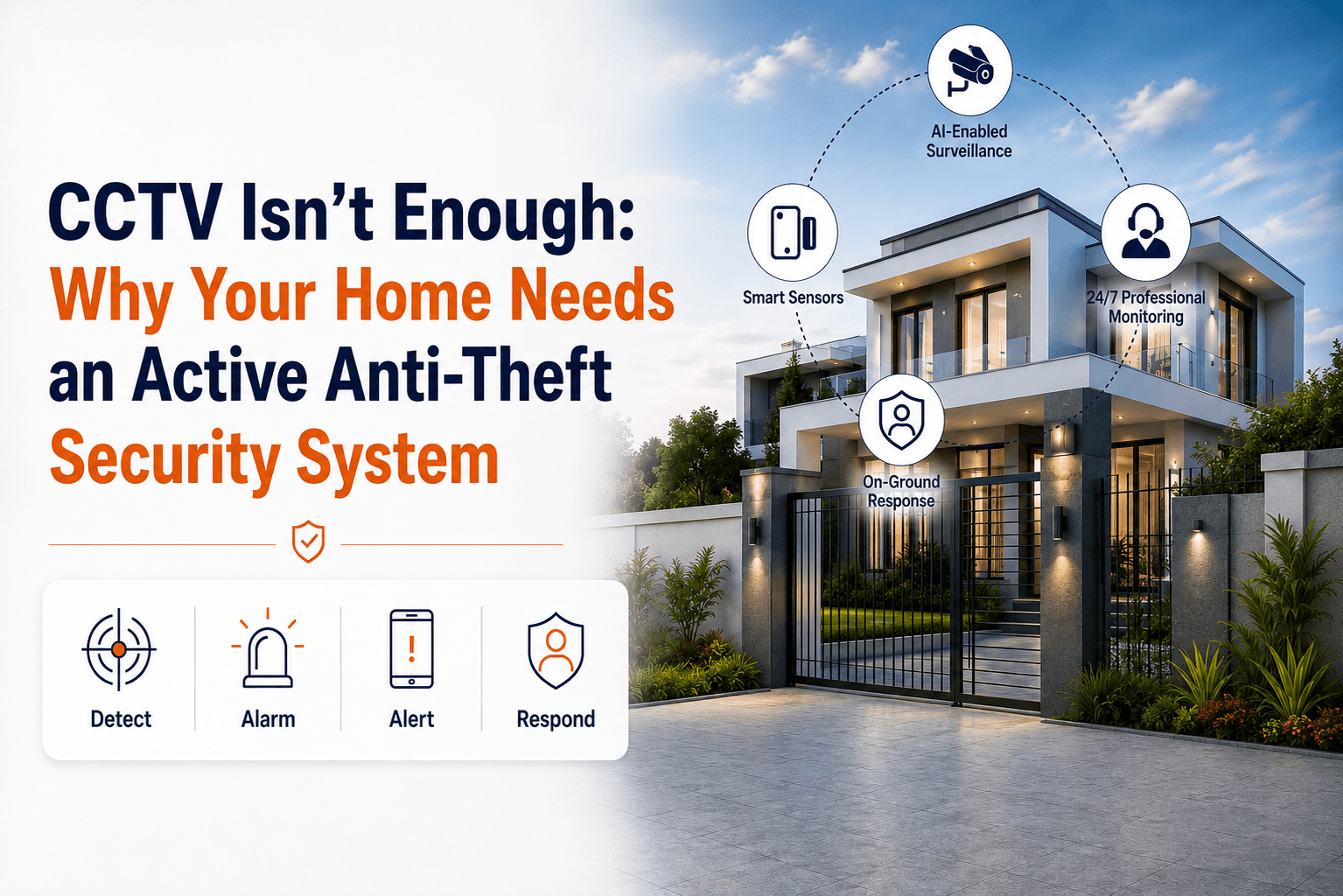

A Camera Can Record a Theft—but Can It Stop One?
A CCTV camera captures a person approaching the gate late at night. The footage is clear, and the time stamp is accurate. But the family is asleep, nobody is watching the live feed and the recording is discovered only the next morning. The camera did its job. The security arrangement did not complete the next one.
This is the difference between surveillance and active protection. CCTV remains valuable for visibility, deterrence and evidence, but a recording cannot unlock a response on its own. For that, a home needs detection, an alarm, monitoring and a clear plan for what happens when suspicious activity is noticed.
Direct answer: CCTV alone may record an intrusion, but an active anti theft security system for home can detect an attempted entry, raise an alarm, alert a monitoring team and support a timely response. It turns security from passive observation into a connected process designed to act while an incident is unfolding.
Why Isn’t CCTV Alone Enough for Home Security?
CCTV is strongest when someone is actively watching it or when its footage is reviewed after an event. In many homes, neither happens continuously. A family may miss an app notification while working, driving, travelling or sleeping. A camera may also have blind spots, poor night visibility or a view that ends before a person reaches a door or window.
Even smart video alerts need a response path. A notification can tell the homeowner that motion was detected, but it does not decide whether the movement is harmless, contact the right person or arrange support. This is why CCTV should be treated as one layer of theft protection for home—not the entire plan.
- Cameras mainly provide visual information and recorded evidence.
- A live feed is useful only when somebody notices the event in time.
- One camera cannot cover every vulnerable entrance, balcony or boundary area.
- A missed phone notification can leave the homeowner unaware.
- Recording a threat and responding to it are different security functions.
Where VProtect Fits into an Active Anti-Theft System for Home
VProtect connects smart devices with professional security services. Wireless sensors and AI-enabled surveillance help identify activity at protected points, while professional monitoring provides an additional layer of attention when the homeowner cannot check an alert. The system is built around deterrence, detection, monitoring and response rather than cameras alone.
Its privacy-conscious approach allows protection zones to be customised around the property. VProtect also includes beat patrolling and coordinated on-ground response within its service approach, subject to the plan and availability in the customer’s location. The result is an active anti theft system for home in which the warning from a device is connected to people and a process.
CCTV vs an Active Anti-Theft Security System for Home
The difference is not whether cameras are useful; it is what the security setup can do when a possible threat appears. The comparison below shows how a CCTV-only arrangement differs from connected active protection.
How Does an Active Home Security System Work?
An active system links detection to a planned next step. The exact process varies by provider, equipment and service area, but a connected setup usually works in the following sequence:
- A door sensor, window sensor, motion detector or smart camera identifies unusual activity in a protected zone.
- The system triggers an alert or an anti theft alarm for house protection.
- The signal reaches the homeowner, a professional monitoring team or both.
- Available information is assessed to understand what may be happening.
- The homeowner or designated contact is contacted according to the agreed procedure.
- The appropriate response is coordinated, including on-ground support where it is part of the service.
This sequence matters because a loud siren alone may be ignored, while a phone alert alone may be missed. The best anti theft alarm for home use is therefore not simply the loudest device. It is one that is reliable, correctly placed and connected to people who know what to do when it activates.
Which Areas of the Home Need Active Theft Protection?
Active protection should focus on the routes a person could realistically use to approach or enter the property. The right zones differ between an apartment, villa and independent house, so device placement should follow a property assessment rather than a standard package.
- A door sensor, window sensor or motion detector identifies unusual activity in a protected zone.
- The system triggers an alert or anti-theft alarm for the house.
- The sensor-generated alert reaches VProtect’s professional monitoring team.
- The team begins verification by calling up to five pre-registered near and dear ones.
- Based on the verified situation, the required response is coordinated.
- Where necessary and applicable, this may include beat patrolling or coordination with the police, fire brigade or ambulance service.
Coverage should be proportionate. Adding more cameras does not automatically create better protection if doors and windows remain unsensored or nobody monitors an alarm. A well-designed anti theft system for home assigns the right device to each risk point.
Why Professional Monitoring and Response Matter
Professional monitoring at VProtect follows a non-intrusive, privacy-led, sensor-only process. The monitoring team does not continuously watch the family or its everyday activities. Instead, smart sensors installed at selected protection points send an alert only when they detect a possible intrusion, emergency or unusual event.
Once an alert is received, the monitoring team begins a defined verification process. Calls are made to up to five pre-registered near and dear ones nominated by the homeowner. This helps verify the situation without unnecessary intrusion into the household’s privacy.
If the alert indicates that further action is required, VProtect can coordinate the appropriate response. Depending on the nature of the verified emergency, this may include beat patrolling, civic coordination or assistance from the police, fire brigade or ambulance service.
Can an Active Anti-Theft System Protect Your Home While You Are Away?
Yes, an active system can continue watching protected zones while the family is at work or travelling, provided it is armed, connected and functioning correctly. Sensors can report an unusual opening, cameras can provide visual context and professional monitoring can add attention when the homeowner cannot respond immediately.
Before leaving, the family should check device status, backup power, communication connectivity and emergency contacts. They should also understand which zones are active and what the monitoring team will do after an alert. Remote access is convenient, but a defined response procedure is what turns remote visibility into meaningful theft protection for home.
How VProtect Provides Active Home Protection
VProtect structures home security as a four-part process. Each layer has a different job, and the value comes from connecting them rather than relying on one device.
- Deterrence: Visible security measures and warnings can discourage suspicious activity before an entry attempt progresses.
- Detection: Smart wireless sensors and AI-enabled surveillance identify activity at selected entrances, boundaries and protection zones.
- Monitoring: A trained team receives alerts through a non-intrusive, privacy-led, sensor-only process. The alert is verified by calling up to five pre-registered near and dear ones before the appropriate response is coordinated.
- Response: Contact, beat patrolling, civic coordination and on-ground action may be coordinated according to the plan and service availability.
This Deterrence → Detection → Monitoring → Response model explains why VProtect is more than a CCTV provider or a standalone alarm seller. It connects devices, professional attention and on-ground capability into a broader anti theft security system for home use.
Conclusion: Move from Watching Incidents to Acting on Them
CCTV remains an important part of home security. It can discourage intruders, help families see what is happening and preserve evidence. Its limitation is simple: a camera does not automatically create action. If an alert is missed or nobody is watching, valuable footage may only explain what happened later.
An active system adds the missing layers. Sensors recognise activity at vulnerable points, an alarm raises attention, a monitoring team assesses the signal and a response process defines what follows. That connection is what makes modern theft protection more dependable when the family is asleep, at work or away.
Every property has different entrances, blind spots and family needs. Schedule a personalised security assessment with VProtect to understand the right active protection for your home.
Frequently Asked Questions
Is CCTV enough to prevent theft at home?
CCTV can deter suspicious activity and provide visual evidence, but it cannot guarantee prevention. If nobody sees the feed or alert in time, the footage may only be useful after the incident. Connected sensors, alarms, professional monitoring and a response process provide more active protection.
What is an anti theft security system for home?
An anti theft security system for home connects devices such as door sensors, motion detectors, cameras, alarms and a control panel. When it detects unusual activity, it can alert the homeowner or a monitoring team and support a defined response according to the selected service.
How is an anti theft alarm for house use different from CCTV?
An anti theft alarm for house protection is designed to raise attention when a sensor detects a possible intrusion. CCTV mainly captures visual information. Used together, the alarm signals that something may be wrong while the camera can help the homeowner or monitoring team understand the event.
What should the best anti theft alarm for home include?
The best anti theft alarm for home should be reliable, correctly placed and easy for the family to use. It should provide clear alerts, backup power or communication options where available, tamper or device-health notifications, professional installation and a response procedure that the homeowner understands.
Can an anti theft system for home work during a power cut?
Some systems include battery backup and secondary communication options, but capabilities vary. Ask the provider how long the control panel and devices are designed to operate without mains power, how alerts are transmitted during an internet failure and how the system reports a low battery or offline device.
Can I protect my home while travelling?
A connected system can remain armed and send alerts while the homeowner is away. Professional monitoring adds attention when the homeowner cannot check the phone. Before travelling, confirm that devices are online, emergency contacts are current and the response procedure is available in the property’s location.
Which parts of a house need theft protection?
Common risk points include main and rear doors, accessible windows, balconies, terraces, gates, driveways, side passages and rooms containing valuables. The exact coverage should reflect the property’s layout. An apartment and an independent house rarely need the same combination of sensors and cameras.
Why is professional monitoring important for home security?
Professional monitoring provides an additional layer of attention without continuously watching the household. VProtect follows a privacy-led, sensor-only process in which the monitoring team receives an alert only when a connected sensor is triggered. The team then calls up to five pre-registered near and dear ones to verify the situation before coordinating the appropriate response.