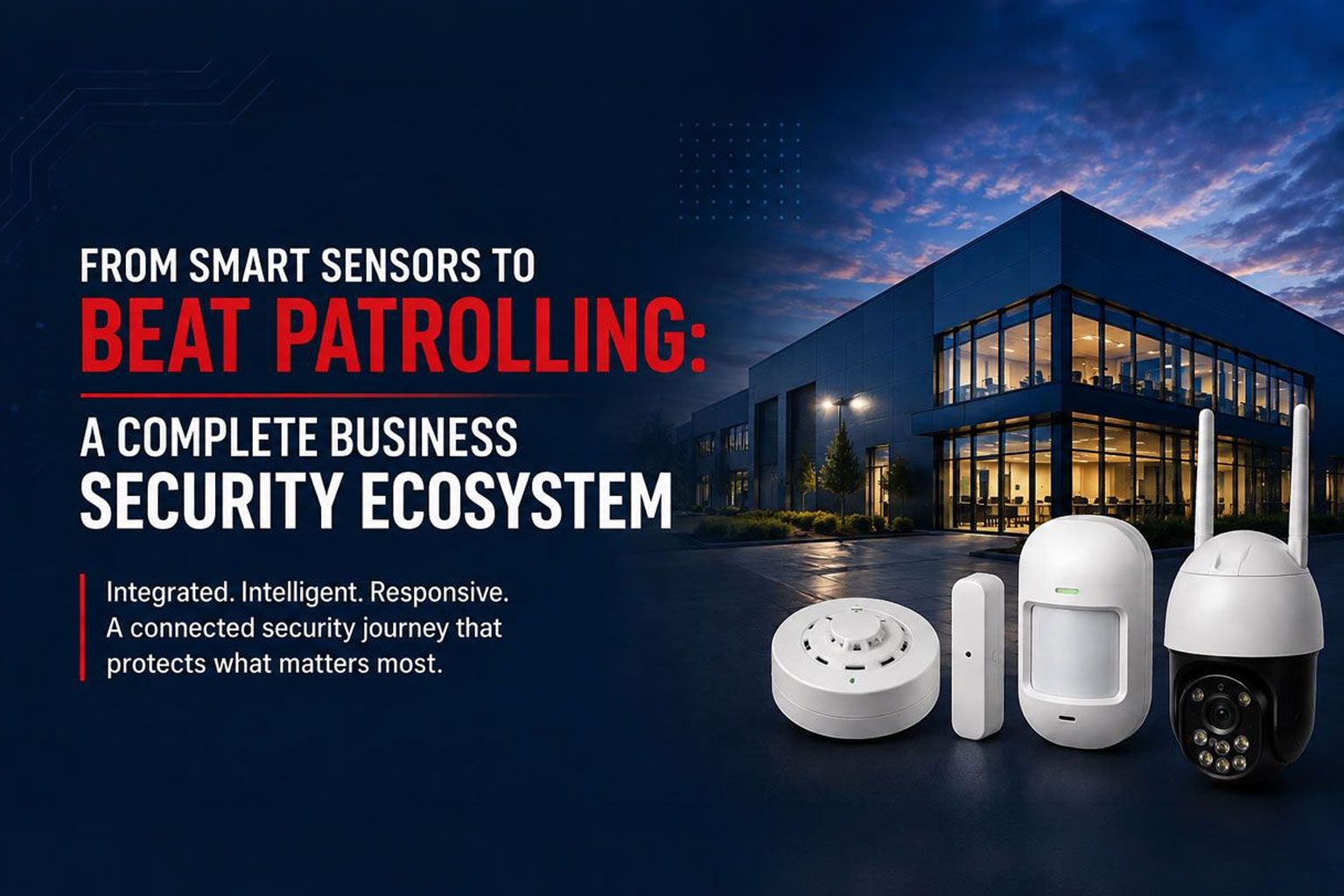

From Smart Sensors to Beat Patrolling: A Complete Business Security Ecosystem
A business rarely feels vulnerable when people are inside the premises.
During working hours, there is movement everywhere. Employees are present. Visitors are coming and going. Operations teams at work. Because of the presence of people, problems are identified very quickly.
The security challenge usually begins when the day ends.
The office lights go off. The warehouse shutters close. The retail store locks its doors. Valuable inventory, equipment, confidential documents and business assets remain inside—but the number of people watching over them reduces significantly.
This is where many businesses realise that security is not just about having a camera at the entrance or a guard at the gate.
Those layers are important. But modern threats require a more connected approach.
Today, a complete security journey is the basis for effective business security systems: Detection → Alarm → Monitoring → Verification → Response Smart sensors detect unusual activity. Monitoring helps understand what happened . Verification decreases uncertainty. Response ensures that the situation moves toward action.
For businesses, security is no longer only about preventing incidents.
It is about being prepared for what happens after an incident begins.
Why Traditional Business Security Has Gaps
Most businesses already have some level of security.
A commercial property may have:
- Security guards
- CCTV cameras
- Locks and access control
- Fire safety equipment
- Manual security checks
These systems provide value.
The problem appears when each layer works separately.
A CCTV camera can record an incident, but someone still needs to notice the footage and decide what to do.
And while a security guard can provide a physical presence, one person cannot cover every corner of a large facility at every moment.
An alarm can create a warning, but a warning alone does not answer the most important question:
Who takes action next?
This gap between detection and response is where many businesses need a more structured security approach.
Modern business security systems focus on connecting these individual layers into one process.
Security Starts With Knowing What Needs Protection
Every business has different security requirements.
A small office, a warehouse, a retail outlet and a manufacturing facility do not face the same risks.
For example:
An office may be more concerned about:
- Unauthorised access
- Sensitive documents
- Employee safety
- Equipment protection
A warehouse may focus on:
- Inventory loss
- Large storage areas
- After-hours intrusion
- Multiple entry points
A retail store may need protection against:
- Theft
- Cash-related risks
- Customer safety concerns
This is why the right security solution does not begin with asking:
“How many cameras should we install?”
It begins with:
“What could go wrong, and how quickly would we know?”
Smart Sensors: Moving From Recording Events to Detecting Them
Traditional security often depends on someone noticing something unusual.
Smart sensors change that approach.
Sensors can detect specific events and raise an alarm rather than waiting for someone to find a problem manually.
Depending on the requirement, businesses may use:
- Door and window sensors
- Motion sensors
- Shock sensors
- Glass-break sensors
- Smoke and heat detectors
- Panic buttons
- Other security devices
Consider a warehouse after midnight.
Nobody is expected to be walking through a restricted area.
A motion sensor detecting movement there is not just activity—it is information that requires attention.
Similarly, a door sensor showing an unexpected opening after business hours creates an immediate security event.
The advantage of smart sensors is not simply that they detect movement.
It is that they detect the right type of movement at the right time.
An Alarm Is Important, But It Is Only the First Step
An Alarm is the moment when a security system says:
“Something needs attention.”
It could be:
- An unauthorised door opening
- Unexpected movement
- A safety-related alert
- An emergency trigger
But businesses should not confuse an alert with a complete security response.
A siren may warn people nearby.
A notification may inform someone.
But the bigger question remains:
What happens after the alert?
This is why modern security depends on more than alarm generation.
The value comes from what happens between the alert and the final action.
Professional Monitoring: Security Without Disrupting Business Operations
The term “Professional Monitoring” is sometimes misunderstood.
Some businesses imagine it means someone is constantly watching every activity happening inside their workplace.
That is not the purpose of a privacy-led monitoring approach.
Modern Professional Monitoring is designed around security events, not continuous observation of normal business activity.
The process becomes active when a sensor or security device generates an alert.
For instance: Something unusual is detected by a motion detector.
A door sensor identifies an unusual opening.
A panic device is triggered.
The monitoring process receives the event and helps assess what has happened.
The objective is simple:
- Understand the situation
- Reduce unnecessary escalation
- Identify genuine security events
- Support the right response
A business should feel protected—not constantly observed.
Why Alert Verification Matters
Not every alert means the same thing.
A warehouse motion alert could indicate:
- An unauthorised entry
- A scheduled employee visit
- A maintenance activity
- A false trigger
Without verification, every alert creates uncertainty.
Alert verification adds context before escalation.
A systematic process identifies: What was the alarm for?
- Is it real?
- Who should be informed?
- What needs to be done?
For VProtect's security approach, verification can involve contacting nominated business representatives or authorised contacts to understand the situation before further escalation.
This reduces unnecessary responses while ensuring genuine incidents receive appropriate attention.
Where Beat Patrolling Fits Into Modern Business Security
Technology can detect.
Monitoring can assess.
But sometimes businesses need physical presence.
This is where Beat Patrolling has an important role to play in a holistic security ecosystem.
Beat Patrolling adds a human layer by providing:
- Regular physical checks
- Visible security presence
- Premises verification
- Support after alerts
- Additional deterrence
For example:
A warehouse receives an after-hours motion alert.
The monitoring process identifies the event.
A trained response team or beat patrol can provide physical verification.
This connection between technology and human presence creates a stronger security approach.
The objective is not to replace people with technology.
It is to make people more effective with better information.
What Makes the Top Business Security Systems Different?
The strongest security systems are not defined by the number of devices installed.
They are defined by how well those devices work together.
Security Layer
Purpose
Limitation Without Integration
CCTV Cameras
Provides visibility and recorded evidence
Someone still needs to notice and act
Security Guards
Provides physical presence
Cannot monitor every area simultaneously
Smart Sensors
Detects specific security events
Needs an escalation process
Alarm System
Generates immediate alerts
Alert alone does not resolve incidents
Professional Monitoring
Assesses triggered events
Requires verification and response
Beat Patrolling
Adds physical security checks
Works better with accurate information
Rapid Response
Converts information into action
Depends on verified situations
The best security approach does not depend on one layer.
It connects all of them.
Small Business Security Needs To Get Smarter Too When we think about security, we usually think about big companies. But small businesses have their own challenges.
A small business may not have:
- Large security teams
- Multiple guards
- Dedicated facility managers
But it may still have:
- Valuable stock
- Equipment
- Customer information
- Cash handling risks
- Operational data
This is why small business security systems are becoming increasingly important.
Modern solutions allow smaller businesses to access structured protection without building a large internal security operation.
A small office or retail store can benefit from:
- Smart detection
- Alarm systems
- Remote visibility
- Professional Monitoring
- Response support
The requirement is not always more security personnel.
Sometimes it is a better-connected security process.
Protecting Large Commercial Properties Requires a Different Approach
Large facilities create different challenges.
A warehouse, factory or commercial building may have:
- Multiple entrances
- Large outdoor areas
- Limited visibility zones
- Valuable inventory
- Longer periods without human activity
This is where commercial business security systems become important.
A commercial security approach may combine:
- Perimeter protection
- Smart sensors
- CCTV coverage
- Alarm systems
- Monitoring
- Beat Patrolling
- Rapid Response
The goal is to create visibility across the property while ensuring that important events do not go unnoticed.
CCTV Alone Is Not a Complete Security Strategy
CCTV remains one of the most widely used security tools.
And for good reason.
It provides:
- Visibility
- Recorded evidence
- Remote access
But CCTV mainly answers:
“What happened?”
A complete security ecosystem answers:
“What happened, who knows about it and what happens next?”
That difference matters after business hours.
A camera can show movement near a warehouse gate.
A security ecosystem can help determine:
- Was the activity authorised?
- Who should be contacted?
- Does someone need to verify the situation?
- What response is appropriate?
Visibility is valuable.
But visibility combined with action creates stronger protection.
How VProtect Creates a Complete Business Security Ecosystem
Businesses do not need disconnected security devices.
They need a process where every layer supports the next.
VProtect combines:
- Smart Sensors
- Alarm Systems
- Privacy-led Professional Monitoring
- Alert Verification
- Beat Patrolling
- Rapid Response
- Police, Fire and Ambulance coordination where required
The approach follows a simple journey:
Detect → Alert → Verify → Respond
Smart sensors identify unusual activity.
Monitoring helps assess the event.
Verification creates clarity.
Beat Patrolling and response teams provide physical support when required.
Emergency coordination helps connect verified situations with appropriate services.
The objective is not simply to know that something happened.
It is to ensure that the right action follows.
Choosing the Right Business Security System
Before selecting a security solution, businesses should ask:
- What assets need protection?
- Which areas are most vulnerable?
- What happens after an alarm is triggered?
- Is monitoring available?
- How are alerts verified?
- Is physical response possible?
- Can the system grow with the business?
The right solution is not always the one with the highest number of devices.
It is the one that creates confidence when nobody is physically present.
Security Should Continue After Everyone Goes Home
A business security system should do more than record incidents.
It should create a clear path from detection to action.
Smart Sensors identify.
Alarm alerts.
Monitoring assesses.
Verification provides clarity.
Beat Patrolling adds physical presence.
Rapid Response moves the situation forward.
That is the difference between having security equipment and having a security ecosystem.
VProtect brings together Alarm, Monitoring and Response to help businesses create a more connected approach to protection.
From small offices to larger commercial spaces, the objective remains the same:
Detect faster. Understand better. Respond appropriately.
VProtect — Alarm. Monitoring. Response.
Speak with a VProtect security expert to understand how a connected business security system can protect your workplace, assets and operations.
Frequently Asked Questions
What are business security systems?
Business security systems are connected solutions designed to protect commercial properties using smart sensors, alarms, monitoring, verification and response processes. They help businesses detect security events and create a structured approach for handling incidents.
Why do companies need smart security systems?
Traditional security solutions may not instantly detect and respond to an incident, which is why businesses need smart security systems. Smart systems integrate detection, monitoring and response for better protection.
Is CCTV enough for business security?
CCTV provides valuable visibility and evidence, but it does not automatically create a response. A complete security approach combines cameras with sensors, Alarm, Monitoring, verification and response.
How does Professional Monitoring work?
Professional Monitoring receives alerts generated by security sensors and devices. The event is assessed and verified before deciding what action may be required. It is designed around security events rather than continuous workplace observation.
What role does Beat Patrolling play in business security?
Beat Patrolling adds to the physical security presence through checks and supports verification and additional deterrence. It works best when combined with technology-based detection and monitoring.
Can business security systems coordinate with Police, Fire and Ambulance services?
If a verified emergency occurs, depending on its nature, security response processes can facilitate coordination with appropriate emergency services – for example Police, Fire and Ambulance teams.
What should businesses consider when choosing security systems?
Businesses should evaluate the complete process, including detection, Alarm, Monitoring, verification, response capability and scalability rather than only comparing devices.