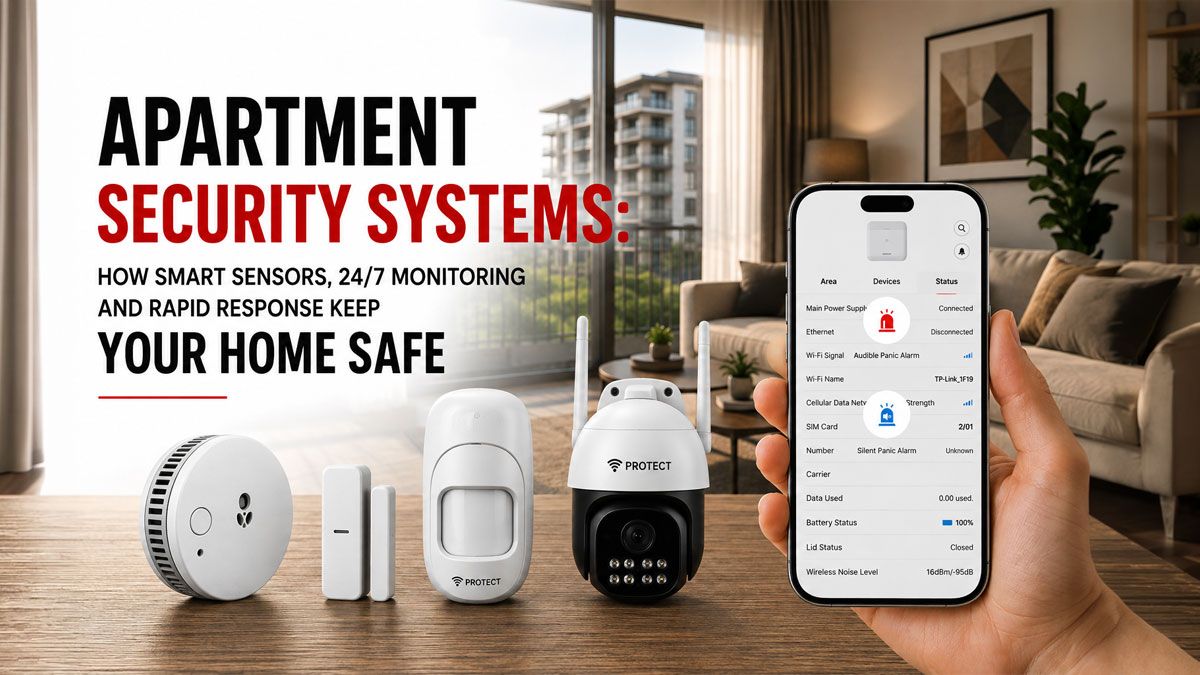

Apartment Security Systems: How Smart Sensors, 24/7 Monitoring and Rapid Response Keep Your Home Safe
Living in an apartment can make security feel simpler.
There is usually a main gate downstairs. Many residential societies have guards. CCTV cameras cover the lobby, parking area or lift. Visitors may have to pass through reception before reaching your floor.
So it is easy to assume that once someone gets through the building entrance, everything else is already taken care of.
But apartment security works differently from building security.
The guard at the gate protects a common entrance. Society CCTV watches shared spaces. Neither necessarily knows whether your apartment door has been opened unexpectedly, whether someone has entered through an accessible balcony or window, or whether a smoke or panic alert has been triggered inside your home.
That is the gap modern apartment security systems are designed to address.
Instead of relying only on what happens outside the building, a good apartment security setup creates protection around the home itself—using smart sensors to detect unusual activity, an Alarm to raise the warning, Professional Monitoring to assess what has happened, and a Response process when action is needed.
Apartment Security Starts Where Society Security Ends
Apartment buildings already have several natural layers of protection.
There may be guards, controlled entry, CCTV cameras, intercom systems and restricted access to certain areas.
All of these are useful.
But they are designed primarily to protect the property as a whole.
Your apartment still has its own security points: the front door, balcony, windows, utility entrance and, in some layouts, service or fire-access areas.
A visitor may legitimately enter the building but have no reason to enter your home.
A delivery person may pass reception.
Maintenance staff may be moving through the floor.
In busy residential societies, several people can enter and leave common areas during the day without attracting attention.
That is why home security for apartments should not simply duplicate the security at the building gate. It should protect the spaces that belong specifically to you.
The Front Door Deserves More Attention Than It Usually Gets
For most apartments, the main door is the most obvious point of entry.
A strong lock matters, but a lock and a security system do different jobs.
A good lock makes the door harder to open without permission.
A door sensor can tell the security system when the door is opened while the apartment is armed.
A shock or vibration sensor, where appropriate, can add another layer by identifying unusual physical activity around a protected point.
The important distinction is between preventing access and detecting an attempt.
Good apartment door security usually uses both.
Before thinking about sophisticated technology, check the basics as well. The door and frame should be in good condition, the locking mechanism should engage correctly, and keys should not be casually shared or left in predictable locations.
Technology works best when the physical security beneath it is already sound.
Windows and Balconies Are Easy to Forget—Especially Above Ground Level
There is a common assumption that windows become irrelevant once you live several floors above the ground.
That depends entirely on the apartment.
Ground-floor homes obviously require more attention, but accessible balconies, adjoining terraces, service areas, pipes, ledges or neighbouring structures can make some upper-floor openings more reachable than they first appear.
That is why apartment window security should be based on accessibility rather than simply floor number.
Window and door sensors can help identify when a protected opening is unexpectedly disturbed or opened while the system is armed.
Balcony doors deserve the same treatment.
Many apartment owners invest heavily in the main entrance but leave balcony access protected by little more than the original latch.
A useful security review should therefore look at the apartment as a complete perimeter rather than assuming that the front door is the only realistic concern.
Smart Sensors Make Security More Specific
One of the biggest advantages of modern apartment security is that protection does not have to depend on somebody constantly watching a camera.
Different sensors can protect different types of risk.
Door and window sensors can identify unexpected openings.
Motion sensors can detect movement within designated areas when the home is armed.
Shock sensors can help identify unusual physical disturbance around protected points.
Smoke and heat detectors can add another type of protection altogether—one concerned with fire rather than intrusion.
Panic devices can provide a way to raise an immediate alert during an emergency.
The result is a security system that reacts to events rather than simply recording everything that happens.
VProtect's current security model uses wireless smart sensors as part of its detection layer, with alerts connected to 24/7 monitoring and response. Its official website describes sensor-based detection across doors, windows and other protected zones, as well as fire and emergency protection.
For an apartment, that event-driven approach is particularly relevant because it allows individual areas to be secured without turning the home into a continuously watched space.
What Different Layers of Apartment Security Actually Do
The best security for an apartment rarely comes from one device. It comes from understanding what each security layer is responsible for.
No single row replaces the others.
A strong system works because these layers connect.
The lock tries to prevent the problem. The sensor detects it. The Alarm raises the warning. Monitoring assesses the event. Verification adds context. Response addresses what happens next.
24/7 Monitoring Does Not Have to Mean 24/7 Watching
This is an important point for apartment owners.
The phrase Professional Monitoring can easily create the wrong impression.
It may sound as though someone outside the home is continuously watching the family's private life through cameras.
That is not the monitoring model VProtect uses for residential security.
Its approach is privacy-led and non-intrusive, built around triggered security events and sensors rather than somebody continuously observing what is happening inside your apartment.
The system remains passive during normal everyday life.
When a protected sensor generates an alert, the Professional Monitoring process becomes active so the event can be assessed.
VProtect describes its monitoring as privacy-respecting and centred on triggered security events, with customisable protection zones giving homeowners control over where protection is active.
That difference matters.
A security system should make a family feel protected—not watched.
What Happens When a Sensor Is Triggered?
This is where an apartment security system becomes more useful than a standalone alarm.
Imagine your apartment is armed while the family is away.
A protected door or window is triggered.
The Alarm creates the initial warning.
The event then reaches Professional Monitoring, where the alert can be assessed according to the established process.
VProtect's verification process can include calls to up to five nominated near-and-dear contacts.
That is useful for a simple reason: the first person may not always answer.
You could be driving. Your spouse could be in a meeting. Someone may be travelling or sleeping.
Instead of making the entire security process dependent on one phone number, a structured verification process provides additional ways to establish what has happened.
Once the alert has been assessed and verified, the relevant Response can follow.
In simple terms:
Alarm → Professional Monitoring → Verification → Response
That sequence is one of the biggest differences between receiving a notification and having a security process behind it.
Why Building CCTV Alone May Not Be Enough
Most modern apartment complexes already have CCTV.
That is a useful layer of security, particularly in shared areas such as entrances, parking spaces, corridors and lifts.
But society CCTV and apartment security solve different problems.
A camera in the lobby may record someone entering the building.
It may not know whether that same person has opened your apartment door without permission.
The security guard downstairs may recognise regular residents.
They cannot continuously know what is happening behind every individual apartment door.
This does not make building-level security ineffective.
It simply means it should be treated as the outer layer.
Your individual apartment security system is the inner layer protecting the home itself.
For apartment communities or properties with larger common approaches and driveways, PTZ camera coverage can also strengthen exterior visibility where it forms part of the wider security setup. But common-area visibility should complement—not replace—door, window and sensor-based protection inside the individual apartment.
Apartment Security Is About More Than Intrusion
It is easy to think of security only in terms of burglary.
But an apartment is also a place where other emergencies can happen.
Smoke or abnormal heat can become a serious problem whether somebody is at home or not.
An elderly parent living independently may need urgent assistance.
A family member may face a panic situation in which reaching a phone is difficult.
A connected security system can therefore extend beyond intrusion detection.
VProtect's current security ecosystem includes smart detection for intrusion, fire and panic-related events. Its response framework also includes civic coordination involving police, fire and medical teams when the nature of the verified event requires that kind of assistance.
This is an important distinction.
The best home security for apartments should not simply ask, “Can we detect a break-in?”
It should ask, “What kinds of events inside this home may need immediate attention?”
Response Matters More Than Another Notification
We already live with notifications all day.
Messages. Deliveries. Payment alerts. Social media. Work.
Adding one more notification does not automatically create better security.
Imagine an Alarm is triggered at 2:30 a.m.
A phone notification is sent.
But the homeowner is asleep.
In that case, the system has successfully detected the event without solving the larger problem.
Professional Monitoring exists to reduce that dependence on the homeowner being constantly available.
Once a genuine event is verified, VProtect's security model includes rapid mobilisation and Response. Its website also describes civic-response coordination with Police, Fire and medical teams depending on the type of emergency.
That makes Response more than a technical feature.
It is the point at which information turns into action.
What Should You Look for When Choosing an Apartment Security System?
It is easy to compare systems by counting devices.
Five sensors must be better than three. More cameras must mean more security.
That is not always the most useful way to think about it.
Start with the apartment itself.
Which doors and windows are genuinely accessible?
Is there a balcony?
Does someone elderly live alone?
Do you travel frequently?
Does the building already provide CCTV and guards?
Are there children who may need an easy-to-use emergency option?
Then consider whether the security system provides:
- Suitable door and window protection
- Motion or intrusion detection where needed
- Alarm capability
- Fire and panic protection where appropriate
- Backup communication and power
- Device-health monitoring
- Remote access for the homeowner
- Privacy-led Professional Monitoring
- A clear verification process
- A defined Response mechanism
The right setup is not necessarily the one with the most equipment.
It is the one that covers the actual risks of the apartment without creating unnecessary complexity.
A Better Way to Think About Apartment Security
There is value in a strong door.
There is value in a society guard.
There is value in the CCTV camera in the lobby.
But none of them should be expected to do everything.
A well-designed apartment security system fills the gaps between those existing layers.
Smart sensors protect the apartment's own entry points.
An Alarm makes an event immediately visible to the system.
Professional Monitoring ensures a triggered event does not depend entirely on the homeowner noticing a phone notification.
Verification helps establish what is happening.
Rapid Response creates a defined next step when genuine action is needed.
And because VProtect's residential monitoring is sensor-led and privacy-first, that protection does not require somebody continuously watching what happens inside your home. Its public security model explicitly combines detection, privacy-respecting 24/7 monitoring and rapid on-ground response.
That is the difference between having security devices and having a security system.
Your Apartment May Be Inside a Secure Building. Your Home Still Needs Its Own Protection.
Living in a gated apartment society creates useful layers around your family.
But once the lift reaches your floor, the responsibility becomes more personal.
Your door is your door.
Your windows are your windows.
And an emergency inside your apartment may require a much more specific response than the security at the building gate can provide.
That is why VProtect brings Alarm, Professional Monitoring, verification and Rapid Response into one connected security process for the home.
The monitoring approach is non-intrusive and sensor-led. Alerts can be verified through a structured calling process involving up to five nominated near-and-dear contacts. When a verified emergency requires further action, VProtect's response ecosystem can support the relevant on-ground response and coordination with Police, Fire or Ambulance services depending on the situation.
The objective is not to fill your apartment with technology.
It is to make sure the right technology is protecting the right places—and that something meaningful happens when an alert is triggered.
VProtect — Alarm. Monitoring. Response.
Speak with a VProtect security expert to understand what kind of security setup is appropriate for your apartment and the way your family lives.
Frequently Asked Questions
What is the best security system for an apartment?
The best apartment security system depends on the apartment's layout and risks. A useful setup generally combines strong physical door and window security with smart sensors, an Alarm, privacy-led 24/7 Professional Monitoring, alert verification and a defined Response process. Fire and panic protection may also be relevant depending on who lives in the home.
How can I improve apartment door security?
Begin with a strong, properly fitted door and reliable locking hardware. Then consider a door sensor or other appropriate intrusion sensor that can detect an unexpected opening or disturbance while the apartment is armed. Physical security and electronic detection work best as complementary layers.
How can I improve apartment window security?
Check which windows or balconies are genuinely accessible rather than assuming upper-floor windows are automatically safe. Keep latches and locks in good condition and consider door/window sensors for openings that form part of the apartment's security perimeter.
Does VProtect continuously watch cameras inside an apartment?
No. VProtect's residential Professional Monitoring is designed to be non-intrusive and privacy-led. Monitoring is centred on sensor-triggered security events rather than somebody continuously watching the family's everyday activity. VProtect's website also describes its monitoring as privacy-respecting and event-based.
What happens when an apartment security sensor is triggered?
The triggered event generates an Alarm and enters the Professional Monitoring process. VProtect's verification procedure can include calls to up to five nominated near-and-dear contacts. If the situation is verified and requires action, the appropriate Response procedure follows.
Can VProtect coordinate Police, Fire or Ambulance assistance?
Where a verified event requires civic assistance, VProtect's response model supports coordination with the Police, Fire or medical/Ambulance services, depending on the type of emergency. Its official website includes police, fire and medical teams within its civic-response capability.
Do I still need apartment security if my society already has guards and CCTV?
Building guards and CCTV are valuable outer layers, but they generally protect shared areas. An individual apartment system provides protection around your own door, windows, balcony and internal security zones, while also creating a process for Alarm, Monitoring, verification and Response.
Are wireless sensors suitable for apartments?
Wireless sensors can be particularly practical for apartments because they can protect selected doors, windows and internal zones without requiring extensive wiring. VProtect currently describes its detection layer as using smart wireless sensors connected to its wider monitoring and response ecosystem.