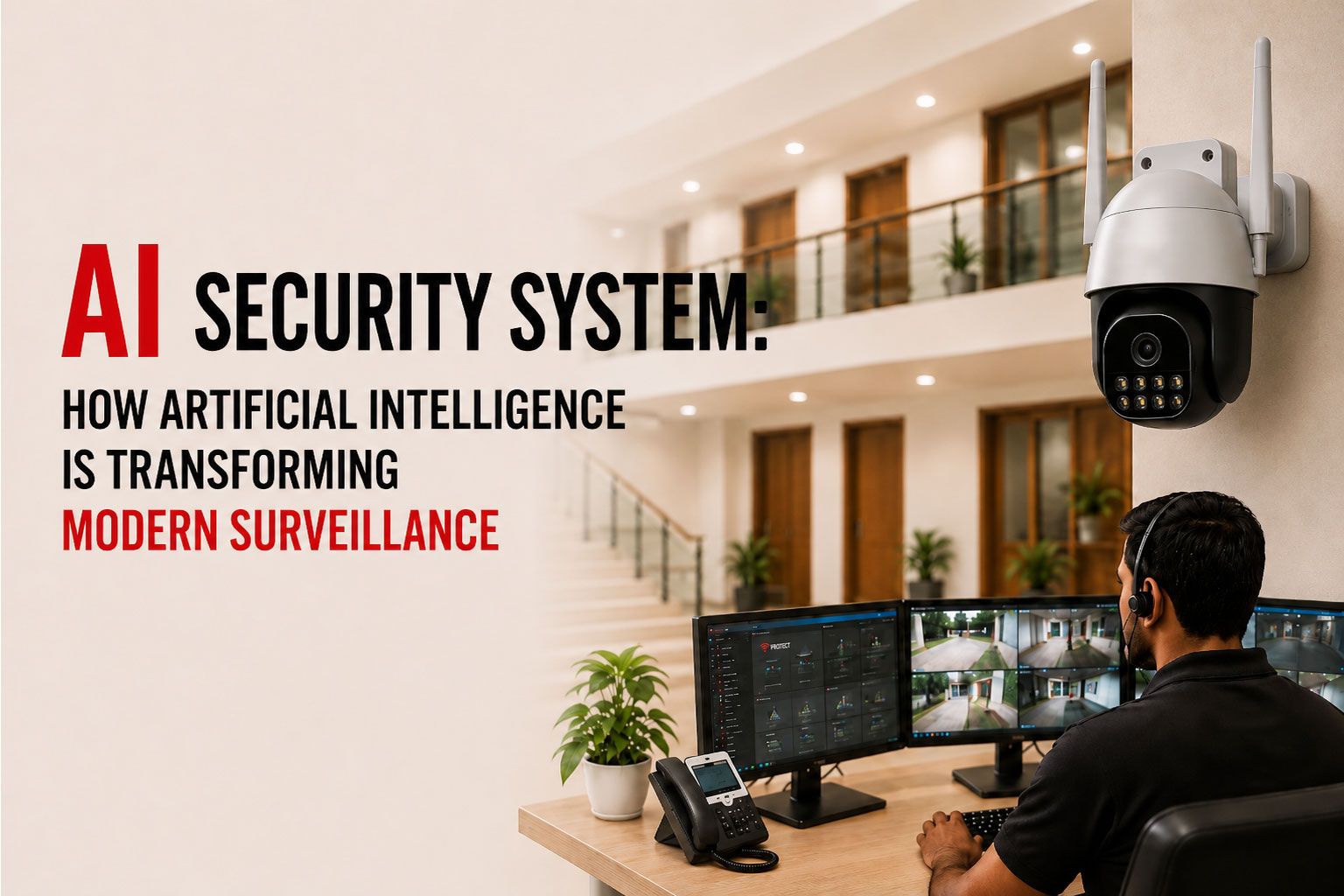

AI Security System: How Artificial Intelligence Is Transforming Modern Surveillance
For years, security cameras did one thing well: they watched.
They recorded entrances, parking areas, corridors, shop floors and residential gates. If something went wrong, the footage could be checked later. That was useful, but it was also limited. In many cases, the camera only helped explain what had already happened.
That is changing.
Today, an AI security system can do more than store video. It can help identify unusual activity, flag movement in sensitive areas, support faster verification and bring important events to the attention of security teams while they are still unfolding.
This shift is changing how homes, offices, retail stores, warehouses and larger commercial properties think about surveillance. The focus is gradually moving from “record everything” to “identify what matters.”
That is the real value of artificial intelligence in security.
What Does an AI Security System Actually Do?
An AI-enabled security setup uses cameras, sensors, software and intelligent analytics to understand activity around a property.
A regular camera sees movement.
An intelligent system tries to understand whether that movement matters.
For example, a person walking through a building lobby at 11 a.m. may be completely normal. The same person entering a restricted loading area at 2 a.m. deserves a different level of attention.
That difference in context is where AI becomes useful.
An AI surveillance system can be configured to monitor particular zones, recognise specific types of activity and create alerts when something unusual happens.
Depending on the technology being used, the system may help detect:
- movement in restricted spaces
- entry into protected zones
- activity around a gate or perimeter
- unusual movement after business hours
- possible intrusion attempts
- tampering around entry points
- events that require immediate review
The objective is not to make a camera “think like a human.” It is to help the system filter large amounts of visual information so that important events are easier to notice.
Why Traditional CCTV Has Its Limits
Traditional CCTV remains useful. It can provide evidence, help reconstruct incidents and give property owners visibility into important areas.
However, its value is often strongest after an event, when footage is reviewed to understand what happened. On its own, it offers limited active threat analysis and deterrence because somebody still has to notice the risk while it is developing.
An AI video surveillance setup can help identify unusual activity while it is happening and raise an alert instead of waiting for somebody to review the footage later. When connected to professional monitoring, alarms, live warnings or an appropriate response process, that earlier awareness can also help discourage an intruder from continuing.
In simple terms:
CCTV tells you what happened.
AI-enabled surveillance can help tell you what is happening now.
That distinction is becoming increasingly important.
How an AI Surveillance System Works
Most modern security systems work through several connected layers rather than relying on one device.
Detection
The first step is recognising activity.
This can come from an AI-enabled camera, motion detector, door sensor, perimeter sensor or another connected security device.
For example, a door contact may detect that a protected entrance has opened unexpectedly.
A camera near the same area may provide visual confirmation.
Analysis
The system then examines the activity.
This is where an AI based surveillance system differs from a simple motion camera.
Rather than treating every movement in the same way, the software can analyse predefined rules, zones or patterns.
That helps reduce the amount of irrelevant footage that needs attention.
Alert
If the activity matches a security condition, an alert is created.
The important point is speed.
A potential security issue becomes visible to the right person much faster than it would through manual video review.
Verification
This stage is often overlooked.
An alert does not always mean there is a threat.
Someone near a gate could be a visitor. Movement near a warehouse may come from authorised staff. A delivery worker may arrive outside normal hours.
That is why verification remains important.
AI can identify the event, but trained professionals may still be needed to understand the situation.
Response
Once a genuine threat is confirmed, the security process moves from observation to action.
Depending on the system, this could involve contacting the property owner, triggering an alarm, escalating the incident to a monitoring team or initiating an appropriate response.
This is where a complete security setup becomes far more valuable than a standalone camera.
AI Security Is Not About Replacing People
One of the biggest misconceptions around artificial intelligence is that it exists to remove humans from security.
In reality, the strongest security systems often use both.
AI is good at repetition.
It can scan video feeds continuously, look for specific activity and flag unusual events without becoming distracted.
People are better at context.
They can assess whether something is genuinely suspicious, understand unusual situations and decide what should happen next.
Put those two capabilities together and you get a more practical security model.
AI identifies.
A trained person verifies.
The response team acts.
That combination is far more useful than depending entirely on either technology or manual monitoring.
Where AI Video Surveillance Makes the Biggest Difference
Artificial intelligence becomes particularly useful when there is simply too much information for one person to watch effectively.
Consider a warehouse with cameras covering loading docks, storage zones, entrances and parking areas.
Most of the time, nothing unusual is happening.
That means a human operator may spend hours watching normal activity.
AI changes that workflow.
Instead of expecting someone to focus on every camera continuously, the system can highlight events that deserve attention.
The operator is no longer watching everything equally.
They are reviewing what the system has identified as potentially important.
That is a much better use of human attention.
Smarter Monitoring of Important Areas
Every property has areas that matter more than others.
For a home, these may include:
- the main gate
- entrance door
- driveway
- balcony
- backyard
- ground-floor windows
For a commercial property, the priority areas may be different:
- stock rooms
- cash counters
- warehouse entry points
- server rooms
- loading bays
- restricted corridors
- boundary walls
An AI security camera system can be configured around these high-risk areas.
This is important because effective surveillance should not treat every part of a property in exactly the same way.
A camera facing a public road does not need the same rules as a camera watching a locked storage room.
AI allows security to be built around the actual behaviour and risk profile of the property.
AI Can Help Reduce Alert Fatigue
Anyone who has used a basic motion camera knows how irritating repeated alerts can become.
A branch moves.
An animal passes.
A shadow changes.
The phone buzzes again.
After a while, people stop checking notifications.
This is known as alert fatigue, and it can become a genuine security problem.
An intelligent system can help reduce unnecessary alerts by analysing activity in more detail.
It can be configured to focus on relevant zones or event types rather than reacting to every small movement.
That does not mean false alerts disappear completely.
No AI system should be treated as perfect.
But better event filtering can make alerts more useful and easier to manage.
The Importance of Combining Cameras With Sensors
Cameras are only one part of modern security.
In many situations, the strongest protection comes from combining multiple devices.
Imagine a home at night.
A door sensor detects an unexpected opening.
A nearby camera captures movement.
The security system generates an alert.
A monitoring team receives the event and reviews what is happening.
That is more useful than relying on a single camera feed.
The same principle applies to commercial properties.
A complete setup can combine:
- AI-enabled cameras
- motion sensors
- door contacts
- panic devices
- intrusion sensors
- fire or heat detection
- central monitoring
- alarm systems
Each layer adds more information.
The more context a security system has, the better the chances of understanding what is actually happening.
Why AI Security Matters for Homes
Residential security has changed significantly.
Homeowners today are not only looking for a camera at the front door. Many want a system that can help protect the property even when they are asleep, travelling or unable to check their phone.
An AI-enabled setup can help monitor high-risk areas around the home and bring unusual activity to attention quickly.
This is especially useful because real incidents do not happen at convenient times.
A homeowner may be:
- sleeping
- driving
- in a meeting
- travelling
- away from the phone
If the entire security setup depends on the homeowner personally noticing every alert, there is still a gap.
That is why professional monitoring and response can become important additions to an AI security system.
How AI Helps Businesses
For businesses, the challenge is often scale.
One store may be easy to monitor.
Twenty locations are not.
Warehouses, retail chains, offices and commercial facilities can generate enormous amounts of surveillance footage every day.
Most of that footage is routine.
AI helps narrow the focus.
Instead of manually checking long stretches of video, security teams can review specific events or areas that have been flagged.
This makes surveillance easier to manage across:
- retail outlets
- warehouses
- offices
- industrial premises
- clinics
- jewellery stores
- educational institutions
- multi-location businesses
For larger organisations, centralised monitoring can also help maintain a more consistent security process across sites.
AI Surveillance Can Improve Response Time
The biggest benefit of intelligent surveillance is not the technology itself.
It is what the technology allows people to do faster.
Consider two scenarios.
In the first, a camera records someone climbing over a boundary wall at night. The incident is discovered the next morning.
In the second, the activity is detected as it happens, an alert is raised and the event is reviewed immediately.
The same camera may be involved in both cases.
The difference is the timing.
Earlier awareness creates more opportunity to act.
That is why modern security should be judged not only by image quality or camera count, but also by what happens after unusual activity is detected.
What to Look for When Choosing an AI Security Camera System
The term “AI security” is used very broadly today.
Not every product offers the same level of protection.
Before selecting a system, look beyond the camera specification and ask a few practical questions.
What happens after an alert?
This is probably the most important question.
Does the system only send a notification to your phone?
Or is there a monitoring process behind it?
A useful security system needs a clear path from detection to action.
Can the system monitor device health?
A camera or sensor that has stopped working creates a blind spot.
Good systems should make it easier to identify device issues before they become a serious problem.
Can the system work around important zones?
A property should be protected according to its layout and risk.
Ask whether the solution can be configured around specific entrances, boundaries or restricted areas.
How are alerts verified?
Not every alert is an emergency.
A verification process helps reduce unnecessary escalation and ensures that real threats receive appropriate attention.
How is privacy handled?
Security should not come at the cost of careless data practices.
Property owners should understand:
- who can access footage
- how video is stored
- how data is transmitted
- what areas are monitored
- how long information is retained
These questions matter just as much as camera resolution.
Is AI Surveillance Suitable for Every Property?
AI-enabled surveillance can be useful across many different environments, but the design should change according to the property.
A small apartment does not need the same setup as a warehouse.
A retail shop does not face the same risks as a villa.
A multi-location company requires a different level of monitoring than a single office.
That is why security should ideally begin with a proper assessment.
The number of cameras should not be the starting point.
The starting point should be:
What are we trying to protect, and where are the actual risks?
Once that is clear, the right mix of cameras, sensors, monitoring and response can be planned.
Where VProtect Fits Into Modern AI Security
The most effective use of artificial intelligence is when it becomes part of a complete security process.
VProtect takes this broader approach.
Instead of treating surveillance as only a camera installation, the system combines intelligent detection with monitoring, verification and response.
That matters because a security alert has value only when someone can do something with it.
The goal is not simply to collect more footage.
The goal is to create a connected security environment where suspicious activity can be identified, reviewed and acted upon when required.
For homeowners and businesses, that changes the role of surveillance completely.
The camera is no longer just a witness.
It becomes one part of an active protection system.
The Future of AI Security Systems
AI will continue to improve.
Cameras will become better at interpreting movement. Software will become better at identifying unusual patterns. Sensors will become more connected. Monitoring systems will become more centralised.
But the future of security is unlikely to be “AI only.”
The more practical future is a combination of:
intelligent technology + trained professionals + structured response
Technology can make security faster.
People can make it more informed.
Response capability can make it useful in the real world.
That combination is what will define the next generation of surveillance.
Frequently Asked Questions
What is an AI security system?
An AI security system uses artificial intelligence to analyse information from cameras, sensors and other security devices. It can help identify unusual activity, generate alerts and support faster monitoring and response.
What is an AI surveillance system?
An AI surveillance system uses video analytics and intelligent software to monitor activity in real time. Unlike basic CCTV, it can help identify events that may require attention.
What is the difference between CCTV and AI video surveillance?
Traditional CCTV mainly records video. AI video surveillance analyses that video to identify predefined events or suspicious activity while it is happening.
Can AI security cameras stop burglary?
No security system can guarantee that a burglary will never happen. However, an AI-enabled system can help detect suspicious activity earlier and support faster intervention.
Is an AI based surveillance system suitable for homes?
Yes. It can be used to monitor gates, entrances, windows, driveways and other vulnerable areas around residential properties.
Can AI surveillance reduce false alarms?
It can help. Intelligent analytics can filter activity more effectively than basic motion detection, although results depend on system quality, configuration and the environment.
Do AI security systems require human monitoring?
Not all systems do, but human verification can add significant value. AI can identify an event, while trained professionals can assess the context and decide what action is appropriate.
What makes a good AI security camera system?
A good system should offer reliable detection, useful alerting, proper device monitoring, privacy safeguards, professional verification and a clear response process.
Final Thoughts
Artificial intelligence is changing surveillance in a very practical way.
For years, security cameras were mainly there to provide evidence after an incident.
Today, they can play a much more active role.
An AI security system can help detect activity, prioritise important events and support faster decision-making. When connected with sensors, monitoring and a proper response process, it becomes far more useful than a simple recording setup.
That is the real transformation taking place in modern surveillance.
It is not about adding the word “AI” to a camera.
It is about making security more aware, more responsive and more capable of acting when something genuinely requires attention.
For homes, businesses and commercial properties, that is a significant step forward.
And as security technology continues to evolve, one thing is becoming increasingly clear:
The future of surveillance is not just about watching more.
It is about understanding sooner and responding better.